Chapter 15: Harvest

Notes on the Afterlife


Not related to Pumpkins? Go pick your own family.
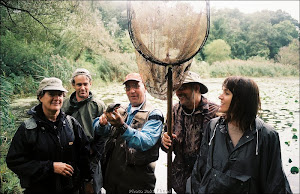
Image (c) Dave Rosane


"A human being is a part of the whole called by us universe, a part limited in time and space. He experiences himself, his thoughts and feelings as something separated from the rest, a kind of optical delusion of his consciousness. This delusion is a kind of prison for us, restricting us to our personal desires and to affection for a few persons nearest to us. Our task must be to free ourselves from this prison by widening our circle of compassion to embrace all living creatures and the whole of nature . . ."

- Albert Einstein.

“You must have a very interesting ecology.”
First time I’d ever heard any body say that to me before. Been a naturalist all my life, worked with professional academics for decades. I choked on my coffee and some came squirting back out my nose.
“Excuse me. Your name again?” I asked, a tad embarrassed.
“Marcel…Y tu?”
“David.”
Un placer, David.”
The guy was in his fifties. Stocky, standard issue mustache, jeans and a short-sleeved checkered shirt. We’d converged on a Sunday brunch hosted by our mutual friend Lucas and found ourselves sitting next to each other, throwing back mushroom-stuffed wonton and Caribbean fish balls topped with chili sauce. Our table was wedged between two large manioc plants in a corner of Lucas’s small overgrown apartment. Marcel had asked me one simple question: Where are you from?
It’s never been an easy one to answer.
“I don’t know,” I quipped, at first.
“You don’t know? Where’s that?”
He wiped the sweat off his brow with a napkin, swallowed a fish ball. Outside, Harlem was steaming. August in New York City, life in the machine; take 350 square miles of impervious cover, throw in the exhaust from 1,2 million cars, smother it with heat generated by 8 million so called air conditioners et voila, you get the ‘urban heat-island effect’, euphemism for Hell.
“To make a long story short I am from the US, I said, except I was born in Guyana, then my folks moved to Montreal when I was 5, then to France when I was 10. I went to school there and worked in Paris as a writer, then I did some research on chemical ecology in the rainforests of Venezuela, where I was adopted by a native tribe, and in Peru and the Dominican Republic for ten years working with Cornell University. Then I moved here to New York, 4 years ago, my first time living in my own country - my whole life. MY wife and I just moved to Vermont.”
“I tell you, you have a very interesting ecology.”
Marcel was a tropical ecologist, from Peru. I had actually heard of his work, had even perused some of his publications. He’d spent years with the Mestizo up and down the Amazon, looking at slash and burn dynamics, life in the flooded forest. He was now in the US, teaching. Like most Latino intellectuals, his English was perfect, better than mine, except his accent was riper than goat cheese and he’d pepper it with the odd Spanish idiom. For the sake of identity, I assumed.
“Thank you” I said, after a moment’s hesitation.
“For what?” Marcel swept his teeth with his tongue then went for another greasy wad of fish.
“Well I’m assuming that by ‘interesting ecology’, you’re referring to the sum of all my relationships to the world. I’m not used to someone qualifying my life history like I was some migratory bird.”
Si senor. Ecology, from the Greek Oikos, meaning household – or home. Mi casa es tu casa. Are you not from planet earth?”
(Marcel spoke with the calm authority and wit of the alpha male. Most academics have this uncanny ability to turn any first conversation into either something like a job interview, a cock fight or the archetypal relationship between mentor-to-mentee. They sense rank very quickly, then set up a hierarchy – like trying to talk to a wolf. Or a Rabbi. Marcel had graciously opted for the mentor-to-mentee.)
“So go on, di me, why do you thank me? Are you really a migratory bird?”
I responded rather emotionally:
“Because my whole life I’ve been trying to describe myself as other do, in terms of nationality, by cultural affiliation, or socio-economic cast, but to no avail. It gets frustrating. I’m like some freaking quantum particle, from no place in particular. Always different, always the stranger - the eternal flatlander. Now, thanks to you, your affirmation, I can simply assert that I’m from planet earth, an ecological entity.”
Te jodistes!
We laughed.
“You said you’re married, David?”
“French woman. Her name is Valerie. She’s an actress.”
“Any muchachitos?”
“ We just adopted a boy last year, our first, he’s going on one.”
“ Well, you shouldn’t have to worry here.”
“You mean here in New York?”
“No, I mean here, in Lucas’s apartment.”
Marcel winked, he was referring to all the guests in the room: Latinos, Pakistanis, Blacks, Jews, dancers, scientists, gays, artists, a peppering of French. All of them activists too, in one form or another. Love mongerers. Gardeners. Grass roots dudes. Think, ‘global rhizome’.
“In this country you call them minorities, David, in the rest of the world we call ourselves the majority.”
I realized I was the only straight, white American male in the room.
“Consider me in, Marcel!”
I asked my friend if he’d ever heard of Paul Hawken. He hadn’t. I relayed Hawken’s idea that us modern day eco-freako oddballs & peace-and-justice wonks constitute the biggest movement in the history of humanity, except this time we don’t follow just one ideology - we’re more like an alliance of creeds, a non zero-sum smorgasbord of different philosophies.
“In ecology we call that a symbioses. Escuchame bien, David. Humanity is growing up. Developmental psychologists say we have the capacity to reach a sort of pan-cultural conscience, to see the world as one, as family. We can transcend the exclusiveness of the conventional group, learn to be of service to the whole. This is a radical idea, but just listen to people like Desmond Tutu, they’re saying the same thing. Bush, Bin Laden, you, me, same family. Besides, geneticists have found that we’re a very young species. We descend from an evolutionary bottleneck of a few thousand individuals, 120 thousand years ago.”
The room around us was full of beans. A raunchy joke here, an explosion of laughter there and Terry, our host’s partner, a human rights watchdog-turned law student was now pounding out some Chopin Mazurka on the piano. The whole place sounded like the roaring 1920’s – only with brains attached. I noticed a small, stingless bee entering the room through the open window. It found one of Lucas’s mint plants and started pollinating.
Marcel spotted the bee at once:
Epa, que interesante… you know I’ve been looking at stingless bees and harvesting of medicinal honey in Peru… que chula, mira la alli
Marcel was obviously in love, with the bee.
“You know there’s honey bees all over this City, I pointed out. I’ve heard they’re hundreds of those stingless bee species here in the states, too, but most have never even been studied. Some of them never even been named. I was with New York Park’s chief naturalist a few years ago, Mike Fellar, he was doing a nature walk through Inwood park in northern Manhattan (I pointed westward, towards Inwood). Mike’s this sort of uncanny Zen Taoist scientist guy, probably the wisest dude in the City, and we saw a stingless bee just like this one and he simply pointed out to the people in attendance that the animal was probably new to science. Everybody went “ooh” and “ah” . He added that places like the Amazon or the human genome or the other side of the universe usually get all the publicity for being the ‘last frontier’, when in fact the last frontier was right in front of us, all around us, in among us, like this bee pollinating a flower in the woods of northern Manhattan, and that we took it entirely for granted.”
“You know.. you have to be careful, David.”
Marcel shifted his tone entirely and looked straight back at me, grabbing another napkin:
“These are dangerous times, muchacho. The Cheney’s and the Clintons of this world, it’s not that they don’t care about stingless bees, it’s that they know precisely how much people like you do. And it frightens them.”
I realized who Marcel reminded me of. Anthony Quinn, in Zorba the Greek.
“What do you mean?” I asked, timidly.
Marcel wiped some more Manhattan sweat of his brow, then pointed an oratorical index in my general direction:
“David, these so-called world leaders, they see the wave we represent better than we can see ourselves. That’s their biggest advantage – perspective. This is why they’re running around trying to occupy stuff like Iraq. Es que tienen miedo. Right now they’re building fortifications, hoarding what’s left… Believe me, they know all about Peak Oil, and a lot more about everything than you think they do. The word in this country is that Bush es un cabron, un idiota. This is false. These are business men, and women, executives, and they are making smart business decisions, from their point of view – this is the nature of power, David.”
Lessons in world ecology. Marcel’s exposé reminded me of the Chomsky line ‘Don’t speak truth to Power because power already knows the truth – how else could it be in power? Speak truth to the people! No doubt he was also hinting at a simple law of nature - the law of diminishing marginal returns. It explains how the bigger the empire or company or country, the bigger the power structure, the more and more complex it gets, the more and more difficult and expensive it becomes for it to sustain its own growth, until it bottom outs. History? A 15000 year old Domino of consecutive implosions, since the first city states of Mesopotamia. Pouf, pouf, pouf.
“So, di me David, what is it your parents did?”
Marcel leaned back in his chair. Started working his teeth with a toothpick.
“My dad worked for a Canadian transnational, they were called multinationals at the time. ALCAN, the Aluminum Company of Canada.”
“Extracting Bauxite, selling Aluminum?”
“I guess. Worked all over the globe. Japan, Africa, you name it. We moved around as a family a lot, my folks took me to Botswana on safari as a kid. They’re originally from New Jersey and Connecticut, respectively.”
“You have a lot to be grateful for, David. Tu papa, did he fight in world war 2?”
“Yes, Europe.”
A seagull flew passed the window, heading south, probably towards the reservoir, in Central Park.
I pointed it out: “Larus marinus - Great Black-backed Gull.”
Marcel wanted to know how I got so interested in nature.
“Well, I figured, being born in the rainforest of Guyana probably helped. We were basically living in a mining town on the banks of the Demerara river that had been carved out of the jungle. You know, parrots squawking overhead, hummingbirds on the Veranda, toucans and howler monkeys, snakes in our cribs, that sort of thing. Throw in a Victorian interest in creation on my mother’s side, a Peterson bird book handed down to me from a grandfather, some ominous volumes of Audubon towering in the bookshelf above, then reading Gerald Durrell obsessively in my youth. Family legend has it that my first grammatically correct sentence as a toddler was ‘Shut up little birdies..’”
“Sounds to me like they never did!”
“It’s unnerving.”
Que?
“I’m still thinking about what you said - An interesting ecology. Brilliant. I’ve been outdoors all my life, working on three continents, I used to teach urban ecology here in the city, and I’ve never heard anybody describe another person’s life that way.”
“You gringos can’t help it, it’s the weight of your culture”
“What do you mean?”
“Americans come from a long biblical tradition of thinking nature and humans are somehow separate (Marcel leaned forward and crossed his arms). Not just evangelists, environmentalists too. Especially environmentalists. You’re trapped by this vision of wilderness on one side, some primeval Eden, this selva virgen place that’s supposed to be devoid of humanity, with a fence around it, then places like New York City on the other side, with all of humanity in it. This is an American dichotomy. It shows up everywhere, even in your political culture. From an ecological perspective, it is baloney. We know this in Peru simply because we are accustomed to living in a jungle. What you call the environment we call home. Besides, there is no such thing as pristine wilderness as you call it because there is no place on earth that has not been affected at one point by the Human footprint in the past 120 000 years. America has to come to terms with this. You have to learn to see the world as a slope, progressing from more ecologically functional places, like the Amazon, all the way down to Times Square or downtown Sao Paolo on the other side, that are totally dysfunctional - but still a part of nature. One gradient, from the sustainable to the industrial.”
“Reminds me of that great Einstein quote.”
“About humans being part of the universe?”
“No, the one where he says you can’t fix a problem by using the same kind of thinking that created it…”
Precisamente. Putting fences up around the wilderness and kicking the poor out won’t solve a thing. We have to change the way we live in nature, work our way back across that gradient, from the industrial back into the sustainable.”
“I know, Arcadia, Jefferson - without the slaves. Sorry for the sarcasm, but I’m writing a book about just that.”
“Then you know exactly what I’m talking about – got a title, yet?”
“Something along the lines of the ‘Nature of New York’.”
“I like it. Arrecho.”
“Yeah, and by extrapolation, the nature of finance, the ecology of greed. I see this place (I point south, for emphasis, through the window and through the brown summer haze, at the shark-tooth profile of Midtown), I see New York like it was some sort of heaving bionic organism, and so I ask the question - where does this ravenous monster get its energy? What’s its effect on the planet, its place in the world ?”
“You should speak to my wife Caroline. She’s been working with some of her Grad students on where and how New York ethnics import all their ethnic food. It comes from all over the globe, apparently, under the radar too.”
“That would be great! You know, I moved here 5 years ago after working in the Amazon for a decade, and so I traveled that same gradient you just described, from sustainable to industrial, and when I got here, at first I looked exclusively at the Nature in New York, the migratory birds in Central park, the insects too – they’re awesome by the way, like that stingless bee. You’ve got dragonflies cruising midtown, a Parks worker told me how the day after 911 he saw hundreds of Monarchs migrating South through the dust over ground zero.”
Senor David, did you know that Thoreau went back every weekend to have his Mom do his Laundry for him on Staten island after one week in the wilderness staring at Walden Pond?”
“Hold on, let me finish about New York. After a year here I slowly began to see the bigger picture. I figured that the Big Apple had more than just some ecological footprint, worse, it had a policy shadow, what with all the political entropy it generated abroad, and the people it displaced across the planet, like it was some giant Nazi cannibal tick, sucking the life blood out of the planet. New Yorkers are so accustomed to thinking the whole world is their tributary.”
“This is because, in ecological terms, industrial civilization is a parasite, David. Did you know that John Muir fled into ‘the wilderness’ because he was trying to dodge the draft?”
“Sounds like half the population of Alaska.”
Epa! You’ve lived in Alaska, too?”
“No I just went there this last summer, to the Yukon too. Met some interesting characters. We were in this town called Inuvik in the North West Territories, in the Mackenzie river Delta. Mostly Gwich’in and Inuvialuit natives, except the cab drivers there are all from Ethiopia. Our first meal in town, we had Chinese take-out prepared by a Palestinian family from Lebanon. In the land of the Midnight sun, high above the Arctic Circle. It was freaky – seemed like all the minorities in the world were up there, gathering before the last battle. You know, I used to teach a course on industrial ecology when I lived here in the City and most of my students were immigrant kids in Brooklyn just off the plane or boat. From everywhere: Baku, Egypt, Guyana even..”
Tu hometown!
“Yeah, teenagers mostly, High School students taking their first college credits, part of a College Now program at Brooklyn Community College. Well, I showed them how, in ecological terms, New York City didn’t produce a thing, other than waste, save for a sprinkling of produce from community gardens. Mostly though, I showed them how the financial practices here in the City contributed indirectly to their presence in New York by first helping to pummel the economies and destroy the ecology of their countries of origin via Wall Street and the WTO. They saw the connect: our planetary elites force emigration from third world countries - then have the gall to complain about immigration at home.”
“Did you tell your students the story of tropical slave ants ?A colony can go out and destroy the adults but it will kidnap the larvae and bring them back and raise them as their own…your students, they must have loved your course.”
“They ate it up. They all passed, too.”
“I bet it helped them put their own frustrations into words.”
“How’s that?”
“Well if you give human beings a language like ecology with which to verbalize their anxieties and articulate their anger and understand and voice their sense of powerlessness, especially a teenager, then they feel a little less alienated. Words do that, they can take the venom right out of us and at the same time empower us. Di me, why did you leave for Vermont?”
“I told you, my wife and I went there to adopt a baby boy…and because we were evicted from our apartment here in New York. Besides, we decided to reorganize our life ecologically, integrate the whole slow food movement, contribute to a local economy, grow our own grub. Which reminds me, harvest is coming up, too. I’ve got about 50 pumpkins waiting to be picked back in my garden – enough food for the winter. I planted way too many. You know Paul Mankiewicz?”
“The guy at the Gaia Institute?”
“Yeah, he has a great line about bioregionalism, he calls it ‘insinuating ourselves back into the processes and flows of nature, if only we had more faith in them.’ He says ecosystems don’t distribute. No FedEx. No oil, no gasoline, no 25 ton trucks. So, barring we change the laws of Thermodynamics we have no choice but to relocalize our economies.”
“So, Alaska...tell me more about Alaska.”
“What do you mean…”
“What were you doing up there? Relocalizing your economy?”
“Yeah, right. Actually, I went to baptize my son. His name is Manny.”
Tu estas loco, David. Your church is in Anchorage or what?”
“No, no, just that my wife and I wanted to see more of the great North American continent before we settled down. You know, you get tired of the contradiction of flying around the planet as the do-gooder environmentalist, working with Indians in the jungle, telling people how we should be living, meanwhile gobbling up jet fuel and living high off the hog while preaching about sustainability. I say: ‘be the change you want to see in the world!’ Except like everybody else my wife and I are completely addicted to fossil fuel, we’re energy junkies. So we joked that before we plugged ourselves back into nature’s processes and I started a farm somewhere, that we’d go for one last fix, one last overdose of unrestrained consumption. Think, ‘Gonzo exploration of the national psyche’. Whole hog on the American Dream.”
Que Paso, David?”
“Listen to this : at 40 we finally got our drivers licenses.”
“You just learned how to drive?”
“Just for this trip. So we rented this beat up RV, a mobile home with this big-ass ecological footprint, replete with CD, AC, Barbecue and DVD, and we gunned the sunofabitch across 3500 miles of immaculate tundra. Caribou, grizzly, wolves walking down the road you name it, all the artic birds I’d ever wanted to see, too. The flowers. The landscape. The wind. I tell you, Beringia, it’s awesome, looks like the last place on earth. There are no words for it. It’s so big it can’t even fit into our language, let alone a camera. We went as far north as Arctic ocean and camped out on the beach and then dipped Manny’s toes in the water and anointed his head and then blogged home that we had baptized our son.”
“Wow”
Marcel grabbed another toothpick.
“You have an editor?”, he queried.
“Why?”
“I’m telling you, you have a very interesting ecology, he sighed. You should share your story. This whole arc of yours, it sort of sums up the story of a whole generation, too. It tells the history of the West, in microcosm. Europe expanded, so did the industrial paradigm. It went multinational. You were born in Guyana, right? You explored part of this industrial empire, you peered over the edge, you climbed down. Te regresastes a Nueva York, to world headquarters, with a message: we can’t go on with business as usual, we have to turn our civilization around, head in another direction.”
Marcel was looking at me, into me. Ever the alpha male. I looked away.
Di me David, how do you like being a father?
“It’s so beautiful I can’t stand it.”
“Are you one of these crazy, zero-population puritans, did you adopt because you didn’t want to add another human being to the planet, for environmental reasons?”
“Not at all. My wife and I couldn’t have kids of our own. We’re sterile. Chlamydia pandemic. The sexual revolution. Millions of people lost their ability to reproduce. So, we adopted, besides, what better way to act out your beliefs than to embrace another human being, especially one totally unrelated to us. Darwinian theory says we should theoretically be caring for our own offspring. Exclusively. Well, that’s not very ‘adaptive’ in today’s world.”
Porque asi?”
“Follow the selfish gene you end up with the atomic bomb. The more we love our own, the more we despise the enemy. Kinship and war correlate. I say we break the cycle, or we’ll all go up in smoke.”
Eso. Adopt the human family.”
“I think even Darwin sensed we should transcend our own biology, for the sake of our own freakin’ survival. Remember, he wrote that part about extending ‘our sympathies to all nations and races’. That’s basically how I see adoption. Pacifism. Plus, I think I needed an afterlife of my own.”
“An afterlife?”
“Yeah, about 10 years ago I was sitting with my friend Freddy in front of his hut, he’s the son of a Ye’kuana chief, this tribe I lived with in the Venezuelan rainforest, and I asked if he believed in an Afterlife. I wanted to know more about Ye’kuana spirituality. So he counted to 5, pointing to the kids playing down by the river. He was counting his 5 kids, like this, “un, dos, tres, cuatro, cinco…” aiming at each one, for emphasis, and smiling. There’s my afterlife David, he said. They’re right in front of you, look, I’ve got 5 of them. Un, dos, tres, cuatro, cinco…”
Mentira…You’re making this up”
“Remember what Mark Twain said, Marcel?”
Si senor. The only difference between fiction and reality is that fiction has to be credible.”

Stay tuned for more - xoxo,
Dave, Val, Manny.

Chapter 14: Leaving it to Beaver

Should New Yorkers learn to chill out?


What does the return of Castor Canadensis mean to New York City, really?
Image © Valerie Druguet

To quote Ed Abbey in the first punches of his Desert Solitaire (as much of a book as a beating), every human has a favorite place, a place known to him/her as “the most beautiful place on earth”. Abbey attributes this to there being “no limit to the human capacity for the homing sentiment”. Our “ideal place”, the “one true home” could be anywhere, depending on the individual: “a cabin on the shore of a blue lake in spruce and fir country” or, for “those of a less demanding sensibility […] a comfortable apartment high in the tender, velvety smog of Manhattan…”

Ouch!
We all have a favorite spot in mind. Me, apart from the entire Universe which I consider to be like, totally awesome, or Inwood Park, the best Manhattan can really muster, or the stinking hot Amazon, my ideal place has always been, since childhood, a few square yards of silent understory in the cool and dark – and to me, cozy – embrace of a thick patch of hemlock trees outback of my folk’s place in northern Vermont. Nothing grandiose, no giant waterfalls, sweeping vistas or charismatic beasts involved, just a small fragment of biosphere tucked away within one hundred and fifty acres of maple and ash and beech and butternut with small things like toads and spring peepers and jumping mice that bounce about the grove within the intimacy of their ecological niches. There’s a tiny stream that trickles through the Hemlock and winds and loops around their trunks like some Lilliputian version of a great meandering river, creating a series of small, sensual beaches of pink sand and blue pebbles where the toads hang out. Then there’s the moss, the plump green moss, on the dank fallen logs of ancestral trees where you can spot red eft; the celestial petals of the white and violet trillium; the foamflowers; the generous curves of cinnamon ferns hanging over the stream’s steeper banks; not to mention the unwavering vibe of mystery emanating from conifers in general, the inebriating whiff of resin, as primeval as oxygen, as old as granite or the grin on a dinosaur. Finally, there’s the clear water of the stream itself, like liquid silk, running its course, dribbling away, downhill, through space, through time, one day to reach the sea, the abyss. This is rain water, runoff from the green mountains, it irrigates and inseminates this dot on the map, the world to me.
I used to go out to the grove as a lonely kid and sit on its shores and look for gnomes and fairies and daydream my summer afternoons away. It was my outdoor den, my most beautiful place on earth, and it set the stage for my pre-adolescent visions and fantasies. It taught me to hide out and aim high, like a kitten, to look up and peer through dark canopies - and into the future that lay ahead- for rarity and beauty to pounce on, to possess, things like the fleeting scarlet of tanagers, the fluorescence of Blackburnian warblers – or one day soon, the female of my species. Let me add to Abbey’s observation: the ‘ideal place’ also has the power to define us, it forges our identity, sexual or otherwise, and by ‘identity’ I refer to that thing we recall in the face of adversity. For reassurance. For strength. When we call out for Mommy, or for the team or party or tribe to whom we belong. Some of us rely on the flag, on patriotism, others invoke Jesus or Mohammed, the Founding Fathers, Yoda and Luke Skywalker for all I care, movie stars or brand names even, others still we fall for the workaday version of the Stockholm syndrome, by kissing our employer’s ass and defending it, too. Me, I take Hemlock. Since my childhood in the woods I have pledged allegiance to the memory of this seemingly random spot of Appalachian green and it has since been my own private life raft, my savior, my imaginary friend, my church, my nation-state – my identity. When confronted by adversity in my adult life (like, every day for the past 30 years spent living behind enemy lines, in bars, in foreign countries and crowded places) I simply call up the image of my favorite place on earth. My home in the woods. It’s automatic, compulsive. It allows me to regress to the comfort and safety I felt as a 10 year old, crouching under those trees. I use the memory of this secret outdoor womb, its sweet and uplifting smell of water, sap, chlorophyll and rot, the same way I rush for my morning mug of bean, so I can wake up again and plow ahead, or when I reach for my daily measure of opiates, to regulate my flow of serotonin, to finally calm down. Or when I call in on my buddies Jack Daniels and Jim Beam. Yep, this little place of mine has been my favorite drug of all time. My ultimate addiction. And I have returned to it physically, once every 5 years or so, for a refill, a walloping snort of the Dave identity.
No longer. On a recent visit ‘back home’, last Thanksgiving as a matter of fact, I walked over to my most beautiful place on earth for a fix and it wasn’t there anymore because it was gone. Underwater, submerged, erased both by time and by H20. More precisely, by two f-ing beavers.
(Let it be said that when you leave the blue city and set up camp in the wild red woods, squirrels, mice, raccoons and beaver, like doing your taxes, can turn you into an instant republican).
The two beavers (I later caught them working…) had just recently moved in, judging by the freshness of the cut wood, the tooth marks, the glistening logs of young poplar used to make the damn, the fresh cakes of mud applied to the side of the hut. In a flash, my tiny stream had become a swimming pool for giant rodentia. I searched the water’s surface for signs of my beloved beaches beneath. Nada. My dark green hemlock trees, now standing knee-deep in a small lake, would all die in the few years ahead from aquatic overkill, soon to be giant broken quills sticking out of the brown back of a still-assed beaver pond. I paused to recover. Part of me was gone, forever. Drowned out by beaver. I felt powerless. Then I smiled. Time to move on. I thought of these Hemlock trees in the near future; their hollowed out trunks would soon be homes for nesting Tree Swallows, Wood Duck and maybe even a few Great Blue Herons crouching like gargoyles at their tops. Come to think of it, these trees, they’d stick out like living totem poles. Reincarnation, just around the corner. And the slimy periphery of the new pond would be the breeding ground of red-spotted newts and tree frogs, home to mosquito larvae and baby twelve-spotted dragonflies. And the pond’s shores would have pink lady-slipper orchids growing on it, and in the water’s depths would hide the hideous giant water bug.
All of these new things and more for Thanksgiving. A beaver’s gift. Beware, because the gift of Castor canadensis is always a gift in disguise. It looks like destruction, but it ain’t. Beavers aren’t engineers, they’re horticulturists, they make habitat. They unnerve the hell out of us humans, too. These two not only sowed the seeds of a new community, a new ecosystem, a new place for this forest, this valley, these mountains, this planet and universe, they invited albeit forcefully one bipedal predecessor (me), to withdraw, to let go. To grow up, already. When a beaver slaps the water with its tail it is to alarm its congeners that potential danger is near. These two guys slapped me right in the face. Good, because Kitten now an Alpha wolf. From now on I embrace novelty and loss, catharsis. My new identity? I breath in, one change at a time. And I howl with the earth.
A few notes about beavers. A species of giant beaver was part of the Meg-fauna in North America as recently as the last Ice age, and it was the size of a black bear. Whoa. And what triggers a beaver’s damn building? Water, of course: beavers have been experimentally shown to start amassing sticks and mud in front of speakers that broadcast the sound of water – duh - but also, the lay of the land appears to be equally important, but which topographical cues the discerning beaver actually looks for remains a complete mystery. Is it all touch and go, trial and error? A failed damn here, a successful one there? Experience? In any event, a beaver’s digs can be, have been, ginormous. Consider the one near the present town of Berlin, in New Hampshire. The historic dam measured 4000 feet in length and the ensuing pond – or lake- housed 40 separate beaver lodges and as many families of beaver. It follows quite naturally that for all their construction of ‘dams’ and ‘houses’ Beavers have long been compared to us, of course, because “unlike almost any other animal except human beings, beavers actively modify their environment”. Hmm. Let’s correct this half-witted quote from an aging guide book uncovered in the dustbin of my childhood bookshelf. What about ants? Termites? Beavers are just like everything else out there; not only do they modify their environment, they evolve with that environment. The fact that they build big stuff only makes it more obvious. But their influence amounts qualitatively to no more, no less, than the wing-beat of a butterfly. As part of a self-creating, self-referential system (called life on earth), they and everything else out there are all, simultaneously, responsible for creating all of the other of nature’s ‘components’. They are part of a system, a holon, they’re driving forces within a low entropy, complexity-driven dynamic called life in the universe. Funny, because when us humans do something like build a dam, we achieve the exact opposite. We drain the system, we weaken it. We channel the water and kill a diversity of life forms and amplify the risk of one hundred year floods and aggravate erosion. Whereas beaver dams create habitat, provide flood control, minimize erosion, increase aquifer recharge and improve water quality by reducing silting of streams in addition to providing habitat for marsh plants that do the purifying themselves. Beavers indirectly create great farmland, too, by damming watercourse and allowing nutrient rich silt to accumulate. So, easy on the analogies between beavers and humans, because when all is said and done there is no comparison: we are outclassed by beaver biotechnology, and find ourselves in an incomparably different ecological niche, one of true parasitism, which according to the ecological definition, defines the behavior of those organisms that take all yet return nothing to their host – in our case, the planet we stand on.
Speaking of erroneous or misleading analogies, I say we also refrain as a species from using terms the likes of “busy as a beaver” or “busy bee” or thinking of ants and monkeys and hummingbirds as equally industrious workaholics. They’re not. Nature is indolent. It doesn’t fidget or fuss. Its stays calm either to cool down or to warm up. Beaver’s work 5 hours a day at the most and even then take a number of breaks and retreat to their huts for a doze. As for bees and ants, they spend 20% of their time doing chores, the remainder of their existence unfolds as siesta or just a plain old state of ‘quiet vigilance”. High-strung critters like hummers or shrews rest anywhere from 70 to 80 % of the time (in addition to a good night’s sleep), sitting on a twig or sprawled out in a burrow. Monkeys hang out for ¾ of the day. For most, resting is actually mandatory. Consider the Moose. For every hour of grazing on vegetation, it needs 4 hours to stand still and metabolize its food - no other option but to chill. All in all, in the functional world of Life on earth (when devoid of post-industrial humans), plants and animals are inherently Buddhist, they’re calorie saving and cautious. Humans are 4 times more active (neurotic?) than anything else out there. “Busy as a human” should be the correct usage. Or rather, modern humans of the Western variety (by western I mean anybody born into a civilization centered around organized agriculture). Indigenous hunter-gatherers go to work 3 or 4 hours a day. The rest of the time, where they are still permitted to survive and live according to their own rights and agenda (or absence thereof), they hang out in hammocks and laugh irreverently at our happiness of pursuit. They also believe in the reality of their dreams.
No one is immune to misusing metaphors. The Lenne Lenape, Indigenous hunter-gatherers of the New York city area nick-named New Amsterdam’s earliest European inhabitants…beavers. No joke (although the thought of some chief hailing the arrival of one Peter Stuyvesant with a “Yo Beaver!” sort of splits my side). There is a serious explanation. The Lenape worldview was one couched in totemic thinking, like with a lot of indigenous cultures, whereby people took from nature and/or the enemy what powers were needed for oneself. If you cut off and ate your opponents heads (like, in New Guinea), you usurped his strength. If you took bison like the Lakota, you inherited its qualities. And if you were Lenape and you saw a bunch of booze-ridden Dutch traders running around the lower Hudson killing beavers and shipping their pelts off to a distant unknown land and then building wooden houses and forts all over lower Mannahatta, well then, you’d think they had a totemic relationship to a great big beaver ancestor dude in the netherworld and that the more beaver they consumed, the more beaver power they assimilated. Actually, early Dutch and later, English traders and businessmen the likes of Astor hogged so much beaver the animal went extinct in much of the area.
And now, for those of you itching about the etymology for the slang usage for beaver, I looked this up online:

“Gynecological sense ("female genitals, especially with a display of pubic hair") is 1927 British slang, transferred from earlier meaning "a bearded man" (1910), from the appearance of split beaver pelts.”


If you look back at our history, we never stopped building. Even the Great Depression got us making more crap, then after the War, consuming more and more, converting more and more natural resources into throw-away human capital. New York has been our economic engine room ever since. We are responsible. First we transformed the region, then the country, now our tentacles reach out and wrap around the entire planet. We can’t stop. Even when we have the two front teeth of our all-consuming man-beaver empire removed, we grow a bigger tooth back. And then we cry freedom. When perhaps, we should be, in this city that never sleeps, reverting to the 5 hour workday, a workday replete with multiple breaks and pauses back within the safety of our digs. Let’s be like real beavers for a change. New Yorkers, chill out.
I find it mildly ironic that the real McCoy has now, this past year, returned to New York City for the first time in centuries. José, a male beaver swam into town from up north and staked out some of the Bronx River –the part the flows within the Bronx zoo – for himself. He was named José after Congressman José E. Serrano (D-Bronx) who, according to the papers, “has helped secure $14.5 million in federal grants for the Bronx River's restoration over the past five years. A quote from congressman Serrano: "I've always felt that what's good for the environment is also good for the Bronx and its citizens."
Sigh.
I wish Jose’s return had hit the front pages with a slam-dunk, more specifically and effectively by embodying the message this animal is truly capable of carrying, from the standpoint of its biology, its ecology, its behavior, one of joyous lethargy and sloth, of transformation, of creativity. Beaverhood could signify a new value system, a new paradigm, the realization for us absurdly frenetic humans that “growth for the sake of growth is the ideology of a cancer cell” (to take, once again, from Abbey), and that the built-in logic of industrial capitalism and work for the sake of work (and greed) is to devour the world inside out; in thermodynamic terms, like having an infinite system try to sustain itself within a finite biosphere. Can’t work, won’t happen. We work too much for stuff we don’t even need – to be happy. We are the new meteor, the new extinction. Worse. We are committing suicide, buckling at the knees, collapsing under the weight of our own gluttony. We take everything down with us. Anticipate total ecocide. Expect that we will no longer be able to write, as Abbey did: “this is the most beautiful place on Earth.”
Unless, of course, we leave it to Beaver to slap us in the face.

Howl with the Earth,
Xo
Dave

Chapter 13: Dirt Day, 2007

In praise of the bogsucker – and other free radicals.


A male woodcock, on migration. Injured, downtown Manhattan. Image © Dave Marshall

“The Earth’s green cover with the few inches of soil which holds the rain and makes plant growth possible is the most important factor in our ultimate survival.” - Walter Clark

Nature can show up anywhere. In the heart of our city, as we now know, in the country too, but also every morning in the mirror, or in my case, within the immediacy and intimacy of my young family. Our first son Manny, adopted at birth, just turned 7 months today and he’s at that age (or so we’re discovering with Val) when, in addition to nonstop babbling and smiling and drooling and waving his arms incessantly while delivering salvos of raspberries, likes to yank on his penis and grab his scrotum. Oh boy. Soon we’ll be teaching him all about the marrow of life and how to suck it out. Things like, how the word orchid really originates from the Greek word for testicle. Or how vanilla and vagina share the same etymology. Or how two snails make a foursome (they’re hermaphrodites) and that they copulate upside down and their penis grows out of their head. Then there’s the symbolic value of the male organ, say, in the case of the trouser-toting matriarchal hyena who dons a pseudo-penis (actually, an enlargement of the clitoris – from the Greek kleiein, meaning ‘to shut’ as in ‘key’), not to mention the deep-sea angler fish, a species in which the male atrophies to his own sexual parts and then spends the rest of his life living within the female reproductive duct. So much for the world’s smallest dick head; I can hear you asking already, but dude, who has the largest? Well, it has recently been discovered that in proportion to body size, the biggest male appendage belongs to a species of South-American duck, the Argentine Blue-bill (Oxyura vittata). Apparently the sperm-competition is so intense in this species of ‘stiff-tailed duck’ (I’m not making this up) that males use their body-long schlong not only to deliver on their promise but also to scrub out their predecessors’ jizz (also an unfortunate but popular word among British birders, meaning ‘gestalt’ as in “oh, I identified the Long-tailed Tit by its jizz”).
One bird who carries a definite gestalt in our neck of the woods is the American Woodcock, a.k.a. Bogsucker – so called in certain States for its habit of sticking its long bill deep into muddy soils in search of yummy earthworms. Accordingly, the bird is brownish and sort of looks like leaf-litter (for camouflage) because it spends most of its life on the ground, facing the earth beneath it. How does it see incoming predators? Easy: the ears are located in front of the eyes, meaning the bird can see out the back of its head, meaning it has total peripheral, 360 vision and can see you coming. It also has the heart-stopping habit of flushing at the last second. The anatomical feat of having its ears in front of its eyes is enabled by an even quirkier accomplishment of adaptive radiation (the bird is technically a ‘shorebird’): it’s brain is upside down. Did I mention that the woodcock is also round and plump and holds the world’s record for slowest flying bird, so as to maneuver between the densely packed saplings in the second growth it likes to live in, without constantly slamming into trees? Yes, there are times in life when I wish I had all the attributes of the bogsucker, including its habit of feasting on the adjective-defying earthworm.
A quick digression on the latter. In our culture, the worm – from the Old English wyrm, meaning dragon or serpent - is loathed, feared even, basically ‘ew’d’ at; worse, we use it as bait for what we really want, sacrificing it on the alter of modern-day hunter-gathering. Why the revulsion? Maybe because worms in general symbolize death, for their habit of 1) living underground and 2) decomposing dead things, or should I say, recomposing them, making them available to plants, to Life. Hah! Maybe that’s why we dislike them: because they’re too powerful! Perhaps, on a more psychoanalytical note, worms are reviled because they’re flesh colored and extendable but also gooey and covered in dirt - as potentially pineal a symbol as they are simultaneously scatological, a combination unbearable for the anal puritan and capitalist control-freak alike. Now try imagining, be it for one revolting second, a culture where worms are celebrated, adored, totemized even, to the point of being eaten, for their ‘purity’. I know such a people. Consider the Ye’kuana people in the Venezuelan Amazon (with whom I’ve lived and worked). For them, the earthworm is a delicacy. The Earthworm is sacred. It’s also a meter-long, jumbo-sized pack of protein in their neck of the woods and it is the favored food for young kids, as pure and boneless a source of ‘blood’ and ‘meat’ as you can find in the rainforest. No spine attached, no body parts. Infection free, i.e.: in their world view, devil-free. Accordingly, the Ye’kuana believe that only old people who have passed the trials of time can eat ‘animals with bones’ without risking intoxication or ‘dis-ease’* from the spirit world. In the rainy season especially, women and children hunt for the giant earthworms within the muddy banks of rivers and streams and eat them live or boiled in a stew. Not surprisingly, they also celebrate a bird, the Green Ibis, for its habit of eating earthworms (like a giant version of our north American bogsucker). The Ye’kuana have a yearly ritual named after it, the ‘Corocoro Madi’. It is a dry season festival for completing the village round house. A house made of mud, mud crafted from a pit in the earth, where dirt and clay is mixed with water, kneaded by the whole community, with their bodies, as they stomp and splash around with their bear feet, their hands, smothered head–to-toe in mud. Mud, home of the earthworm, made into a home for people, the ‘So’to’. From underworld to überworld, death into life, thanks to life-forms the likes of a worm. Closet biologists take note: the worm also marks the transition to modernity in evolutionary terms, to complexity; it harks all thing arthropod and vertebrate. It is more closely related to us than to the jellyfish or the coral reef. Earthworm, caviar and crux of our terrestrial family tree.
In New York City, the worm-eating Bogsucker can be found in any borough on migration and in three during mating season. It has a field day in the Big Apple because, like the robin, it can feast on one of urban ecology’s first signs of dysfunctional soils: massive amounts of earthworms without much topsoil to live in. Fast food for birds. Overpopulating monocultures of earthworms. In Central park and all other Parks – European earthworms, to be precise, brought over with potted plants; just remember how all the northeast used to be smothered by glaciers so earthworms did not survive and have since been introduced, along with smallpox, progress and the industrial revolution by the white guy. Don’t believe me? Go to Central Park, bend over and notice how the leaf litter is non-existent (because it’s raked). Notice then how the topsoil is quasi-absent. Notice too the superabundance of worms. Now, were we to let the leaves decompose, let the worms do their jobs of recomposing ‘dead’ stuff into ‘life’, there would be more topsoil and less worms. How to? New York City takes great pride for having just calculated the economic services (price tag) bestowed unto us by our urban trees, claiming that for each dollar we invest in one, the benevolent old geezer gives us 5 dollars back (in clean air, shade, etc…).
Okay, now that we finally have an all-American, half-decent reason to save our trees for their market value and invest in more of them, how say the Apple put a value on its dead leaves, too? Only one problem: when you let Money talk, it can get to talking too loudly in polite society, saying the wrong thing to the wrong people: if New Yorkers understand the ‘yooge’ value of dead leaves then we’d have to leave them there, on the ground, let them wilt into the earth, die and de-, and recompose in peace, instead of raking them up each fall. Imagine that!, the Greensward of Central Park littered with leaf-litter. Ouch. Not going to happen. How could a society who 1) grows lawns just so they can mow them and 2) denies death its intrinsic value, possibly learn to value rotting things like brown decaying leaves, let alone assign a dollar value to them? First, understand that neither trees nor leaves are objects. Let alone consumer goods. They are part of a process. They are the process, in fact; a soil-making process, a life-making process, along with the earth worm, the rabbit and the dandelion. Communities of beings that make soil that then makes more communities, which in turn means more trees, more worms, more rabbits. Value that! I’m drifting, dreaming. In this country, if you want to let leaves fall where they may, first you’d have to get everybody to reconsider their use and definition of the word ‘dirt’, teach them to revere it (it and other nasties, like ‘rot’ or ‘decay’), as well as change the cultural status of the earthworm, soil, dandelions even. In other words, Americans would have to reconsider their relationship to death in its entirety, learn to see it as a potentially fruitful thing here on earth. We’d also have to see ourselves not only at the top, but at the bottom, too, of the food chain, instead of consistently locking death up in a coffin – and a flag, as if it was beyond us. Only then might we have a chance at changing the world at our feet. More to the chase: a society who truly values life wouldn’t even need to put a price tag on death. And vice-versa.
Ultimately (am I still dreaming?), the US of A would have to stop gloating over symptoms and find the roots of its problems, too, and accept so-called radical ideas as intelligent and ethical ones. But speaking of radical (as in root), all of this would require digging, n’est-ce pas? Probing. Re-immersing ourselves in the underworld, the land of the dead, the land of our past, emerging with filth beneath the fingernails of our raw, parched hands.
Back to my woodcocks. The bird nests in various locations in the Bronx, Staten Island and Queens. In Pelham Bay Park in particular you can hear and see the males display in the evening, beginning in March and lasting through April. They start by flying out into their ‘lekking’ ground (from the Finnish word for play), a meadow or clearing in the woods (or a golf course if they have to) where the males compete for female attention. Which involves the following: a bird will hang out on the ground at dusk and make a call that bird books describe as ‘beent’. I prefer the image of an egghead with a very bad cold trying to say the name ‘Pete’. Then quite suddenly, the bogsucker take to the air and flies skyward in spirals, while making his wings twitter, to a couple of hundred feet, then returns slowly twittering (this time with his beak), then lands, then starts to say ‘Pete’ again. Etc. For the female woodcock, quite the knee-weakening spectacle.
The problem with lekking is the following. It usually occurs in bird species where the male has ‘lost’ the war of the sexes. As in all species, females have to invest in eggs and young and that’s expensive. You need a good return on your investment. A good male. The best male. The best genes. In the case of the woodcock, males have had their wings twisted, as it were, into performing this ridiculous routine every night in spring. So the females have the luxury of choosing between competing dorks. Some bird species have it worse, like this other cock, the Cock-of-the-rock, a non-migratory rainforest resident of south America who spends its entire life in these big, all-male disco-like arena setups in the understory dancing their hearts out every time some finicky female shows up. Turns out there’s usually one jock alpha who appropriates most copulations and some birds apparently are left out their whole life. Never chosen. They continue to dance nonetheless (hope, the thing with feathers!). But they never get laid. Zippo offspring.
I don’t think male bogsuckers ever have it that bad – minus one caveat. In the Bronx, one of their lekking grounds is wedged between a giant parking lot, a public beach, a NYPD firing range and located just under the approach to LaGuardia Airport. I’ve been there in late March, with my pal and NYC parks biology dude Dave Kunstler. The woodcocks were spiraling skyward into a low hanging sagging mess of clouds lit up all pink from beneath by urban light pollution as giant, roaring airplane lights descended through the whole thing like something out of Close Encounters of the Third Kind. The birds’ aerial displays were both invisible and inaudible to any potential on-looking females. Urban bird species like mockingbirds and thrushes can solve the noise pollution problem; they modulate their songs in urban environments, play around with frequencies and send them bouncing over the surrounding wall of white noise, but that’s because their songs are learned, and can be perfected over a life-time. A woodcock on the other hand comes with a genetically, hard-wired repertoire and so these unfortunate Bronx birds don’t have a snowball’s chance in hell of being heard. Luckily, LaGuardia shifts its approach around, so some nights, I hope, these woodcocks have an attentive (albeit toffee-nosed) audience of exigent female bogsuckers.
A word about Dave Kunstler. He first brought me to this odious mating ground in the Bronx a few years ago. We spent a few days in the field together, between Van Cortlandt and Pelham Bay Parks. Dave grew up on Long Island. He’s humble. Careful. He’s a naturalist, not a consumer. Sort of embodies the Thoreau idea of integrity, although, unlike the latter, does not return once a month to his Mom’s place have his laundry done. He also sports a classy ‘stache and has sort of a tick where he twitches it, mostly for punctuation, for emphasis. He also likes to uproot (or dig out) invasive plants. He has no other recourse. He works for the NYC Parks Department. He can’t stop world trade. He can’t close the ports and airports of New York through which these castaways hitch a ride into the Americas. So he sacrifices the odd Garlic Mustard, the Japanese Knotweed. They have uncouth tricks whereby they take over entire ecosystems, killing out all other plants. If they’re growing in the midst of a Bronx wildflower meadow he’s been trying to restore fro ten years in Pelham Bay or Van Cortlandt, Dave hastens to yank out the unwanted wort (old word for plant, in English, monophyletic with the word ‘root’, as in liverwort).
Many times when we’d be in the field together, I’d be bending down to identify some Violet or Rue and this arm would appear over my shoulder and with one terse snap of a stem, de-earth a living creature in front of me. I’d turn around: there would be stolid Dave, profiled against the NY sky like out of some spaghetti western, with a twitch of the old ‘stache. Onward we’d proceed, thru the woods of which he is the steward, the caretaker. The lover. He showed me the Spring Peepers and Wood Frogs he’d reintroduced in diminutive ponds near the Park’s Golf courses. In Africa, men fight over elephants and big game. In Yellowstone over wolves. In New York city, characters like Kunstler fight for frogs the size of a finger nail, over rare species of mint that grow in last bastions of fragmented urban Dystopia, surrounded by moats of cement and impervious cover, protected – God forbid- from the onslaught of this thing called wilderness.
Dave showed me the birdhouses he’d put up for swallows and Bluebirds that rim one of the Park’s golf courses. He had his 15 minutes a few years back when the NY times featured the return of the bluebird to NYC, the first breeding pair in years, the state bird of the Empire State no less, that he had ushered back into the Bronx on a red carpet of bird boxes. The bluebirds accepted. They nested. They have not returned since. Bluebirds, bogsuckers and wildflowers. Dave Kunstler, in a nutshell. Not to mention his love for butterflies, for dragonflies. On our first meeting I asked him where is family was from:
“Austria.”
“the Name Kunstler have any particular meaning?” I queried.
“My grandfather won a prize in a competition, one of the prizes was a new name, Kunstler, means ‘artist’.”
Used to be the main difference between an ecosystem and a work of art was that the latter could not reproduce, whereas as an ecosystem can. Today, fragmented habitat cannot achieve any sort of perennial status without the intervention of an artist the likes of Kunstler. Or Don Riepe. Or Dave Burg. Or Mike Klemens. Or Mike Fellar.
These are my friends, my community, my ‘men’ – I won’t use the word hero because the cemeteries are full of them. These grassroots New York nature dudes (now that I have left the city), have helped me in my exodus to Vermont. They left me with a legacy of what to do. City or country, same fight: dig. Get grounded. Root cause or bust. Be the change you want to see in the world. What do I do up here? I take the word ‘root’ quite literally, I seek it everywhere, in my language, my psyche, our history, but most of all now, starting with our own food, the one I’ve decide to grow, so I too can root myself
and my family into this ground I tread upon, to reassert my ecology at every level of its calling. It’s my first step towards self-sufficiency – and the new number 40 on Confucius’s 39 steps of escape, the number 1 of which is flight, remember. Because self-sufficiency, when you think about it, is sort of like starting a family. Unlike self-indulging and the protracted teenage life of the contemporary male (and some females), it requires taking care of everything on whom your survival depends. The compost you make, the soil you help replenish, the plants you care for and that eventually take care of you. Being self-sufficient means no longer being the only important guy in the room. Come to think of it, it’s sort of like adoption (from the Latin Adoptare, to choose, to wish).
Another thing with self-sufficiency (that distinguishes it from provincialism and chauvinism and isolationism and racism) is that it imagines and creates a world where everyone is equally important – just like in an ecosystem, just like in the goal of democracy. A world not just for the elders. Not just for the youngsters, either. A life, and hopefully one day an entire human population, decentralized to the point of no longer obeying to one centralized ego – or projection thereof. Funny enough Darwin sort of nailed it a century and a half ago, a feat all the more ethically mature considering his time and the fact that his own theory could have led him into the Hobbesian pits of ‘reciprocal altruism’:

“As man advances in civilization, and small tribes are united into larger communities, the simplest reason would tell each individual that he ought to extend his social instincts and sympathies to all the members of the same nation, though personally unknown to him. This point being once reached, there is only an artificial barrier to prevent his sympathies extending to the mean of all nations and races.”

You heard the man, time to adopt the world around us.
Now I make bird houses, too, like Dave Kunstler. I make (from the Indo European Mag, meaning to knead, since the first houses were made of mud, duh) mine with scrap wood I found in my barn attic, because I wouldn’t want to make them from Indonesian hardwood like they have on sale at the ‘local’ Sticks and Stuff. Remember, in today’s Wal-Mart world there is nothing more radical than making your own stuff. Also because the first object you make changes your relationship to all ‘objects’ in general, because when you start to make things with your own time, everywhere things start to have a subject attached. A dimension. A name. A life. You can no longer enter a store and take a carrot or a shirt for granted. Time and context become present, too. Call it color, taste, touch, smell. I call it reality. Because without subject, object becomes abstract. Object no longer real.
I’m removing invasive plants, too, like this giant and stubborn patch of Japanese Knotweed up the road from where I now live.
I also have a lekking ground for bogsuckers nearby – minus the air traffic. I hear them blurt out the odd “Pete’ every night at dusk.
Most of all, I’m into plants. Gardening. Germinating. Tilling. Hoeing. Raking. Composting. Dirt! Ah, life’s sweet brown medium, the essence of autopoiesis - one man’s dump is another guy’s food. Side note, a question really: when we water the earth, our minds sing ‘fertility!’. Then why is it that when we throw dirt in the water our culture screams ‘disease!’. Funny things, these cultural constructs of ours. Seems are minds are the real mud in town. Scientists are now learning (sic!) that muck is good for our kids; that getting dirty can improve the regulation of your serotonin levels, thus helping to prevent depression and that exposure to dirt can also help boost a child’s developing immune system, versus staying indoors with chemical cleaning acids and breeding asthma along with allergies while developing cancer.
Do we not come from the earth?
Our aversion to filth, where is it from? A left over from living in pestilent, cholera-living cities? Is it adaptive? An evolutionary by-product? Likewise, our craving to restore an earthly paradise, a functional, locally grown, organic garden of ‘eatin, be we American environmentalists or evangelicals – is this evolution at work? Will gardener’s inherit the earth? Should it be ‘the survival of the filthiest’ – as in a gardener’s fingernails? Of the greenest thumb? According to some of today’s top-notch ecologists like Lester Brown or William Rees, it’s not that we have to or should – it’s because, when you do the math, we have no choice. There is no decent arable land left. We have to save what little is left, restore what’s gone, and make more at home. Consider the community gardens of New York City. Night Soil. Adam Purple. Bricks and Central Park Horse manure.
Used to be I spent my life looking over the fence, the ocean, looking for Eden in places like the Amazon, in somebody else’s back yard. No more (I ended up in New York). No, today, perhaps because of -or should I say thanks to - New York City, every day on earth, wherever I am, has sort of turned into a kind of ‘Dirt day’, a day for grounding, in praise of gravity, and all things Telluric, especially back home, here in the Green Mountains, in Vermont, perhaps because here we call spring ‘mud season’ and so lately I have been snorting too much of the stuff. The other day, Val and I actually made some dirt. We crafted some starter soil for legions of baby plants by mixing in some peat and local nitrogen-rich soil and some cow manure compost and we spent days kneading a ton of this stuff together with our bare hands in the cellar. Cow shit and top soil. The odd earth worm gently let back outside. Dragons, dirt and manure.
Manure, from the French main d’oeuvre, meaning to work with one’s hands, to mix in some of the old bovine bull’. Again, why the bad rap? Is all manual work and/or labor synonymous with shit? Remember agriculture 12000 years ago had more to do with the centralization of power than with food, guys with power in one corner and a lot of losers with sore backs and bad knees working the fields in the other. If you were low cast, a peasant, not even chosen by God, if you were poor, as in dirt poor (vs. filthy rich?), then it meant you had to work the fields, feed the rest of humanity, get dirt under your nails. And vice-versa. You were a bottom feeder, at the bottom of the food chain. Scum. We used to be a land of farmers. Should I take it we were a land of losers? No. Now we are an empire of consumers. Real shysters. Want homeland security? Then restore or take care of the topsoil beneath us. Don’t let BigAg take out what little is left. Set up a compost in your kitchen, invite some worms in to help with the job (the game!), start a dry-toilet, grow your own potatoes and tomatoes and corn, and carve out your own knife, fork and spoon, too.
I choose not between right or wrong, I chose between life and death, earth and sky. Enough with the heavens already. Paradise is beneath us. Around us. Consider this: good topsoil is organic material that the cold months of winter won’t let decompose and recompose and recycle immediately into something else, like in a tropical rainforest, where no humus has time to accumulate. It accumulates north and south of the equator. At the equator, no winter, no delay in recycling, no soil. Get it? Thus, intensive monoculture (and the empires that accompany it) are deeply rooted in nature’s cycles – including long cold winters, and their propensity to ‘make’ soil, the very dirt our same agriculture has successfully depleted. Now, reconsider climate change and the end of cold months and what will happen to temperate topsoil. Topsoil no longer. Civilization?
Today, every morning I wake up, and after watching my son gleefully manipulate his own genitals and stuff some wooden toy into his mouth, I take five, and go into the woods and pretend I can see plants growing. Think about it, take a tree for example, isn’t it supposed to sink with its own weight, respond to gravity? Nope. Life on earth is inherently pneumatic. It is outward bound. Expanding. It achieves this by creating porosity and interstitial space and volume and surface area like no other force in the universe. A square inch of rich, nutrient rich top soil is bubbling with a gazillion bacteria and equally humungous potential for surface area, for water retention and gaseous exchange. Imagine what happens when it fills with roots - more absorption value still. A few square miles of saltmarsh peat on the coast can stop a hurricane surge. A forest (and its soil) is the world best dam. Think of life as a cake in the oven doped on yeast. The mother of all sponges.
After my spin in the woods watching the Trillium and the Trout lily start to grow, I work my way downstairs into the basement of our Cabin where I have a whole crowd of thirsty seedlings of broccoli and onion and basil and stuff in the boiler room. Wailing for my attention. Val and I have also converted half of our living space into a ‘greenhouse’ – just for the effect. My own contribution to the ‘war on climate change’. My pumpkin plants and tomatoes are doing fine (for a guy without a green thumb, but a green heart). And by the way, my son’s nickname is Pumpkin. Go figure. A shrink might clear his throat and suggest I have still to resolve my fertility issues if I’m so busy growing my own seed alongside my adopted son.
Points of view. Retain many, opposite if possible, and still function. I say we cultivate cognitive dissonance. Inner discord. Your own private democracy. If somebody says you’re contradicting yourself, say “ good”, that you prefer it that way. Like eyesight, two different views come from two different eyeballs, not one is correct but together they somehow give you perspective.
So this is what I’ll share with Manny (i.e.: my point of view), one day, if indeed we get there, apart from the aforementioned sexual literacy. Enough of looking skyward, already, I’ll say, you’re not a freakin tourist, be grounded, face the earth, swim in the stuff, because every day is dirt day, this dirt from which we all grew out of – as in ‘out of this world’, yes, we’re out of this world, Manny, we did not come into it, we came out of it. Know that.
Just don’t yank too hard on your orchid, and show great respect for vanilla.

With love,

Pete, the wannabe Bogsucker.


Ps: Phallus shares the same Indo-European root as Bull and Whale.

* Thanks, Selena, for letting me steal this brilliant spelling from you.

Chapter 12: Watershed or Waterworld?

Redefining the life aquatic.


In New York City, esthetically mesmerizing Hooded Mergansers grace the waters of Central Park every fall, winter and spring. They also serve as a quaint metaphor for human behavior in our glossy yet fierce, urban environment - as in “duck-paddling”, the habit of sharing a calm and tranquil exterior, when in fact we’re kicking like crazy just to stay afloat. The Suitors, Hooded Mergansers, Central Park NYC © Alan Messer.


“It is a tragedy that we in our western culture have been conditioned by our religion stories to believe that we are fallen sinners incapable of goodness and unworthy of salvation except by divine grace."
- David Korten

“The major problems of our time... are all different facets of one single crisis, which is essentially a crisis of perception.” - Fritjof Capra


A point of similarity: days in the Amazon can be just like days in Manhattan in August, they’re hot and sticky and miserable. You sweat a lot, you dehydrate, except in the Jungle you don’t breathe in carcinogens you just collect sandfly bites the size of pancakes - no need for nose rings here, arthropods will take care of the personal aesthetic.
In both places, the lay of the land is largely a product of water. The jungle is defined by flooded forests and horrendous rainfall. Likewise, the New York landscape, its bridges even, are a gift, directly or indirectly so, of compound aquatic forces. The city’s islands, moraines, sandpits, beaches…all molded in the past and present tense by rivers and waves and riptides and their frozen alter ego of prehistory, the glacier. Water, water everywhere. Not just the 100% humidity and the drip from the dying air-conditioner in the corner of the room or the scorching steam that travels around underground and surges up to heat our apartments in winter. No, our topography, too. As well as our history. Why was New York City founded here, like, in New York City? Because there’s water right here and lots of it, making it a nice place to live, and because the harbor (read ‘enclosed pool of water connecting river inland to Atlantic ocean”) was spacious and calm enough to park a lot of trading boats in the 17th century. Remember, we didn’t have trucks back then. Nor FedEx. Just Iron men and wooden ships. The good ol’ days.
Then there’s our drinking water, our bath water. Come kitchen or clean-up time, where do you think it comes from? In the city you swing open a tap and out flows a steady gurgle of H2O straight from the Cascades or the Delaware or the Croton watershed. Watershed? In our case, a huge chunk of upstate land, 2000 square miles of empty space to be precise, poke-a-dotted with collecting dams and reservoirs, with no one living in it, set aside for the needs and requirements of a relatively small slice of real-estate with 9 million human sardines living on it, who together consume 1,3 billion gallons of water a day. Take out the watershed, no shower. No infrastructure. No New York even.
Today, thanks to 300 miles of tunnels and aqueducts and 6,000 miles of distribution mains, we have good H2O.
We also have gravity, in our case, an extremely influential and ecologically and financially correct bonus. Water pours down to NYC from the Catskills. No electricity is needed to get it here, which saves a lot of cash and a lot of pollution. Yep, we are geographically well endowed (notice, too, how the minute you act with the environment you become sustainable). Experts add that our water is the champagne of tap waters, as well, thanks to the forests of Upstate New York, giant bio-engineered water filters.
I beg to
differ: H2O doesn’t come from Upstate New York, it just lands there, after circulating the globe via the atmosphere. So what if it’s full of mercury and cadmium from coal-powered power plants in the Midwest? Today American drinking water contains traces of everything from caffeine to vitamin C to the Pill to antibiotics to endocrine disruptors and some if not all of the 80 000 compounds we have invented and/or released into the world around us. “Our” watershed means you drink all of that, too. The whole system has been permeated. Water just helps transport the stuff, ship it door to door. True, we live in a world of mass distribution.
If, on the other hand, you’re living in the Venezuelan Amazon, say with the Ye’kuana people, as I did and continue to do so, once a year, there is no shower. Nor faucet. Just a river. A very big and powerful river. Now, you can either bathe in the river with the villagers at dusk, refresh and cleanse and reboot as a collective, and fetch your drinking water with a bucket right next to the soapy kid swimming in the water in front of you, or go it alone, after dark, when a thick canvas of a billions stars come out and the cane toads rev up their engines and the jaguars step gently on leaves that go crack in the night and you lay there, on your back, floating in the brown water of the Ventuari, as the village falls asleep, silhouettes of dark jungle trees around you, like the sides of a cradle, and look straight out into the all-encompassing totality of space-time above you. No drugs needed. I usually go it alone.
Isaias, the 75 year old headman, knows it. He knows of the romantic, frontier fantasies of westerners. All that crap about the noble savage. The quest for paradise and innocence and immortality. Guys like me and you. He wasn’t at all surprised last year when I told him that the US had recently declared ownership of space, for example. He, the descendant of a long line of shamans and chiefs of Carib descent, of oral tradition, has lived among us, the ‘Yaranave’, conducted his own anthropology, and taken note of all our idiosyncrasies and neuroses and all the guns and germs and steel that our writing societies have fathered on their way to heaven. He once lived and worked and married in Caracas ( i.e. civilization), for decades, before returning home to his people to grow his own food and go swimming in his own drinking and cooking water, his own river. So when he sees me at dusk about to walk down to the river’s edge, he repeats the same joke, every night: “Don’t forget to turn the tap off, or we’ll run out of water, ha-ha-ha!”
Seems I’ll have to carry the old man’s petrified face and toothless, face-splitting grin reiterating the same friendly cue to my grave. I have always smiled politely in response, and in time, it seems this bad joke of his has become prophecy, reminding me suddenly of that sappy song from the seventies about some loser who ‘started a joke that started the whole world crying’. Planet earth is running out of water. Someone, it seems, forget to turn off the tap.
Now, when I’m in New York, once a day at least I walk to the water’s edge (harbor, riverside, oceanfront, sink or toilet bowl) and contemplate the tragic and the comic in the fate of H2O. On a rainy day, all I need is to look at my window sill, which always reminds me of what Albert Camus once wrote about a trip to Manhattan, that if you stand downtown, on a narrow street like Wall Street, on a soggy day, it’s like you were standing at the bottom of a well. How could we possibly be running out of water? The fact is there’s still plenty around in the world today, expect it’s spent and polluted. We have oceans full of mercury, lakes full of sulfur, nitrous oxide and acid rain and rivers full of PCB’s and streams full of battery acid and glaciers and snow banks that no longer deliver drinking water to billions of people worldwide because they are disappearing or have disappeared. More atmospheric carbon means more melting means more evaporation means quicker and faster storms means less interglacial quiescence in which to frolic. Whether or not its been this hot before on planet earth is irrelevant, we weren’t around to suffer the consequences. Today, symptoms of aquatic decay include 1) aquifers worldwide are depleted or are being depleted, 2) two dams continue to be built every day on earth and so much water is being diverted in the process for lawns, industry and corn syrup and soon ethanol for cars that most of the planet’s major rivers no longer reach the sea, including the Rio Grande, the Colorado, and most rivers in China; the Yukon is toxic and the Mississippi is so full of shit that the Gulf of Mexico is dying of anoxia. The revolution has been industrialized, indeed. 60 000 acres of wetland (read earth’s water filters) are lost every year, to progress. But when mainstreamers (no pun intended) the likes of National Geographic talk about water scarcity, they hint instead at the effects of overpopulation (mostly brown people like Isaias in the third world) as a menace to the worlds’ remaining drinking and agricultural water. The same mainstream fails to remind us that western Industry is as bloodthirsty for water as it is for oil, if not more. Nowadays, machines dictate that we need water to make everything, including more machines. Examples might include the 2072 gallons of water needed to make four new tires for your car; 25 gallons of water to grow and process one ear of corn; 1300 gallons of water for one hamburger; 44 gallons of water to refine one gallon of crude oil. Worse perhaps, the sick irony of bottled water: 6.74 times more water needed, on average, than in the bottle itself. Take a bottle of Fiji (just don’t buy it). It consumes even more, a total of 26.88 kilograms of water, one liter of oil and emits 562 grams of Greenhouse Gases.
We’ve installed too many taps. Too many pipes and drainages connecting water to too many trivial processes in the workaday world. Take bread, something as simple as bread, the icon of organized agriculture, of wheat and fire, of western civilizations and empire. Say, a simple loaf of wonderbread, some 5,000 years in the making, a project initiated in the killing fields of Mesopotamia, by violent agricultural City States the likes of Babylon, then continued by Rome, then the empires of Europe, then in the Mid-west, with the Dust bowl, then by the Green Revolution and now, full circle, straight back to where it all started, that ravaged land of oases nestled between the Tigris and the Euphrates, Iraq. Why the connection? To import a ton of wheat is to import a thousand tons of water, is to import 10 times as much in oil. Therein lies the hidden foreign policy of wonderbread. Am I oversimplifying? Yes. The culprit is not mechanized, fuel-based and water-depleting agriculture. Nor is it extraction wars for fossil fuel or the strategic and economic control thereof. It is all of the above. It is all of us. Not only is our ecology as a species at fault, but our ecology as a thinking, speaking and story-telling species. In other words, it is also the stories we live by that are to blame, the myths we adhere to, the narratives we act out.
Take, for example, the idea that the past 5000 years of civilization have been an inherently good thing. Well, when you do the math, the cost in war, poverty, genocide and environmental destruction has far outweighed the technological benefits of say, inventing the television, radio or the atom bomb. Or the suburban middle class. Or cheese cake and cheap oil. Admitting this is tough, exactly like dealing with issues of denial, except it’s worse, because it requires that we think and act and heal at a societal level. It demands that we rethink the way we see and organize ourselves as a species, the way we relate to each other, race to race, culture to culture, class to class. The way we relate to the rest of the planet, too, including the 70% of H2O within us. It suggests not only that we finally accept responsibility for the decay and entropy around us, but that we see it for what it is: a direct result of the hierarchal power systems and heavily industrialized, mechanized and weaponized pyramidal societies we build (1st the churches, then the nation-states, state communism, now the neoliberal hegemony of transnational companies) - all versions of empire built on segregation and exploitation, of other people, of the environment. All versions of one initial, monotheistic script, the story of dominion –our belief therein, our acceptance thereof.

For now, we play it safe. We are like children. We buffer reality with conventional one-liners, truisms, pieties, sound-bites, delusions and reflexes. Air-bags. We believe what the teacher taught us. Or what the founding fathers said. In the constitution. The Law. Without question. In good versus evil. In villains and heroes. In Fairy tales. And what the specialists advance. What Oprah says. Without flinching. Not to mention the books we swear by, and the shows we saw, our fundamental ideologies.

Take something as trustworthy as ‘saving the world’: it’s a hero myth; we expect us or someone or a new president or any great leader dude (Bono?) to show up and rescue us like a knight rescues a damsel in distress. The same applies to our steadfast belief in agriculture and its envelope, development; we tend to believe that if we rework nature, make it fit the machine, if we “improve” the lives of the animals and savages that inhabit it, that our tide will lift all boats - Katrina style?

Do-gooder organizations? The conscience of the conqueror. The peace-corps? No comment. My work with the Ye'kuana? Guess.

If you actually read the historical literature, the one written by the losers, development creates misery and organized agriculture, since its inception, destroys the land and the health of the people who ‘work’ it. All in all, the blind rule that humans can improve nature, or change the world by assuming power over it, is an aging and sick paradigm bloated with contradiction.

O Socrates, where the hell art thou?
Since what I’m saying here sounds a little unconventional, best I provide more evidence. Let’s start by taking a harder look at our immutable belief in progress. In this country at least, it plays out as a self-destructive gloating over perfection, fitness, achievement and success. Our unending struggle for greatness, for bigness, for largesse. For consumer satisfaction - and in the god-given right to instant gratification. Look at our lust for idealized beauty, our cult of number 1, our slobbering over eternal youth, over fame; our compulsion for good-looking superheroes, superstars, saviors. These are the day-to-day symptoms, the surface acne of a deeper and tacitly shared belief in a higher, overriding purpose. In
ironclad values and immutable dogmas. The “one right way”. Always out of reach, yet somehow attainable. Things like virtue, purity. Wealth. Sustainability, even. Whose, exactly?
Notice how willingly and quickly we submit to
great expansionist causes, how we’re wooed by the rhetoric; things like liberty, our way of life, the American dream (just that, a dream), the home team, the mother company, my side of the aisle, universalism even. My country, right or wrong. Again, without flinching. Why the messianic impulse? The need to convert? The urge to save? It’s that kind of arrogance (or is it desperation?) that got us in this mess in the first place.
If we look carefully, we see that exceptionalism has a necessary corollary, faith in the afterlife - at the expense of this one. And in eternal growth, at the expense of the planet. Keyword: immortality. Collateral: self-hatred. For David Korten, author of the Great Turning, “It is a tragedy that we in our western culture have been conditioned by our religion stories to believe that we are fallen sinners incapable of goodness and unworthy of salvation except by divine grace…” Likewise, we have been conditioned by advertising to believe that we are worthless except by purchasing the latest thing. The product is our savior. At least until the next new item. Remember eternal growth’s prerequisite – eternal, throwaway consumption, i.e.: wealth as waste and affluence as the power to create more of it. Forever, like, in Heaven. Wealth as disparity, too, because disparity is a primordial given, and competition is healthy, and health achieved through competition. Because what’s good for the individual, be it at the expense of the other, is good for society. Notice the contradiction.

These stories are couched in violence and aggression and denial because violence and aggression and denial have become the tacitly accepted method and rules of engagement by which these goals are realized (or so we think). We take violence (and football) for granted; not only the violence perpetrated on our neighbors, foreigners, adversaries (the losing team), but the violence we inflict on ourselves. Notice our glorification of sacrifice. Our cycles of guilt and redemption. Notice, too, how self-loathing and self-righteousness go hand-in-hand: together they compose a self-reinforcing, runaway phenomenon. A feed-back loop. No matter how hard we try, we will never be good enough. So we reach out for more, because more will never be enough. Our arrogance grows stronger, in turn reinforcing our capacity for self-flagellation, and resentment, and ultimately, the resentment of others. It is a sad irony that we should punish each other in public, when it is most often for our own secret shortcomings, our own shameful impulses, that we put the world on trial (look who’s talking, here). Then we punish ourselves in private. Within the secrecy of our heads, or our relationships, our family, by ‘taking it out’ on the ‘other’. Psychologists say we’re nuts. Determinists believe we have it in our genes. Political pundits claim it is our destiny. They all reiterate and reinforce the same biblical fatalism, our common narrative of original sin.

I say we love to play victim.

Additional symptoms include our celebration of treadmills (notice how our work-out machines line up in gyms like machines on an assembly line), our Stakhanovite commitment to hard work; followed by hours of mindless entertainment, because apathy and ignorance and stupidity are phenomenal rewards, because indifference is divine. Maybe we’re fueled by the belief that one day, we too might be the master, the king, the person of property, he who floats above the fray. The head of the plantation, the head of the network. God, he who transcends the world- and all its futile knowledge. If we work hard enough, if we don’t stop to think. If we suffer long enough, if we dream hard enough. If we’re nasty enough. Because life is cruel, and unfair, and nature red in tooth and claw and business as usual is a wondrous combat sport. Don’t know how to pee? Get off the pot!

If we smile enough, too. Because smiling is the ultimate expression of submission. Be nice – it means you agree. But stay competitive, it means you play by the rules. In California they call it duck-paddling; all calm on the surface, frantic legwork below. Worse than a double standard perhaps, a double bind, a cultural straightjacket - if we are thus divided within ourselves, does it mean we have been conquered?

Anthropologists and neurobiologists claim we don’t have much of a choice; ours is a Hobbesian state of nature. We’re ass holes. Chimps, not bonobos. I see a great Orwellian sadness in this die-hard conviction, especially engrained in us gringos, that human beings have no existence rights, no chance at salvation, other than by struggle, gain and conquest. I live by pain, therefore I am.

The aforementioned beliefs are our real addictions, not oil, because these are the stories that drive us to oil in the first place. They must be exposed. They move us to dam rivers in the name of salvation, quite literally, in the name of glory or entitlement or voluntary ignorance or submission to a higher power (same thing) - and we ask ourselves to believe that that is okay!? Yes, to buy a big car or a new cell phone is okay, whatever the consequences, be it the poisoning of rivers in China where they’re made, because China has been deregulated, because we’re worth it, as is our happiness. Our personal comfort. Our wellness. We claim it’s the American dream, or see it as freedom, the freedom to possibly, finally, do what the fuck we want, be it at the expense of community, of the environment. Of planet Earth. Who cares? We have the rapture, End time, the Apocalypse – give or take 70 odd virgins. Call it fundamentalism. Call it meritocracy, narcissism, kleptocracy, call it psycho. Give me historic reasons, excuses. Regardless. We have an attitude and it leads us straight to war for peace. To the idea of moral equivalence. To an eye for an eye. To self-contradiction, to democracy by death, if we have to.

Take something seemingly benign. Seemingly good. Carbon offsets. I.e.: the acquired right to pollute and thereby undermine the existence of others, given the economic means, the wealth of some nations to trade in pollution as if it were a mere commodity; worse, to usurp the wealth of entire countries with the help of the WTO, the World Bank and the IMF on the same premise. Because we deserved it. Worked for it. Beat them to it. Had better genes. Don’t agree? Ready to protest? Want something back? We’ll bomb you. Arrest you. Forget you. Remember, violence and annihilation are our first recourse to solving problems and differences, perhaps because deep down we nurture this morbid conviction that things can only exist by catharsis, by necessary sacrifice – such apparently is the noble trajectory of man, to die for a bloody cause. Maybe the atom bomb made the whole world expendable, and the rest of us feeling truly hopeless. In any event, we continue to operate and co-author a culture of death and disaster. Of nihilism. Who wrote this script? Humans did. More interestingly perhaps, humans can rewrite it.

These belief systems have the uncanny ability to change our physical reality. Even our cosmic one. Our drooling over technology, our trust in positivism, in finalism, our boasting of the world's current 45 000 dams, most of which are needed to grow exponential amounts of wheat or rice or corn, or electricity, and land grotesque amounts of wealth in the hands of the few…They’ve shifted so much weight we have slightly altered the speed of the earth's rotation, the tilt of its axis, and the shape of its gravitational field. There’s the history we write, too, one egregious, violent act at a time.
At a more local level, look again at our metropolitan Watershed. It is not entirely for free. It carries a monetary and social cost. Watershed is land and land is money and so the city needs to buy lots of Upstate real-estate to secure its own water supply. Translation: New York needs to prevent upstate communities from developing (from doing what they want). Result: our clean water breeds resentment elsewhere. It is a simple law of physics, the First law of thermodynamics to be precise, that what goes around comes around. Expect blowback. Minor acts of terrorism. Stories are legend of guys Upstate who dump or take dumps into the watershed’s many streams, with a “Drink that New Yorkers! Here’s for your 15 minute showers!”.
Therein lies one aspect of the reality of our ecological deficit and the policy shadow of our city and its effect on the lives of others. Our water. Yet it’s only one small aspect of our shadow, given that the majority of our carrying capacity (food and energy sheds) we export to the entire planet. We measure it as an ecological footprint, the sum of all land and water surfaces needed to feed the beast. The lives that we ultimately displace. The deregulation needed to get things on the cheap. Trust me, we are indebted. Deep in the red. Not only are globalized Free trade and financial free flow (of which NYC is the capital) outrageously expensive in real economic terms, one day (soon?) we will be handed the bill. It is a sad law of ecology that all hegemons collapse. Bacteria is just the exception that confirms the rule.
Collapse or rewrite?
I recently heard Dr. Paul Mankiewicz, who runs the New York Gaia institute, lecture to a class of CUNY students on the future of urban ecology. The question of self-sufficiency arose. Could New York city proper, its 300 square miles of largely impervious cover generate its own water and maybe one day even its own food supply without impacting the lives of others or those of its own citizens? Paul made some simple, ecological observations. There was enough porosity under the city form leftover glacial till to store months, if not years, worth of water supply from rain or storm water. Greenroofs could not only help grow our food but absorb and retain excess storm water, thereby helping to prevent flooding in the streets and sewage overflows. Real, restored soil replete with soil’s inherent sponge-like property for water absorption, be it on a roof or in our parks and our streets, more trees planted, say a mere 1200 foot row could capture 6 inches of rain water; or 4500 thousand gallons, the equivalent of a 10 year storm. Not only would this cool the city through simple evaporation and reduce air-conditioning to a near nil, it would quench our thirst and clean our bodies with one stone. Idem regarding our waste water, Paul says we should use what we have, because its cheaper too, actually it would save the city 18 million dollars a day: 1.5 acres of ribbed mussels in modified marshland would suffice to filter out the 100 million gallons of grey water produced by the city every day. Gratis. The list went on. Nugget after nugget. My favorite example was that New York city could generate enough water to grow a temperate rainforest. Imagine the fruit!
Naturally, the question came from one students as to why we weren’t applying this knowledge? Paul said that the challenge ultimately was to fully re-insinuate ourselves into the energy flows and nutrient cycles of ecosystems, which required admitting that the web of life and its processes can do things better than we can; that “maybe we should have faith in them.”
Faith? Evolutionary psychologists today advance that religiosity has been selected for in our species. Or that it is an evolutionary side-effect, a spandrel of the brain. If indeed we are inescapably religious (for now), then I offer the following ten commandments of ecological literacy . 1) Nature outperforms industry, 2) Nature needs no improvement, 3) Earth is paradise, 4) emulate her, 5) respect her, 6) recycle, 7) waste equals food, 8) ecosystems do not distribute, 9) truly productive and functional ecological life is a highly localized, place-based phenomenon, therefore 10), sustainability does not fly first class, nor economy for that matter. It stays in place.
For authors and actors interested in rewriting our collective narrative, head the following advice: bicycles and sail boats allowed.
First, learn or relearn those stories that we have right in front of us. At our feet, at the tip of our hands. In our water. Consider, once again, the story of H2O. Forgive me, the stories of H2O. Never has an element been so simple and yet so deceivingly complex in its infinity of appearances, and possible ecological outcomes. Most of the water on planet earth, the blue planet, 97.2% of it in fact, slurps around in the oceans (which also explains why we can’t really drink it), not one ocean, but millions of variations on the same theme. Much less (only 0.9%) is found in groundwater, a mere 0.02% in freshwater lakes, inland seas, and rivers and finally, a puny 0.001% is atmospheric water vapor at any given time. Remember last summer’s colossal rain storms? Nada. Insignificant. Most importantly, none of this water sits ‘anywhere’ specifically (except the stuff temporarily locked up at the poles and in glaciers). It’s always on the move, rising, falling, running, flooding, yesterday in the Pacific, today in a lake, tomorrow in your urine. Next year somewhere in France, say in a bottle of Perrier.
It comes as no surprise then to witness the rich and powerful symbolism of water in earth’s diversity of cultures, that of conveyor belt between life and death, of transcendence, of Axis mundi. For the mystic and philosopher and shaman alike, water is a universal harbinger of origin and source and identity and directionality and name (we’ll get back to that).
For the poet, too, water is an obvious reflecting pool for existential mood (remember Camus), or for anyone’s projections of death or sex or both, for that matter. Take the waters of New York City, the broth of Flushing Lake, the translucent stream in the north end of Van Cortlandt Park, the coffee-colored Bronx river, the cocoa colored waters of Eib’s Pond, on Staten Island. To paraphrase my buddy John Waldman, Professor of biology at Queens college and angler supreme, it used to be the City turned its back on H2O. Manhattanites forgot they were on an island, it’s as if Brooklynites forgot they lived by the sea. Now we look outward, we embrace our own water. There is a world out there, after all. 911 improved our vision. People started buying books, reading about the world around them.
(The human species possesses 3 psychological tools that we use abusively: agent detection, causal reasoning, and theory of mind. All three dictate that we need an explanation for everything. No matter what. Feeling attacked? Depressed? Hated? Scared of death? We command ourselves to find out why. For those less easily charmed by rhetoric and Hubris, “They hate us because of our freedoms” became “Yeah, well why do they hate us for our freedom?”).
See
what you may. Water can be a wonderful mirror. It can be transparent - and therefore shallow, as predictable as a politician; or it can be deep, and blue, and secretive, promising even, as it roils beneath the waves, contorted, ready to pounce. It can also turn green, the likes of stale pea soup, a eutrophic gumbo that reeks of heart disease, bad food, lung mucus and entropy. Some days, water is just plain gray, offering no more than a lonely reflection of you, the one who is searching. Are you paying attention?
To the nerd-ass physicist, water is quirky. Fun. A quasi anomaly. It is theoretically a gas, yet on earth it is primordially liquid, due to its polarity which makes its molecules stick together like pins to a magnet. Its physical and chemical properties enable it to climb vertical walls, float a duck, or a battle ship, or dissolve entire compounds. It can rise as vapor, fall as rain, walk and cover the earth as one glacier, float on itself in the form of a solid (ice) or melt away and swallow us all.
How often do we overlook the obvious, the omnipotence of something as simple as water?
Why, for example, is there so much of it, at least originally? Water is all over the universe because its constituents, namely Hydrogen and Oxygen, are all over the universe. Hydrogen and Oxygen, the fresh produce of stars, of billions and billions of atom-building stars, billions and billions of cosmic water farms! Water delivered to earth, it is believed, by comets, not just big ones that come crashing down intermittently, but smaller ones too, cosmic snow balls as they’re called, raining down day and night on this planet’s atmosphere for the past 4 billion years.
And what does water do when it gets here? For one, it stays here, which in itself is not so obvious a feat. Our planet is just big enough to hold water; any smaller and our gravitational pull would be too weak, our oceans and lakes and rivers would eventually piss away into the cosmos. But since it’s here to stay, water regulates the climate, too: it cools the surface of the earth by the mind-boggling simplicity of evaporation, enough so that life can happen. Kudos to H2o. Without it, the ground beneath us would overheat and fry to a crisp. Remember, we are only the 3rd rock form the sun.
Water is a life-saver, yes. Not only to the cosmologist, physicist and to the ecologist, to the farmer, too. In fact, it’s important to all of us if we chose not to deny it. For reminders, try a day’s hike in the desert or a day at the gym without Gatorade. Or the simple, paradigm-shifting factoid that us humans are also a part of earth’s metabolism, that we are in the environment, of the environment, that Homo sapiens (are you really ready for this?) is a component of earth’s HYDROLIC cycle. Water flows through us, the same as it does through plants, animals, soil and sky, rivers and streams. There is no escaping it. We drink it, we absorb it through our food, then we evacuate it, we sweat it. It evaporates out of us. Think about it, we help make clouds every day. And French Perrier too, remember!
In fact, it is because water is restless and mobile and transcendental and transnational that we are alive at all. Try looking at it this way: we don’t carry water, it carries us, supporting us as it streams through us, stopping only to exert its life-inflating and life-generating qualities. H2O is a central and essential component of the metabolic processes common to all of us, you, me, the polar bear, the desert rat and the rainforest. By removing water, cells make big molecules (anabolism). By adding water, cells carve out smaller ones (catabolism). Without water ripping through us, we wouldn’t function. We wouldn’t grow. We wouldn’t run. Come to think of it, we say WE are 70% water, when in fact 70% of us is always on the move, to be shed, only to be renewed. Hence the sink. Hence the toilet boil. Call it turnover. I call it soul. Water, like solar energy and things like nitrogen and phosphorus, is what animates us and the world from which we emerge. Allow me to infer the existence of water, the liquid God. Like electricity through a bulb. Ding! A common spirit for all biological life, one psyche shared by all. The breath of water.
Thus defined, it appears water is not so much a thing as it is a process, a process connecting every nook and cranny of the biosphere. To answer Vandana Shiva, I believe water to be more than a global commons, I see it as a global common denominator. Imagine a multi-directional support beam. A fluid one, more like a worldwide, all-encompassing and all-penetrating liquid rhizome. The mother of all matrices. Thus the philosophical and ecological absurdity, not to mention the ethical deficiency, of trying to enclose it, own it, privatize it, sell it. Again, by which stories do we chose to live? To privatize water, let alone patent life, is to want to enclose, own, privatize, sell the right to connect to the global lifeblood, and ultimately, the right to live. Owning the existence rights of others. Hmm. I believe we had a war in this country regarding such a theme. I believe a man was shot in this country for upholding the opposite, some 40 years ago. I believe a book entitled Silent Spring was written on the same subject, the subject of the civil right to life; for all life, the right to life.
How far since? Today, water is the single most traded commodity in the world. Before coffee and oil.
Feeling thirsty? Ready for a shower? Try ontogeny soup: water is the simple stew in which, and from which, we were all made. As simple as H2O. Think about it: we are all ocean water, reshuffled. In fact, we still carry the ocean, in our eyeballs, our wombs, our sperm (in fact, to carry the ocean with us, within us, was the prerequisite for ocean life’s adventure onto land). So do not be alarmed that we are blind to our own fate, that our fertility and sperm counts are falling. We have contaminated and emptied the oceans, remember, and that includes the seas that roil within us. As cynical politicians might venture to joke: “we have destroyed our base”.
Water has been with us since earth’s inception. The story of water and life per se starts 4.6 billion years ago, in the world’s primordial seas. How? First, learn to think differently, I mean, systemically, holistically. Before the first species came the first ecology, the first possibility of habitat. This, taken from Biophysicist Harold Morowitz:
“Sustained life is a property of an ecological system rather than a single organism or a species. Traditional biology tends to concentrate attention on individual organisms rather than on the biological continuum The origin of life was thus looked for as a unique event in which an organism arises from the surrounding milieu…
Again, the “stories” we tell ourselves. To look for a single event says more about how we project our own organizational template and culture of vertical power on reality; how we place the individual over community, God over people, heaven over earth, reason over emotion, man over woman. Stop me! Genetic determinism and Newtonian-type physics and linear thinking over the sheer complexity and patterns of probability and uncertainty that shape the universe and the circular causality inherent in life’s capacity for self-creation, for autopoiesis.
Morowitz continues:
"A more ecologically balanced point of view (on the origin of life) would examine the proto-ecological cycles and subsequent chemical systems that must have developed and flourished while objects resembling organisms appeared.”
The chicken ? Or the Egg? Or the possibility of a connection between the two?
Enter the membrane, theorizes Morowitz, a porous ring of oily droplets in earth’s primordial seas, an initial attempt at the semi- permeable integument, the first “layer” to define an outside, and an inside, to separate the ocean without, from a the womb within. Think of it as a house, an Oikos, a roof under which to foment life’s first network of biochemical interconnections, its first proto-genetic and epigenetic processes, the original organizational structure of life, embodying cell-like energy flows and material cycles that communicated, via this semi-porous membrane, with the outdoors, the environment, the world.
Then came self-renewal. Self-transcendence. At one point, theorizes Morowitz, this first proto-cell cloned itself, passing on its entire metabolism.

Isn’t Morowitz still thinking in single events? Not exactly. Here, it is not life’s first ‘DNA’ that started the show (as in object), but life’s primordial network (of relationships), contained in this oceanic proto-habitat, this primordial community of being, this inside world of an aquatic cell. From it, we ultimately all descend, via microbe, via the multi-cellular, via the arthropod, the amphibian, the ichthyosaur. Today we all share the same basic and ancestral biochemical processes, unchanged for the past 4.6 billion years, in the seas as it is on land; the same building and un-building of constituent molecules, the same atomic and molecular exchanges. You, me, the giraffe, the zebra fish, one big happy Family, strung together like pearls in one biological, space-time continuum. We are the environment. There can be no distinction. I repeat: we share the same matter, the same energy, the same water. Not only are our molecules -including our water molecules - part of previous – and future – organisms, so too are the basic principles of organization that we share with the rest of the biosphere, from slime mold to Donald Trump (alas). As humans, our concepts and metaphors and language, even, are embodied in the experience of evolution, in life’s incremental accrual of complexity and cognition. We owe it to our environment, all of it water-based. All of it here, on a blue planet. Some say we are embedded in the web of life. I say we are swimming in it.

Think about it next time you take that shower. Or slip in the bath tub. Or wash the dishes. Or swim in a tropical river, by yourself, after dark. When we bathe, baptize, ablute, submerge or resource (from the Latin resurgere, to rise again), we are doing just that, going back to the source, then rising a new, rebooting, living a virtual renaissance, a rebirth, each skinny-dip a reenactment of our “delivery” and evolution from water. Every pore and cell in our body knows that, because every pore and cell in our body is that. Renewal. Like any earthly organism, we are defined by self-replication; as our cells break down and build structures, our tissues and organs replace our cells in continual cycles. Cycles couched in water. Anabolism and catabolism. When we bathe we immerse ourselves in the medium from which we all emerge and metabolize. Think of it as a home-coming. Followed by a new departure. Just remember to turn off the tap.

Besos con agua,
D&V&M


Chapter 11: Raccoon soup and Apple Juice

Musings on the political ecology of food


Some societies take pride in converting poison into food. Industrial agriculture does just the opposite, give or take a few thousand food-miles per carrot. So get down and local and to your greenroofs: your children will be (healthy and unpoisoned) farmers! Image © Val Druguet.

This year I’ll be growing food. Corn, squash, beans primarily. I’ll throw in a few tomatoes for color, basil for taste, and radishes for the sake of radicalism. I will not regiment these plants, I will not plant them in rows. I’ll mix ‘em up, toss the seeds into the winds of chaos that blow through my discreet part of the universe. I will not use gas-based fertilizers, I’ll use cow manure and whatever other shit I can lay my hands on, maybe some peat from the bottom of a nearby beaver bog. Nor will I use any petro-chemical pesticides, nor engines, nor rototillers. I will rely exclusively on the energy of the sun, my solar carrying capacity. I’ll be doing what’s been done for millennia in Central America, the practice of Milpa, the most sustainable and ecologically sane of all agricultural practices ever, and probably humanity’s greatest invention, or should I say realization, the capacity, in David Korten’s words, to ‘augment nature’s largesse through active participation in its regenerative processes’.
I won’t call it farming, because farming has more to do nowadays with killing what plants you don’t want to grow than growing what you want to grow. In fact, modern meat-and-potato farming has more to do with re-creating disaster, since most of our food comes, ecologically speaking, from three post-disaster colonizing annuals: wheat, corn and rice. When we plow a field we’re actually recreating a flood, a landslide. When we plow the entire country, we re-create a natural disaster on an industrial scale.
In a former life I worked and lived with the Ye’kuana tribe in Venezuela; they take great pride in being able to convert a poisonous plant, Manioc, into food, by a process of rinsing and cooking and which provides for 80% of their diet. They grow the tubers in round slash-and-burn gardens, have round hairdos and live in round huts. Our societies, by contrast, seem to take great pride in using technology to turn food into poison, and to incidentally stuff people who live within the confines of strict Cartesian geography with bad, malnutritious food forced to grow within the confines of strict Cartesian geometry.
Another symptom of how we confuse food with poison in the West might be how the pesticide industry, created with leftover mustard gas from world war 1, now spearheaded by Monsanto, has bought up and taken over the seed industry in the past half-century. Notice, too, how our industrial agriculture has poisoned the soil, our water, not to mention ourselves. Today there are 1 billion obese people on the planet. That’s officially as many as there are starving. Obese people, it is true, are easier to control. They do not revolt as easily. Instead, they are poisoned. Slowly. Here, a supporting quote from activist and author Billie Best:

Food security is the process of balancing the supply and demand of food. We don't know for certain if we are truly food secure until we know when we are not. The diabetes epidemic is an example of us believing we have enough food, and then finding out that the food quality is so poor it makes us sick. Obesity is easier for our society and culture to sustain than hunger, because obesity is less socially disruptive than hunger. So for the time being, we live with obesity as a solution to food security. That is we feed the poorest among us cheap food filled with empty calories to maintain social order, then we pay the true price of their food with our healthcare dollars.


Back to my plan for a garden. For Milpa. This is no hobby. It is a radical act, and bear with me as I explain why. It took me four years to come to the realization that food was everything; four years of living in Midtown Manhattan, New York city, as a matter of fact, and that I should grow some myself. Perhaps because I was a million miles away from where my food was coming from. Four intense years studying our urban environment, helped, so did the simple extrapolation, the observation that the very nature of our society, our policies, our belief and value systems, our relationship to life on earth, i.e. : the ecology of our civilization, had everything to do with food.
Why food? Isn’t that just like, what we eat?
Food is a beautiful word for energy and matter, which, when you think about it, makes food a very powerful thing. It is for food that we invented fire (if you don’t believe me try surviving on live termites) and combustion, and eventually, the machine; for food that we invented our first weapons and tools. Because of food that we stumbled upon agriculture, too, which if I remember correctly, deals almost entirely with food. Then we organized agriculture, and the peasantry, and called it monoculture, and built cities for command and control of the food-producing populace. Then we built standing armies, too, to defend our fields of wheat, corn, potatoes, cows, and rice. And then we invaded other’s peoples lands, to secure things like gold or oil and slaves and various currencies with which to secure buying power, political power, the power to secure even more food, i.e.: energy and matter. Yes, food is a very powerful thing indeed. As a French friend once told me, when you make food you make love, and if I remember correctly the man was an excellent cook. I’ll always wonder what the ladies said.
Food is the fuel of life. Come to think of it, shag that metaphor; life is not a machine, despite our current belief that we should grow corn for cars. The world around us is not a clock, it's a network, a giant bubble of systemics, a can of worms. Biological systems are self-referential and biologically free, i.e.: they don’t need a key and a transmission, they're self-sustaining, self-replicating, self-transcending.
Perhaps I should illustrate my point more accurately with a half-decent story, a small rewind, in the form of an excerpt of a manuscript I recently submitted for a book on why nature matters to New Yorkers. It relates my ultimate life-changing, paradigm-shifting, wake-up call experience, fours years ago in Central Park:

My first spring in Manhattan I spent bird-watching my brains out in Central Park, mostly in the ‘north end’ area, up the Great Hill, around the Pool, down through the Loch and into the Ravine, what Olmstead designed as the ‘Adirondacks’ of this great public space. Most of it is woodland or meadow; all of it is ‘planned’, none of it ‘wild’. Surreally manicured within the concrete, over-raked, over-fertilized—an economic and ecological sink. A puddle of green, assimilated by the grid.

The American Dream? Dream on.

In the wee hours of the morning (5:30-ish), male prostitutes (and their clients), and birders are the people you usually first bump into. Then come the dog owners, the joggers, the families. The cops and the gardeners. The occasional turkey, the rare coyote.

One particular morning I will carry to my grave. I had been in the park three hours already, since the crack of dawn, and a warm breeze had New Yorkers giddy-faced and flushed. Bugs were buzzing and birds everywhere were bubbling over with song and testosterone. I was ecstatic, on a ‘warbler’ high. Spring migration was peaking, big time. The vegetation was teeming with high-strung, feathered dinosaurs, migrating north from South America, stopping here to feast and refuel, many of them on freshly hatched inchworms. My eyeballs were drunk with the likes of Rose-breasted Grosbeaks and Scarlet Tanagers – usual fare for Central Park on a good day in May. There were Indigo Buntings, too; a perfect day, really. The sun was shining, the pin oaks and tulip trees glowed lime green, the sky was blue. But what had me really happy (in the Constitutional sense) was my warbler count: more than 20 species, including Blackburnian, Cerulean, Golden-winged, Blue-winged, Chestnut-sided—Miro paintings, with wings.

Too bad I had to leave the Park, for a meeting in Mid-town.

I was exiting on a path lined with benches, on the north side of the Pool. To my left, just ahead, two women were seated, each with two young children at their sides. The kids were bouncing with enthusiasm. The two working-class moms, one Hispanic, a Salma Hayek look-alike, and one Asian, were waving to me, smiling profusely, gesticulating. They wanted me to slow down and to look upwards, up behind my right shoulder. I did. Whoa! Male raccoon. Old, raggedy, sick-looking, male raccoon. Hunched up in the fork of a tree.

My first Central Park raccoon. I love raccoons.

I inched my way over to the bench, said hello to the women, introduced myself, then sat down beside them. Smiles all around. They explained what was going on in broken English. They had been watching the animal for minutes, waiting for the old geezer to climb down. At the base of the tree was a public waste can and he had been sizing it up with his beady, glazed-over eyes.

We waited. So did the raccoon. At last he climbed down, head first. The four kids went bananas. The raccoon took his time. He arrived at the base of the garbage bin, climbed up its side, laboriously, and then disappeared inside. We heard rummaging. The kids held their breath. He emerged, holding a paper bag from Burger King. Junk food (how surprising). Screams of excitement all around. The Latino lady clapped her hands; the Asian woman said something to her kids.

The old raccoon climbed back out of the garbage can, sat at the base of the tree and, facing us, proceeded to adroitly unpack and throw back half of a leftover Whopper ™.

Bursts of laughter, all around.

Rewind. Here we have a very white naturalist of European descent (me), two beautiful young mothers from foreign lands and their kids, all awash on the shores of springtime glee, brought together by one very native and very adaptable American animal salvaging the worst food known to man from a waste can cloaked in derived petrochemicals in the most contrived slice of nature this side of the Atlantic.

Exit Miro, enter Hieronymus Bosch.

And welcome, by the way, to the Nature of New York.

Icing on the cake? As we laughed with the raccoon (Gary Larson said never laugh ‘at’ a wild animal, they can’t tell the difference, especially African buffalo and grizzly bears), a heavily-powdered, horse-faced lady in high heels and slacks and a small designer purse hurried by. Country of origin: Upper East Side. She jumped at the sight of the raccoon, then without stopping, spouted out some confused advice about “not letting the kids get too close to the animal, they might get rabies or West Nile or the bird flu even”.

The Latino mom, to my right, sighed and then shouted after the woman, ‘‘The kids are fine!” She looked at me and shrugged in exasperation. “Cogno! These white people, they spend waaaaay too much time in libraries!”

The raccoon finished up and climbed back into his tree. He started to clean his coat, like a cat. I turned to the Asian woman, who was looking at the raccoon. She noticed me, smiled, and then timidly inquired, pointing at the animal, “Can you eat in soup?”


What is nature? Is an urban raccoon eating a hamburger wild or domesticated? What about wild tuna? In a sandwich? Is food natural? What is wilderness? Civilization? All social constructs, deconstructed, melted away in a vat of raccoon potage. Thank you New York. I came to the city viewing the world, like most of us, in simple polarizing terms, nature versus humanity, culture versus biology. A universe divided into parts. Made up of neat segments. A clock! In my mind, and others' I'm sure, Nature and City formed an oxymoron. They were opposites in conflict, similar to duos the likes of 'the humanities versus the sciences', 'the mind versus the body', 'waste versus food', 'us versus them'. Humans were not, could not, be part of nature, at least in its purest form. Did such a thing even exist?
I'd been indoctrinated. My worldview, the narrative I belonged to, was that of a spreadsheet - animals in one column, us in another. The West dictates that nature can be protected by putting a fence around it, put in a preserve - and wolves too, by putting a fence around them, a sort of outdoor zoo, disconnected from the world. Accordingly, my initial view of the urban environment was one of parks and migratory birds; not how we, as a species, might fit into the landscape, with our buildings, our streets, our sewers, our supermarkets. The raccoon soup incident was my deflowering of sorts; it changed my mind, my eye-sight, my behavior even, the same way good therapy can reveal denial. It was a leap in consciousness and maturity. To paraphrase Blake, I was beginning to see the world as it is: infinite.
I had overlooked the obvious. New York City, the dysfunctional entity that it is, and the world it fed upon, were part of an unfathomable gray zone of trophic ties and food chains and interconnections and causalities and nonlinear feedback loops and overlapping fuzzy categories in which humans and their industrial revolution and their surprising capacity for culture and the past 5000 years of Empire were deeply rooted. And yet, this web of life, to which we belong, with which we are one, we have imposed and enforced artificial barriers upon it. We've invented species. Campbell's soup. Rows of corn. The Manhattan Grid. Gated communities.
How long before we act with the planet? In sync with complexity and chaos? With creativity? Life is governed by processes and flux, subtlety and nuance, pulsing with energy flows and cycles of matter, colored it is true by thought and language and cognition and symbol, yet too complex for us to ever completely understand. Or control. Our world may be grounded in tangible, physical phenomena; it will forever be fleeting in its explosive potential for emerging properties, and gestalt, and meta-realities, from which we will forever be hidden.
Today, when I utter the words ‘ecology’ and ‘nature’ and ‘environment’ I no longer refer to wild species and wilderness, but to the relationships that define us, the relationships between humans of a civilization, between civilizations, between civilizations and the earth, and most importantly perhaps, the relationship between us and our food, and ultimately between us and the cosmos, its solar energy and embodied matter, the heterotrophs and autotrophs, and what we catalogue as either wild or domesticated – and how in turn these classifications betray us.
Nature is also what we eat. The species we consume. The biodiversity we need to survive. The ecosystems we depend on. In fewer words, the enduring connection to the planet and the universe from which we all emerge. If we can't save wolves by putting fences around them, then maybe we can save them by changing the way we live, the nature of our relationship to our surroundings, our environment. Namely, by the way we fit into the aforementioned can of worms, the way we eat and more importantly perhaps, by the way we grow and tend to our food - the cosmos within us.
Our cities, our machines, our propaganda systems, these are the devices and symptoms of our ecology. They are our ecology. Just as our culture is our biology, our built environment and our toys and sound bites and our systems of agriculture define and embody and help influence the evolution of our relationship to the universe, our home. Ecology, the study of relationships, from the Greek Oikos, meaning household. Ecology, the home study. The mother of all bigger pictures.
Such a simple idea, that we are part of nature, and that our planet is our only home and family, is a radical thought in this stubbornly modernist and religious country, it borders on heresy; I needed support, intellectual allies. Luckily I found authors, the likes of Cronan, Merchant, and this quote from David Suzuki, “We are the environment, there is no distinction (…) just a big blob of water with enough organic thickener added so we don’t dribble away on the floor.” Forgive me, for I use it ad nauseam.
On the opposite end of the cultural spectrum, the following quote from a student of mine: “No way! Food ain’t part of nature!”
Why exactly do we overlook food? Or view it so dimly? In addition to what Michael Pollan has recently pointed out, that food in America is more synonymous with guilt and sin than with pleasure and love, cultural historians and anthropologists have revealed a stunning aspect of our collective psychology; in our fright of death and all things mortal and earthly we have waged a war in the west and in America in particular against all things gravity-prone and earthly: things like soil, dirt (just look at the connotation of those words!), work, peasants, women, wilderness, fertility … when you think about it, a war on life itself!
Who’s responsible? I think testosterone might have something to do with it. 5000 years of patriarchal rule, of monoliths, monotheisms and monoculture, and its current apex, the US of A, also help. In our vain efforts to transcend death and control the forces of life and create ethereal realms for the spirit (and virtual financial transactions) we have managed to achieve just the opposite; we have subjugating life’s potential and we have created a globalized culture of death. Not us, as individuals per se, but as a collective. For more on that subject, I recommend a quick read of seed activist Vandana Shiva’s work. Unless you agree with Maggie Thatcher that society does not exist and disagree with Mary Douglas that institutions have minds, in which case, forget it.
But perhaps the biggest and simplest schizophrenia of our society can be seen, not only in the way we disconnect our spiritual or intellectual aspirations with our more basic ones, such as food and waste, and our work from our play, and our profit from our non profit, and our GDP from our shadow economy, or our cities from our nature, but in the economic disparity reflected in our current dietary trends. Today there is much talk and practice and use of Arugula and such organic goodies at our local and expensive farmers markets. For the 20% . The elite and the managerial class. Then there’s Dunkin’ Donuts and MacDonald’s, whose highest density per capita of storefronts is on the island of Manhattan – for everyone else. The same societal crack follows the divide, between stock ownership or estate ownership (a reality enshrined in every aspect and institution of our country by the Constitution), and the deeper, perhaps truer soul of this country – the indebted, the modern day indentured. On one hand, the rights of property and capital and the enclosure of the commons, on the other, the eviscerated and rundown rural heart of America. Scallions on one side, corn syrup on the other.
Quick parenthesis: life on earth is primordially female, in that it is self-producing, self-replicating, self-dividing. It is primordially parthenogenic. Male-ness is a recent evolutionary add-on, a means of enhancing genetic variability and viability. In our case, it’s taken over, colonized and parasitized and the earth and women and the poor in one sweep. For further dialogue on this subject, read the Chalice and the Blade, by Riane Eisler. Or visit the vernal pools of Upstate New York, and the Blue-spotted salamander in March, when male and females congregate to mate in spring. Three distinct populations of the salamander have evolved here. There is one pool where all three can be found. On one end of the sexual spectrum, you have a population of parthenogenic females. On the other a population of traditional heterosexual salamanders and in the middle, a population of females who rely on males for just one thing; their sperm acts as an enzyme that triggers parthenogenesis in the female. These males have no offspring. What function do they fulfill? That of an audience?
Close the parenthesis. The divide between nature and society has not completely disappeared from my over-simplifying, male simian mind (additional proof I guess, that I am part of nature); just it’s taken on a new terminology and reflects a new conceptual canvas. I see the world as divided on one hand into functional, autopoietic and productive systems, female-leaning, like living cells, organs, organisms, ecosystems – or Milpa plantations!; and on the other, mechanized, industrial, monolithic, Allopoietic, dysfunctional and high entropy, male-leaning systems – like cities, like militarism and empire, like centralized industrial agriculture, like western civilization, like neoliberal economies the likes of which have depleted fresh water aquifers on the planet, eviscerated the oceans, damned the rivers, shaved the earth of its forests, mummified its wetlands and poisoned the atmosphere and domesticated and exploited billions of people; but worse perhaps, cut and castrated the processes that entertain the web of life.
Life on the planet is mostly about energy flows and cycles of matter. As one of Life’s most recent products, we have managed to stop many of these processes from happening. Take detritus. Waste as food. Cow manure is dumped into rivers because its cheaper to make and deliver industrial fertilizer than it is to transport the manure from the feedlot to the cornfield. Result: the Mississippi and the Golf of Mexico are dying a slow death of Eutrophication and anoxia. Before dying, the great epistemological breaker-of-balls Ernst Mayr questioned the adaptive value of higher intelligence. He was referring to humans. He reminded us we’re only one in 50 billion species having existed on the planet and that we have only been around as a speaking species for 100 000 years. He pointed out that the history of life on earth contradicts the claim that it is better ‘to be smart than to be stupid’. He took the biological success of beetles and bacteria, as an example. They are vastly more successful in terms of survival than we are and yet never invented the Cell-phone or the atom bomb.
I’m digressing; back to the subject of food. After my raccoon soup episode, I decided to step back and see NYC at a different scale, say from an imaginary space capsule. Today I see this big apex of modern civilization as a fat and bloated squirrel. So my first question, as a naturalist, was: where does the squirrel get its nuts? What is its place in the forest?
The key to the answer is excellently articulated in this paragraph from a recent article published by plant-breeder Stan Cox on AlterNet:

Humans are unlike other animal species in that we have access to vast amounts of energy from sources other than food. Only one percent of the energy consumed by the average American comes from simply digesting what we eat. The other 99 percent is used in the many other activities, including agriculture, that burn fossil fuels and deplete natural resources.
It is as if our bodies were connected by invisible wires and hoses to a global resource-supply network. Based on those metabolic formulas, it has been calculated that over a 24-hour period, the average American consumes as much energy as would a 66,000-pound primate not living on that network.


When you hear the words ‘climate change’ or ‘global warming’, read ‘industrial metabolism.’ In New York City, we basically have two metabolisms, the biological (our food, our water) and the industrial (the food of our machines). From an ecological perspective we are bionic; the cities and its machines (and the same would apply to our cities’ spoiled offspring the suburbs) are extensions of our own bodies. Together we form the bloated squirrel.
Another characteristic of this half-flesh, half-steel and plastic, million dollar irate rodent is that it distributes. It creates food miles. It brings its nuts in from 1500 miles away on average. Then it throws its waste into the global atmosphere and oceans or the garbage can (read ‘landfill in Pennsylvania’). Worse, its two metabolisms are meshed. 10 calories of fossil are today needed to make one calorie of food. And a lot of that is distribution. As any ecologist (there are too few, alas) will tell you, quite matter of factly in fact, the main reason our industrial metabolism is ecologically dysfunctional and that climate change is happening is that cheap and deregulating fossil fuel economies destroy life instead of creating it (duh). I.e.; Because it distributes. Because ecosystems, as phenomenally productive communities and networks of living organisms DO NOT DISTRIBUTE; they are place-based, localized phenomena, by definition. The consumers live in amongst the producers, and the decomposers too. All is rooted in community.
Our cities, as monsters of consumption and want, are not rooted in community. At all. They feed off of the entire planet. They are extractive, colonial, exploitative, imperial. Needles to say, they resort to brute force, on a regular base, at home in NYC, say against bicycle riders, or by sending its own poor to murder other poor people in poorer countries. My favorite example, the one I share with my students is that of simple bottle of Dole Apple juice and all that it entails economically and politically and philosophically. Take this other excerpt from my chapter on New York’s Nature:

“In our ‘happiness of pursuit’, our western societies have succeeded in creating a quasi-ethereal existence for ourselves. Not only are we ecologically detached from the place we live in, so too are the things we make and sling around the planet. The captains of Industry tell us that ‘production has been globally integrated’. Fragmented might be a better word. Pulverized. How about ‘Atomized’. Consumer goods no longer come from somewhere, they come from everywhere. Or nowhere. Shoes, toothpaste, teddy bears, they’re the sum of raw materials flowing out of the planet’s pores, from multiple locations, pre-assembled in as many countries; they get the finishing touches in others. One single object such as a computer can involve the entire planet. Take a bottle of Dole Apple Juice. Read the label: “Contains apple concentrate from Germany, Austria, Italy, Hungary, Argentina, Chile, China, Turkey, Brazil…and the United States.”

Now Dole, the biggest single producer and marketer of fruit, has offices all over the world, does business in more than 90 countries, which means that phone calls and emails (human thoughts) emanating from as many different office buildings around the world and relying on apple groves in as many disparate localities, ‘manage’ the production of just one bottle of apple juice that can then be distributed anywhere—to New York City or to Beijing or to the South Pole. Regardless. Origin and destination are now irrelevant.

There’s been a lot of talk of the end of History. Welcome now to the end of Geography.


To quote urban ecology Guru Tjeerd Deelstra ‘Today, we – us humans- don’t really live in a civilization, but in a mobilization - of natural resources, people and products.’ Everything is on the move.
New York City, our beloved and bloated squirrel, is a prime example of the phenomena, since, as many thinkers have noted, it is not so much a place as it is an idea, an idea through which everything moves, or moves to. Indian food comes to Jackson Heights. Ethiopian to Staten Island. Chinese to Downtown. Moussaka to Astoria. Think of the following idea: in summer New York smells like the world met to cook in the same kitchen. For me the most eloquent example of this New York ecology of food is a Noshwalk with food guide Myra Alperson. My wife and I went on a tour with her through Bensonhurst in Brooklyn last summer. In a few hours, we sampled snacks from 10 countries and in ten different languages (and as many renditions of English). Myra has a book out on the subject and she dedicates it quite appropriately to the people and history of New York who have made the City such a ‘delicious place to live in’.
Unfortunately the taste of the Big Apple comes at a huge ecological cost. The Ecological footprint of our squirrel, or in simpler English the amount of land needed to support New York City’s metabolism is closer to the size of the Empire State than to that of the City’s own boundaries, meaning that Gotham is in deep Ecological deficit. Running up the scale, the same applies to the Nation as a whole. We export our carrying capacity to the rest of the planet. We owe the rest of the globe the usurpation of its riches, of its capacity to grow and distribute food, to bring us matter and energy.
“As a species, to quote Richard Manning in ‘The Oil we eat’, we use up 40% of the planets primary productivity. More than two thirds of humanity's cut () results from agriculture, two thirds of which in turn consists of three plants: rice, wheat, and corn.”
Who said food wasn’t relevant? Another way of stating the obvious is that agribusiness is the oldest and most powerful industry (and lobby) on earth, all the more so for being, as we’ve seen, meshed with our consumption of oil, for which we need the military industrial complex to secure supplies. When we fight for the control of oil, we fight for (bad) food. Iraq, Mesopotamia (where organized agriculture and cities were created). The circle is complete!
There’s more ironic still: in our subconscious efforts to build a superior and eternal civilization, a city in the clouds full of immortal citizens, basically to distance ourselves from fallen nature and petty land and wild wilderness and dirty soil we have never become so dependant on them. Eat that Homo sapiens ! The same might apply to food; in our subconscious efforts to overlook it, we have never been so addicted to it. We are the cheesecake nation, after all.
Thus, ecology has joined the ranks of Astronomy, evolution and psychology, teaching us as much about ourselves as the universe around us, what we chose to ignore and to bury, what we chose to believe or to deny. Freud famously said that humanity had suffered three great wounds, first with Copernicus, the realization that we were not the center of the universe, second with Darwin, that we descended from warring chimps, third with ol Sigmund himself, that we largely unaware of what we do or say. Welcome to the fourth; with ecological footprint analysis, we learn that we are in fact one with the world around us. Inseparable. And that growth as we know it is synonymous with suicide. Or, if you agree with David Suzuki and that ‘we are the environment’, growth as synonymous with autophagy, the art of eating oneself. Ew.
Let’s talk some more about immigration. A student once pointed out to me how immigrants probably enlarged New York’s footprint by importing all the ethnic foods once they’d established themselves here. Yes and No. People do come to this town with their own recipes and meanings and cultures of food; they also come with growing techniques. They meet in community gardens where diversity of plants meets with diversity of origin. They meet by the thousands to fish on the shores and from the bridges of New York City, too. When you look at the skyline, the composite image of skyscrapers, jet planes, fisherman and community gardeners, you can actually see all stages of human history. The Neolithic, the hunter-gatherer, the industrial. All of our species current geography and anthropology too. All of space time, as a matter of fact, sucked into this all encapsulating black hole we call New York.
These human histories, their relationships to food, the food that defines their cultures, their economies, remind us that rooted in the word agriculture lies the word culture. The saying goes, we are what we eat. I disagree. We are ‘how we get what we eat’. Change how and where you get your food and you will change everything about your life. Bill McKibben recently realized that the entire social fabric of his life changed the day he switched to local agriculture. He met more people and made more friends.
Feeling atomized? Cut off? Check your diet.
The most obvious point-prover is the grid of Manhattan, designed at the onset of the industrial revolution, at the onset of industrial agriculture. We live in rows. We grow our food in rows. Such is the nature of the machine.
Anthropologists have long noticed how we classify and organize the world as a projection of our own societal organization. As an example, my Ye’kuana friends see and speak of the world in terms of relationship and kinship, since they themselves view their culture in terms of brotherhood, cousinhood, motherhood etc. A bird species is never isolated in its existence, as a species per se; it is described as cousin to so and so, or brother in law of such and such another bird species. Similarly, social ecologist Murray Bookchin once observed that we probably started domesticating each other before we domesticated our food and before domesticating the wilderness around us. Accordingly, we probably started viewing ourselves as superior to nature only after considering some of us as superior to others.
In the beginning was the Class, and then came bad food for the lowest among them.
Not so coincidentally, immigrants with a wealth of culture and background are quick to impoverish when they come to New York. All studies concur: people arrive healthy and non-violent, thin and fit. Full of guts and hopes of glory. Most don’t speak English, which might even be their best protection. Within one generation, obesity, asthma, diabetes, stress levels, heart-disease and criminal ‘behavior’ not only set in, they skyrocket. As one comedian on the Letterman show recently mused, “It’s the English language that’s killing us.” Perhaps the guy was referring (unwittingly?) to advertising, the power and lure of junk food, and the intrinsic decadence of the ‘throw-away’ society.
Ed Abbey claimed that violence defined America. What do the statistics say? More Americans have fallen to domestic violence than have died in foreign wars, ten million in the 20th century alone. Homicide, rape, robbery. According to the NY Times: “375,350 by firearms, and the rest were due to other means, including beating, strangling, stabbing and cutting, drowning, poisoning, burning and axing.”
The doctors I know tell me how the erosion of immigrant health correlates with local geography. Most immigrants are poor, and poor people live in low rent neighborhoods. No Whole Foods in sight, just Dunkin’ Donuts and MacDonald’s. Low rent neighborhoods adjoin places like airports and the Cross-Bronx Expressway, as well as Con Edison plants and waste transfer hubs. Giant food depots. Places with diesel engines that idle, jet engines that spew. Cancer clusters that spawn.
Gandhi said there is nothing more violent than poverty.
Abbey also said that growth for the sake of growth is the ideology of a cancer cell.
More than immigration, perhaps it is devolution that defines New York.
Or perhaps it is poison.
If you’re looking for another rationalization for explaining planetary ecocide, anthropogenic that is, think again of the Manhattan grid. Use it in conversation. It is here as a mirror, dare we look at it, to help us understand, explain and perhaps escape our current suicidal fate – perhaps its only redeeming quality. You can quote me on that. Tell the world that “Life on earth survives in all functionality by creating what ecologists call resilience by redundancy, many species duplicating many processes within the system. That’s why wilderness looks like a wild mess – because it is. An extremely untidy interweaving of curves and fractals where no circle nor straight line can exist. Such complexity buffers against entropy. It is a remarkably efficient user – and saver- of energy. On the other hand, planet-wide industry backed by hyper centralized economies of scale are non-local by definition; they promote what’s called economic efficiency; in lieu of a promotion of redundancies, an elimination thereof; read the annihilation of ecological resilience and ‘sustainability’. The tenet of modernity itself. To quote my favorite writer of the moment, Howard Kunstler, ‘efficiency is the straightest path to hell’.”
Remember the 66 pound gorilla factoid? Here’s another nugget from Stan Cox:

[Humans] obey a general biological law: The greater the energy consumption by individual animals of a species, the fewer offspring they will produce and raise.

From little monkeys to big apes to prehistoric humans to subsistence farmers to commuters in their SUVs, increases in energy consumption lead to smaller families. (For you math fans, the decline in fertility is proportional to the cube root of per-animal energy consumption.)

A blue whale needs a much bigger vascular system and a lot more energy than does a rabbit to deliver nutrients and oxygen throughout its body. An American toddler, in turn, is hooked up to a support system that dwarfs that of the blue whale: a planet-wide industrial infrastructure.

We humans have the unique ability to extend our "energy networks" far beyond our physical bodies. As we've drawn upon greater quantities of fossil fuels and other resources, we have built societies in which people have education, contraceptives and pension plans, all of which encourage smaller families.


In simpler, crass economic terms, more money earned is more money spent, on family, on children. The more products consumed, the more waste created. In the developing world its cheaper to have 9 kids than to have 2 in the West. That’s why we have fewer kids up North. Cox, continuing:

The people of rich nations might like to believe that high consumption has thereby freed them from the laws of nature. () Of course, in biology, no mathematical relationship is absolute. Looking at those nations that deviate from the overall trend can be as instructive as studying those that follow it. Cuba, when compared with Central America and the larger nations of the Caribbean, has similar per capita energy consumption but only half the birth rate. Cuba's lower rate of population increase is generally attributed to its high degree of economic equality, a rarity in Latin America.”


Define overpopulation. Is it a reaction to poverty? How is poverty created? What qualifies as poverty? The Ye’kuana are poor the minute they leave their villages to live in the outskirts of Caracas. They trade in the wealth of the rainforest for the misery of the slums. Why do they leave their villages? They are attracted to development.
On a recent schmooze fest in Manhattan, I had the luxury of sitting at an expensive table surrounded by influential people and listening to E.O. Wilson give an acceptance speech for a prize he’d just won for his work as an environmentalist. He mumbled something about the future of our species and our fate and that of biodiversity on the planet being as of now in the hands of women if they ‘had fewer, more quality children’.
Now, if I follow Cox’s argument, either Wilson is expecting every human being to consume as much energy as a 66000 pound gorilla, which would gobble up the planet’s resources overnight (not very good for an award winning environmentalist) or that we should create zero-wealth disparity be socially engineering a Stalin-esque overhaul of society the likes of Cuban communism. Hmm. Maybe Wilson was just thinking what many 90 year olds from Alabama do think, that it’s a woman’s responsibility to clean up after a man’s mess.
Luckily there’s a third way, here. Economic equality exists all around us; it exists in nature (not ours, but in the functional one, in raw wilderness). It exists as local, place based communities called ecosystems. We can achieve that if we decide, choose, have the wherewithal to re-immerse ourselves, re-insinuate ourselves into ecosystems and their ecological processes. Should we chose to be truly productive, that is, by living in amongst the producers; or, as producers, by living in and amongst the consumers. The fruits? Entropy would decrease. Resource productivity would increase. Waste would become food. Disparity would decrease, as an immediate, mathematical consequence. In New York, in the exurbs, from coast to coast and pole to pole, our children would be farmers, too. Basically, the human species would come home.
That is why I am going home, to my native Vermont, this summer, to plant a garden and to live there, in amongst my Milpa and the army of raccoons that will undoubtedly show up to eat my corn at Harvest. I’ll make sure they get some of my home grown apple juice, too. Every Eden has an apple tree, including my backyard in the Green mountains.


See you next month,
Dave Rosane


Ps.: Let me leave you with this other excerpt from my forthcoming book with John Waldman, not that I’m self-promoting here but because Bill Bryson once strongly recommended to writers that they recycle. I heed his intuitively ecological advice:

“There’s been a lot of hype recently about the greatest migration on earth, the largest one in human history, the mass migration of hundreds of millions of people from country to city, worldwide. Is this voluntary? Do people across the globe just wake up in the morning, and after reading the morning paper and guzzling down the requisite mug of bean, say, “Honey, let’s move to the city!”

Let’s look at the situation from the perspective of the south.

Today’s gospel of Free Trade is that indebted countries concentrate on producing a few special goods for export in order to generate foreign exchange, in order to reimburse northern investors. Rural people and their land are auctioned off by their own governments and sold to the global commodity market, which means converting their once diverse hills and plains for the production of mono-cultured, industrial cash crops, which in turn leads to the depletion of natural resources (diversion of fresh water, dried up river beds, soil erosion) and forced migration of large numbers of traditional farmers from their communities. Either their environment has been plundered by this new economy, or they can no longer compete: often both reasons apply. Those that don’t commit suicide head for town.

Cities aren’t growing, per se, they’re harvesting the world’s agrarian crisis, harboring a world wide exodus of peasants who technically qualify as both economic and environmental refugees. They number 5,000 a day worldwide.

They end-up in barrios, favelas, ranchitos. Today, that’s nearly one billion people, one out of every 7 people on the planet. Living in a slum. Surviving. Scavenging on the periphery of sanity : personal service, sexual service, begging, crime.

Some of them come straight to New York.

Beyond having just an ecological footprint, our cities have a policy shadow, and the two conflate each other. To think otherwise would be to merely corroborate the built-in Cartesian divide between mind and body; the all pragmatic body and its physical impact on the world, and the evanescent spirit, which knows no earthly consequences.

Know your history, your natural history – there have been precedents. When Dewitt Clinton pushed ahead with the construction of the Eerie Canal, at the onset of New York’s Industrial Revolution, he had the support of a host of clever, forward-thinking financiers. By slicing a new river through bedrock he cut a shortcut to the Great Plains: exporting wheat to Europe would now be cheaper via New York than via the Mississippi and New Orleans. Wheat prices crashed in the Old World, putting Central European wheat farmers out of work.

Where did they go?

Ellis Island.”

Chapter 10: Go figure!

The trouble with numbers.


What could be worse than counting birds at Christmas? A lot…

The Bird feeders, Central Park © Alan Messer. From left to right and top to bottom: Cooper’s Hawk, Tufted Titmouse, Gray Squirrel, Red-winged Blackbird, Hairy Woodpecker, Red-bellied Woodpecker, White-throated Sparrow, American Goldfinch, White-breasted Nuthatch, Carolina Wren, Downy Woodpecker, Brown Creeper, Cardinal, Dark-eyed Juncos.

“In this world which is officially so full of respect for economic necessities, no one ever knows the real cost of anything which is produced”. - Guy Debord


Each Holiday season, around the third weekend in December I get to meet up with my pal Alan Messer, the artist and author of the above mosaic of feeding winter birds. The point of our annual rendezvous: to clamber up the steep, wooded slopes of Fort Tryon Park, a small scrap of ecologically dysfunctional, urban parkland wedged within the urban grid of hilly, north-western Manhattan, round about 201st street, just north of Washington Heights, to count birds, very meticulously in fact; everything from Pigeons and House sparrows to the odd, over-wintering rarity, such as a Catbird or an Oriole (if we’re lucky).
It is our brave and loyal contribution to an all American tradition – the annual, nation-wide, century-old, Christmas bird count. A social event, mainly, for under-socialized nerds, curmudgeons, misfits, moral outcasts, male dancers as well as ordinary beautiful people - and opinionated, urban serfs like ourselves. Our Central Park alter-egos usually flush up something rare, like a Boreal Owl, or an over-wintering Palm Warbler. Not us. We never see that much in the way of ‘good’ birds, but I don’t care, because we get to see each other, and talk, and laugh, and share ideas and dark feelings about our impending futures.
Plus, to be guaranteed at least one visit with a best friend in the city of Manhattan, statistically speaking, can be claimed as a victory over time and money (or the lack thereof) and the confusing whirligig of business as usual - so I count our holiday-time meeting as a blessing.
From the subway exit, Fort Tryon looks like a Medieval, fortified, hilltop town. Something the Cathars might have built, say, in southern France. It tops at 260 feet above see level, it’s the second highest hill of Mannahatta – the ‘island of many hills’, and the views rival those afforded by Trump Towers. It’s no Yellowstone, for sure, but part of the universe just the same. The general area, including Inwood to the North, used to be lived in by native Americans, possibly the Weckquaesgeek Tribe. Today the hill and the Park are surrounded by an outlay of rent-controlled apartments packed full of full-o’-life Dominicans (with their window sill gardens) and people like Alan and myself: do-gooders, liberals, free radicals - workforce or cancer to America’s elite, depending on your point of view.
This year Alan and I meet, like every other year, at 7:30 am on a dismal and damp Sunday morning, down at the end of Dykman Street (off northern Broadway), on the shores of the Hudson, just to the north of the Park’s entrance, where a little Dominican food shack (and its chickens, and roosters…) as well as a small harbor full of small fishing boats, grace the meeting of land and water. Barges plow south through the gray river in front of us. We’d think we were somewhere else (where exactly, I don’t know…) were it not for the Henry Hudson Parkway bridge, roaring with white noise, looming over our heads, here to remind us that we’re gathered here this morning to count birds in a polluted and polluting aggregation of Techno sapiens, in the forgotten and messy back yard of gentrified New York City. The monocultures of Asian Bittersweet and Mugwort that line the sidewalk and mark the border of the Park we’re about to enter don’t help, either.
What else could go wrong? There is a brownness and grayness of winter in the city’s outer-perimeter that bears a resemblance to northern England at the peak of the Industrial Revolution. Our health? Alan is a tall guy with a bad foot and I’m a tallish guy, with bad knees. We both have grey hair, we’re still in our forties. We enter the Park. We move slowly. We try to hide our respective limps. Joggers jog by. Dog walkers and skate-boarders. All of freakin’ fitness USA. We hear someone mock us in the distance, laughing: “bird-waaaaaaaatchers’. You wouldn’t tell by the sight of us that both Alan and I were in Punk bands when we were kids (young adults). Wait a minute: wasn’t that like, yesterday? The pink neck ties?
Nowadays, Alan ‘churns through the morass of managerial muck’, as he likes to put it, in a downtown office building, but most of the time he’s up all hours painting and sculpting birds like a madman in his home studio. I’m paid to teach and proselytize, gonzo-style, on behalf of the environmental community. Alan is from Oregon, originally. The man is clever, witty, concise. I hail from planet earth, an ex-pat, a corporate brat. Lazy, but intense, and vaguely paranoid.
We start climbing the damn hill. We enter its ‘woods’. So far we’ve counted two pigeons and heard a crow. No leaf litter to speak of. No top soil either. A few benches and some empty paper cups that litter the hardened ‘forest floor’. A small, fenced-in, kid’s playground, to the left. The Park is an environmental sink, an embodiment of the ecologist’s worst nightmare: the positive feedback loop. We’re on an ascending, curving path punctuated by sudden staircases made of stone slabs. Fort Tryon was carved into a pyramidal chunk of 500 million year old schist and you can see the rock everywhere, strewn about in big chunks of grainy, carbon-colored mineral that’s freckled with shiny fragments of Mica. We pass giant boulders of the stuff and big roots wrapped around them. Oaks, maples and ash (or is it hickory?) tower above us. Did I just see a goblin behind that tree?
I did, and it was wearing an Ipod.
“Man, I love the texture of these rocks, and the color, it’s almost a deep anthracite,” observes Alan.
“Alan, you ever see a talk by this geology prof out at Queens College, Alan Ludman, he says the first violent thing about New York is our geological history. Continents have been going back and forth like an accordion and this place has somehow managed to be caught in the crossfire most of the time. Collisions, rifts, subductions, volcanoes, faults, the place is a war zone.”
The going is steep. We stop to pant. Still no more birds. We carry on. The path turns a corner, then another one, then crosses another path, then a road (in a Park?) then loops around. We hear a car go by. Fort Tryon Park is tattooed with a rambling web of crisscrossing trails and yes, roads for vehicles, that from space probably look like goo-trails left over by a pack of French garden snails. Don’t believe me? Look at a map. The park’s brochure claims “8 miles of pedestrian paths”, and informs us that the place was landscaped by the Olmstead brothers (sons of the guy who did Central Park). Were they drunk?
“Alan, the city’s website says this park used to be a place for the filthy rich, they had ominous houses and horse carriages and stuff. Then it was purchased, revamped and handed over to the City by Rockefeller, who also bought and donated the entire Palisades, across the Hudson, just to save the view.”
“Think there’s any Inwood marble in these rocks?” asks Alan, taking note of two pigeons overhead. Alan tends to answer my queries by switching subjects and he always walks out in front, too. Keeps me on my toes, my mind alert. He’s fitter than I am, and taller too, so I feel like I’m his younger brother or something. I lag behind, and whine, per usual.
“Bet you we won’t see any birds this year, Alan. 10% of the worlds’ species are in decline. 25% will be functionally extinct by 2100. Expect disease and pandemics as a result, the death of entire ecosystems deprived of their avian agents, the seed-dispersers, the pollinators, the seed controllers. Remember the Passenger pigeon? Used to eat acorns, which kept the mouse population in check. Now mice are everywhere. And so is Lyme disease. In the past 500 years we’ve lost an estimated 25% of all individual birds. That’s a big chunk of biomass removed from planet earth. I’m telling you, we’re toast.”
I shut up. I need air, water, and sugar, primarily. A third cup of coffee would also work. Luckily, our friend Adele, who we met earlier at the base of the Hill, has given us the mandatory Chocolate Chip Cookies of her own making – she does so every year. So I start eating a cookie. Adele is the bird-count coordinator for northern Manhattan (and as sweet as her cookies). Bird count coordinators have the unforgiving task of rounding up us volunteers and then centralizing everyone’s data in his/her area and then diligently sending the results onto National Audubon, the godfather of Christmas bird counting in the US. With the data go envelopes full of 1, 5, 10 and 20 dollar bills, contributions from participants like us. We are promised letters of thanks from the head office – we never get them.
“Alan, I rant, we’ve been high-jacked. This annual pagan ritual of ours, this bird count we loved as kids cause it was simple fun, now it’s a giant fund-raiser in disguise… Plus, all we’re doing is footwork for some Ivory Tower academics.”
“That’s why they call it citizen science, Dave. Look!, a Red-bellied Woodpecker! (Alan peers ahead through his binoculars) Is that a Junco over there, to the left of the Maple?”
“Which Maple, Alan?”
"Wait a minute, White-throated Sparrows, 6 of them”.
“Hey, isn’t that a Black-backed Gull, overhead? Do I count it?”
“Only if it’s not flying.”
“It is.”
“Then don’t count it.”
“Who sets the rules?”
“They do.”
“Who’s they?”
“Dave, some whig in a lab publishes the data and gets all the recognition for unraveling the population dynamics of North American birds, okay? And this is Christmas count #107 and today they’re 50 000 of us volunteers out in the rain and snow using decimals and obeying protocol. But please, don’t get started…”
“Alan, 60% of American productivity is unaccounted for by the ‘official’ economy… the whole concept of GDP is a joke… I say we revolt.”
“Dave, check out the under-tail coverts on this Carolina wren horsing around in that Multiflora rose, to the right. I’d never noticed the corrugated effect.”
The Carolina wren is a small bird with a diminutive tail and even less conspicuous under-tail coverts. But Alan pays attention to details, even those of a bird’s booty. Detail is what keeps him floating, I think. It’s one of the secrets of his painting, too, his love affair with small places and the unspoiled horizons of overlooked things. It is why I love Alan; his relentless underscoring of detail rescues me from my latent penchant for megalomania, simplistic world views, sweeping statements and unconstructive platitudes.
“Alan, I just read Kunstler’s latest piece in Orion Magazine. The US state department says that world oil production already peaked in December 2005 at 85 million barrels a day and that it’s stayed flat at around 84 million ever since, and that we just consumed 85 million so far this year already, which means that demand now exceeds world supply. He also says no ethanol nor bio-diesel will save our ass, that we’re history, basically, at least our current way of life is, the Wal-marts, the FedEx’s, Las Vegas. He says the whole kit-and caboodle will blow.”
“Dave, a Cardinal, a Chickadee, a Nuthatch, one o’clock, 50 yards, mid canopy.”
“This is the year Alan! We’re going to see something good, Alan! A Sabine’s Gull! A Bohemian waxwing!”
We climb higher. We’re half away up the hill. My knees are hurting. I realize that people who climb mountains usually tend to be thought of as heroes who legitimize the excruciating reality of their own death wish with historic one liners, like ‘I climbed it because it was there’… A lot of them die, too, in the freezing cold, they give their lives away to some innocuous romantic idea of ‘reaching the summit’; in the process they exemplify the idea of progress and the ascension of man to higher realms, to ‘greatness’. So Freudian, too.
“Alan, I think I’ll write a book one day about some old geezer who ‘conquers’ a bunch of mountains with a shopping cart full of graffiti aerosols and for each ascent he deconstructs one aspect of the progress myth and plants an upside down flag on each consecutive summit with the words ‘so what’, or ‘big deal’ or ‘I need a drink’ tagged in.”
Alan points me to a downy woodpecker, climbing a black birch (a tree, that if you scratch its bark, smells like root beer), says I should watch the bird carefully. I do, reaching for another cookie.
“So?”
Dave! Come on! Look at what a black and white bird does to a tree’s bark! It contradicts the apparent brownness of the trunk, it reveals it for what it really is, a composite of infinitely parsed purples and lavenders and stuff, by contrast alone. By opposition. You should see a black-and-white warbler do that – it will completely light up its surroundings, put stuff into perspective.”
The woodpecker continues to climb, inspecting the bark’s crevices for dormant insect larvae. It passes a splotch of lichen. It highlights, in a flash, just how green a splotch of lichen can be.
“Downy: 1…” Alan takes note of the woodpecker, does a quick sketch.
“Alan, you know all this hyperbole about how a century ago Americans would go out and hunt birds on Christmas, blow them out of the sky, and that these Christmas bird counts were introduced by some valiant Founding Father of birdwatching to promote conservation, replace the massacre? Well, what if it was all a hoax, the likes of corporate journalism and American plutocracy. Seems to me all we’re doing out here is counting leftovers. Birds that made it. Little feathered heroes. This whole event reeks like a real brown-noser, too, a curtsy to the power system, a diversion, a politically correct veneer to gloss over bigger, uglier crimes against terrestrial nature and the whole of humanity. Denial, for nerds. We’re like those retard musicians on the Titanic who played that sappy Victorian muzac on deck while everyone in third class was drowning. It’s like for everything else in this country, our optimism is perverse, meaning we get to chose what we ignore.”
“Which explains the President we have…”
Alan’s heard my shtick before. But you haven’t, so here it is: I fear the current endeavor to survey biodiversity, whether you’re helping to sort through bugs and plants and birds in the Amazon like I have, or counting pigeons hiding under cars in Manhattan, like I am now, contributes close to zilch when it comes to conservation. It is exploratory by nature, therefore as inherently expansionist as the system it pretends to stop. Ultimately, it just softens the image of Empire, a little. Makes it look like it has a conscience. It’s a PR move, a correcting mechanism built in to the sanctimonious aims of universalism, like NGO’s and the peace corps. Bird counts? Bioprospecting for useful drugs? Same spiel, same bulldozer: sophisticated metrics and intrusive research that reflect the girth of our own greed. The whole biodiversity craze, the one published in National Geographic with glossy photos, nothing but a performance designed to make us colonialists look cool and feel better about ourselves, so we can say ‘hey, at least we’re aware of what’s going on… at least we’re trying.’ When all we’re really doing is studying the 6th mass extinction, the one we perfected. It’s sort of narcissistic when you think about it: we get to document our own work, the biosphere’s demise, in real time, revealing trends and patterns as we go along; plus we get to play with new technological gizmos and new computers whose manufacturing contributes way more to environmental destruction than they do to protecting the environment. It’s like reality TV, or Debord’s ‘Society of the spectacle’.
What about all of the new and valuable data that’s collected?
It gets stored, analyzed, digitized. It serves to be shown off and help build personal careers, it gets published then either lost in the unfathomable pits of bureaucracy or locked away by privately financed universities; knowledge subverted by industry, commoditized, converted to currency, withheld, held secret, or patented, and protected by corporate personhood - or just plain ol’ gets printed on paper which means more trees cut down anyway.
“Alan, you should see how my High School students out in inner city Brooklyn react when I tell them all about New York philanthropy, the 1ooo dollar dinner servings at Manhattan fund raisers to feed the poor. Or the white-shoe events for the environment. Or take Bill and Melinda Gates recently ‘uncovered’ for investing their Foundation’s money into the same fat cat transnational Oil gigs and pharmaceuticals who’s crimes the Foundation pretends to alleviate… It’s not only absurd in a sort of Camusian way, it rivals state hubris as the epitome of cynicism. Thing is, we can’t even accuse Gates and lovely wife Melinda, theirs’ is just another example of how the world's new economy was designed. It’s a systemic problem… Alan… are you even listening to me?”
“Finish your cookie.”
“Alan, real wealth funneled to the North, stolen from third world people, ripped out of the South…raped…not to mention this idea of ‘giving back’, ‘trickling down’... It’s grotesque! Do you think most people are unaware, or do they just not give a damn.”
“Blue jay! overhead! It’s the Happiness of pursuit, Dave, not the pursuit of happiness.”
“Alan, you know what the ecological footprint of my 1000 dollar pair of Leicas is? We’re part of the process, Alan. Why don’t we just stop counting altogether. Screw the science. Let’s kick back and contemplate, look at black and white birds and purple bark and green lichen and grow some potatoes or something so we don’t starve to death. Contemplative biology, with a green thumb.”
“Dave, quick, there goes a Cooper’s or a Sharp-shinned over the hill. Diving to the west, towards the Hudson. The rectrices look rectangular, the eye to head ratio’s kinda small, hmmm, probably a Sharpie. Last year we had two, right? Juveniles?”
“Alan, listen to me, these numbers we’re generating, all these statistics, they just serve to cover up decline and entropy more than they reveal it, I’m telling you. They’re fodder and dressing for the media, fuel for the big machine, the stuff of sound bites on CNN or some Animal Planet, couch potato special…”
I look down. A used condom. The roach from a spliff. Urban ecology 101.
“Hey Alan, Opium production and export increased 2000% after we invaded Afghanistan. That’s $180 billion street value, plus a walloping $3.6 trillion once you launder it into Stock Markets and it gets processed by the likes of Chase Manhattan.”
“Dave, you just quoted numbers...If we’re lucky, this year’s count might turn up a trend related to global warming, that way we can make the news, show that birds are spending their winters further and further north.”
I sense irony in Alan’s voice.
“See what I mean, you facetious ass ! All we’ll accomplish with some rare birds is give the Parks Department another great occasion for a soon-to-be-forgotten photo-op and another, quick-to-be-trashed, column in the New York Post. Fill for advertisers. Ultimately, we’ll just be helping to fuel more consumerism.”
“Seriously, Dave, warblers and birds that would usually be in the Caribbean by now are popping up all over America this winter, from what I’ve heard, it’s December and Garter Snakes are still slithering and moths still fluttering under streetlamps and Forsythia is already in bloom and Morning Cloak butterflies are already flying and we’re all gonna die, Dave.”
(The following day I do manage to catch a glimpse of this year’s Christmas bird count media title, in the New York Post: “Flock shock!” Apparently, somebody saw 500 grackles fly over Central Park, when they ‘should’ have been further south. The Parks commissioner was there. The adds on the page were for Samsung, WaMu and Continental).
“Back to the numbers issue, Alan. They’ve always troubled me. They seem to put a cold finish on the warm texture of reality and experience, don’t you think? I mean, straight lines and calculus and fractals are great for discovering how smart we are, as a species or as individuals, but I think they tend to fare poorly in the hands of technology and industry; namely, the human military endeavor. If you’re good in math or physics you can unravel the mystery of quarks but you also get to inadvertently design the atom bomb or program the computers that derivative hunters and hedgefunders use to plunder the planet with their financial schemes.”
“Red-wing Blackbird, over head, way up, heading south…”
“Alan, I found this great passage in Carl Sagan’s Cosmos, his TV shows are airing again on Discovery. He says the Greeks really flipped out when they discovered that the square root of two was irrational. The Pythagoreans feared the citizenry would find out that their world view of a perfect mathematical universe might not make ‘perfect’ sense after all, so they suppressed the knowledge of the square root of two from the public eye. The outside world was not to know….”
Alan sits down on a bench for a breather, eyes still riveted to the trees above us, to the skies. I join him. Swollen knees.
“You know Mike Klemens?, I ask, the turtle guy who works for WCS, the guy who’s fighting sprawl up towards Westchester and Connecticut? Well, he says things haven’t changed much since the Greeks, the majority of scientists are still elitists, condescending of the public, thinking that knowledge is somehow sacred, unworthy of the ‘bewildered herd’, to be kept within the Ivory Tower, protected from contamination by the masses.”
“See Dave, Americans aren’t morons after all, they’re just deprived, cut off, zero access…hear that? Two more crows…calling…oh! Wait, look, Cedar Waxwings! Over there, straight ahead, in the Hawthorne tree, swallowing berries!”
“You hear that story last year of a flock of waxwings that were found dead in some courtyard. They’d gotten drunk on fermented berries and flew into the glass windows of the building, a whole flock. I’m sorry, but glass sucks.”
We stand up and continue climbing. In silence. We walk under Plane trees, Linden Trees, there’s Winter Jasmine all around, in sunny, yellow flower. We reach the top of the Hill. A Japanese-like garden and esplanade, full of Heath and Beauty Bush and the tired stalks of sleeping perennials surround us, spread before us. We look beyond, straight down at the Hudson below, the igneous cliffs of the Palisades on the Jersey side, the opposite shore, westward. The George Washington Bridge, to the south. Awesome. No Grand Canyon, for sure, but part of the Universe, nonetheless. Old women walk the esplanade with their dogs. A middle aged dude with a sizeable hinder does Yoga. In-vitro twins zoom by in their Humvee-for-babies contraption; Mommy’s on her cell phone! More joggers... An American Airlines jet screams by, just overhead, north up the Hudson valley, then banks to the right, eastward, towards La Guardia. What a life.
“Dave, 10 more waxwings, on another Hawthorne, straight ahead.”
“Alan, what really gets me with numbers is that they’re also good for exterminating people, like the Nazis did, using IBM technology. Or sacrificing human lives by factoring them in as rational segments of some savvy mathematical equation, in the name of efficiency, like the clinical McNamara in the Fog of War: “If we do this, we’ll kill so many men, if we do that we’ll lose only 10 000 more.” Abstraction is a lethal proposition, Alan, it always has been.”
“Stalin said that ‘one death is a tragedy, a million deaths a statistic’.”
“Yeah, and look at how many poor sods he offed. ‘Risk management’, Alan, ‘Risk management’…Today the same ice-in-your-veins attitude travels undercover, all around us, in stealth mode, camouflaged by the comforting, promising, reassuring euphemism of ‘risk management’. It’s the reigning axiom of our business-minded, cost-effective, profit-seeking society. The reason of God has given way to a god of Reason and cost-benefit analysis. The Pentagon, the Kagan brothers, the Wall Street Journal, William Kristol and our beloved commander in chief invoke it all the time: is protecting vital American interests abroad worth our sacrifice, i.e., the investment? Of course…why even ask? Peel off words like ‘freedom’ and ‘liberty’, then look at the benefits, follow the money. Pragmatism is the new covert ideology. Look, imagine some conservation dude had invoked the same sort of logic and proposed that the Red-Tailed Hawk, because it is so abundant elsewhere, in the hinterland, be allowed to be sacrificed in Central park, and Pale Male’s nest removed…All hell would have broken loose.”
Alan looks at me, stolid like, through his glasses. “There’s a hermit thrush behind you Dave, on the ground, behind the bench, with some White-throated Sparrows…There’s one thing Buddhists never got into…”
I look at the thrush, “what?”
“Sacrifice, Dave, sacrifice…Life as commodity. Neocons believe we’re on a special mission, Dave, to spread our way of life around the globe, at all costs, whatever it takes – that includes the lives and resources of others. They say they speak for a majority of Americans, that we all carry this messianic drive, so deeply in fact it’s actually subconscious.”
“Maybe they’re right. I saw John Waldman the other night at the Historical society talk about sharks and the roles of predators in old New York and how our attitudes have changed towards them. Used to be New Yorkers would kill anything and everything, especially sharks in the estuary where crowds would gather with guns and blow the suckers out of the water from a pier. Now we’re protecting Pale Male, some bloodthirsty, pigeon-porking, rat-raking, bird of prey who also happens to be the ultimate patriarch, the King Ramses of buzzards. How many offspring has that bird sired? Dozens? It’s actually been documented, written up in the Times, with fancy charts and drawings of family trees. Pale Male, the new role model. I say we go shoot the fucker, for the heck of it…”
“HA! The ghost of Edward Abbey! Heyduke lives!”
“Come to think of it, screw Pale Male. Let’s shoot the creators of NAFTA for crimes against humanity instead…then plead self-defense.”
“Dave, take the Military-Industrial complex. Add on Big agriculture.”
“What?”
“They had so much ammonium nitrate leftover from bomb making that they converted it to fertilizer to grow corn, and called it the Green Revolution, so now we have all this corn and beef-fed corn and oil to keep it all harvested and distributed and packaged and delivered and stocked in supermarkets and then we fight more wars with more bombs to secure more oil just to keep the whole damn agro-complex going. Its Farmageddon, brother!”
“Where did you hear that?”
“NPR. I’m a liberal, Dave, and that’s what we liberals do, we listen to NPR. Ha-HA! For every dollar we spend on food, the farmer gets 8 cents. The rest ends up as profits, equity funds, you name it, this year’s Wall street bonuses were the highest in financial history.”
“Yeah, and I heard a special on NPR once claiming Socrates was a bigger ass-hole than Machiavelli, so…?.”
“The subsidies, Dave…Whoa, two more nuthatches to your left, on that Pine tree…rappelling down. Actually, there’s this guy I’ve heard, some organic farm down South who’s using sheep rotations that poop on his field after it’s been harvested then a battery of chickens that swing through and eat up the worms in the sheep poop and scratch the ground, and till it, and make for this unbelievable organic yield the following season that are driving all the other traditional farmers nearby absolutely bonkers.”
(Note to the reader: typical conversations with Alan are like what goes on in a particle accelerator in Switzerland, or a trip through Hypertext, come to think of it. I say something and some unpredictable keyword embedded in my usual logorrhea punches a button in his brain and off he goes. And vice-versa. And so onward we tango, on our chaotic pas-de-deux, unwittingly embodying the new story-telling of our time: the freedom of every individual to sit down in front of Google and weave some haphazard narrative through cyberspace, some day-to-day, personalized script. Forget linear arcs, make-sense plots, dissertations and other antiquities such as the one I’m trying to write. Down with the monolithic, tightly-packaged essay that develops but one, single proposition; that tells us what to think, what thought to embody and what doctrine or country or party to belong to. Kill the Op-ed. Delete and reboot. In with the multi-dimensional, the multi-intentional, the multi-lingual plasmoid plot of the post-territorial, post-individual world of the Noosphere. Long live contradictions, oppositions, the multiplicity of voice. Real life. Chardin’s Omega point. Free-association, as the dominant meme. In today’s intercourse, we can start off our day with the Wikipedia definition of String Theory and end up with Grandma’s recipe for Banana Split. And still make perfect sense.
“Mockingbird, 5… Carolina Wren, 3…”Alan starts to tally up the morning’s observations.
I carry on, in habitual gadfly mode: “The problem with numbers Alan is they’re used to draw up the blueprints for rigid orthodoxies. They’re supposed to be a guarantee for objectivity, yet you can twist them and spin them any way you want, depending on your own callous and mendacious calculations, ha-ha, your own bloody subjectivity…Same with words and rhetoric, too, I guess, but with words at least you can write stories. Numbers can’t do that on their own, they’re here to back agendas, prove talking points, run machines. Seems to me they have less to do with knowledge than with the crass accumulation of power, a means for manipulation and control, a mere technology.”
“Morning Dove, 1… Great Black-backed Gull, 2… Ring-billed Gull, 2… Dave, take Margaret Rubega’s work on the evolution of bird beaks in waders… She spoke at the Museum... She says the opening and closing of the beak is an archaic and conservative trait, evolutionarily speaking, that all birds use the same open-and-close gesture but in ingeniously different contexts.”
“Alan, take the infamous bell-curve, it’s a totalitarian proposition, by definition. Our so-called democracies, they amount to giant machines built on economies of scale whose premise is: minorities will be and should be sacrificed. If 80% is what’s best for ‘all’, then so be it. The majority rules. You’re different? Part of the remaining 20%? Tough luck. Just another victim of ‘risk management’, a waste product. Take the example of the New York Water supply. Giardia is a problem for a few New Yorkers, but not enough for to justify revamping the entire Croton filtering system. Too expensive. Much cheaper to take care of a few sick folk who hell, might even die. I hate to think what goes on in the airline industry. Can we afford to lose one bird by not repairing it? If insuring the victim’s families costs less? Hell yeah.”
“White-throated Sparrow, 35… House Sparrow, 45… Rubega says a turnstone will lift stuff by opening its beak, by first wedging its bill beneath the targeted object, the clam or the lump of seaweed, and an ocean-going phalarope will open and close its beak just the same, except this time it’s a way of using the physics of surface tension and water adhesion to suck up the drops of seawater that contain their prey, the phytoplankton, that’s in the water…get it?”
“I guess phalaropes are probably full of plastic then, since they’ve found plastic particles as far out as the middle of the Atlantic, it’s so pervasive it’s been incorporated by the metabolism of phyto and zooplankton way out in the middle of the ocean.... Alan, remind me, why is it that without ever proceeding as we do, that nature, in her wondrous productivity could generate 4.6 billion years of ecological design, resulting in coral reefs and rainforests and turnstones and phalaropes and things so complex that the added surface area of all life on earth is superior to the surface of Jupiter? And yet not once, not one freakin’ single time, has the biological process emulated or used the human template of hierarchy and industrial enterprise, its logic of efficiency, its bell curves. I’ll tell you why: because in the evolution of life on earth, without extreme individuals free to do their eccentric things at distal ends of the spectrum we would simply not exist. Change would not happen, time would stop. Life on earth is all about wild confusion and heated chaos, and differences, and minorities, because diversity is the only known barrier against entropy, by entropy I mean death and extinction and the cold and sterile emptiness of deep space. Problem is, Alan, an honest Cowboy cannot stand chaos and confusion, because he can’t brake it, ride it and brand it. He thinks it equates with death and wilderness and the bloody Indian, so he resorts to cold-blooded, linear equations: the straight line of gunfire, the castrating efficiency of a barbed-wire fence, spreadsheets and surgical strikes, crew-cut lawns and golf carts. The honest cowboy trusts only violence, because violence and death are the most honest expression of his own, immediate fear.”
“Cardinal, 3… Robin, 9… Canada Goose, 31… yeah, that’s why we’re hooked on artificial flavorings and the flesh of tortured animals, too. In our country fat is a product of fear. We’re genetically crafted to store excess layers of blubber if we sense the probability of leaner times ahead. So the scarier things get, the more insecure we feel, the more pounds we pack on, subconsciously. And since we live in a atomized society of zero community and loads of fear run by fear mongerers then it’s no wonder we’re freakin’ obese. Now that we’re scared of terrorists and bird flu and global warming and Armageddon and all that baloney I say we’ll only get fatter and fatter!”
“NPR?”
“Noooo, my friend Chas, the East village angler, eats Hudson bass for a living…full of mercury but doesn’t care…says we’re already screwed as it is…Red-Winged Blackbird, 2; Hermit Thrush, 1; Dark-eyed Junco, 4.”
“Alan, I’m at the point where I’m teaching my High school students how IMF and World Bank-backed structural adjustments in the ‘developing’ countries are sacrificing the jobs and lives and cultures of millions in the global third and fourth worlds, in the name of so-called economic expediency, and how the WTO keeps pushing for commodity production in exchange for currency for import, from the streets of Flint, Michigan all the way to the thatched roofs of the Amazon. The kids love it, they get to articulate their own experience. Most of them are third world immigrants and have a first hand understanding of what I’m talking about. By the way, David Korten says the US has the same profile as the third world countries we’re eviscerating. We mass produce agricultural goods like soy and grain and we are the largest debtor country on earth and our wealth disparity is equal to that of Namibia.”
“Takes one to know one, Dave. Red-bellied Woodpecker, 3… Nuthatch, 3… Goldfinch, 2…Downy woodpecker…1. My friend Peter Ligieri, the sculptor, he says civilization is run by mafias, anyhoo, not the Mafia, but by mafia-style psychology, mob and vendetta mentality, whatever the legalities of the system, whatever the cover, the veneer…nothing but hitmen and offers that no sucker could refuse.”
“Alan, did you ever stop and wonder how the Manhattan grid might affect our everyday life? Ever notice how easy we are to find when you live, say, on the corner of 28th and 7th, apt 20b? Sounds like social engineering, State control, Big government and its privatized proxies, a.k.a. Big Brother. This fanatical belief in scientific efficiency, we’re digging our own global grave, you know.”
“Dave, was it one song sparrow, or two?"
“What really peeves me Alan is the way the elite and their obedient managerial watchdogs claim realism as their basis for action and then blame us flowery lot for being a bunch of childish dreamers, utopians. How can they claim to be realists when they are so far removed and disconnected from the real, gritty bloody world for which they are partly responsible? How can they claim ‘realism’ at places like Davos and ignore the value or tragic ending of one single human life, often the result of their decision-making, their policies? The reality that goes with the pain of loss, of losing a limb, your entire family, your home, an entire hillside, your village, your forest – to truly experience and feel this reality, the dominant reality of our time, is to be the true realist in my mind. The idealists are the ones in private jets, not us.”
“Black-capped Chickadee, 2… Tufted Titmouse, 4…”
“I wonder who’s agenda those numbers will end up on?”
“Which numbers?”
“Your 4 Tufted tit-mice…tell me, do they always travel in pairs?”
“..and one Sharp-shinned Hawk, Dave
“Have you been imitating that psycho computer in 2001?”
“By the way, Dave, thanks for all your help, this morning, Dave…”
“See what I mean! Numbers reinforce the vertical value system, everything from cast systems to the separation of earth and heaven and one day, the conquest of space. They legitimize an up and down, a high and a low, a superior and an inferior. A master and a servant. A perfect world above, a dirty one below. Again, blame it on the Greeks. Sagan says Plato and Aristotle were totally comfortable in a slave society, says they offered rational justifications for oppression and believed in the alienation of the body from the mind. They separated matter from thought and divorced the Earth from the sky, the ruling class from the meek. Good ol’ Carl. ‘Billions and billions of stars…’ He says these divisions have dominated our thinking ever since. But what if it’s a primordial human trait, Alan, as old as eeny-meeny-miny-moe…all this thinking in gradients …nothing more than the ingenious yet ruthless proposition of the Hobbesian mind of the human male. Simple folk like you and me, manipulative, hunter-gatherer apes decked out in suits with shades.”
“Or ex-punk rockers with pink neck ties and bad hair.”
“Pray we never enter the power pyramid, Alan.”
“Remember last year’s Coopers’ Hawk? It took out that pigeon on the path right in front of us, in that blizzard, and this jogger guy who trotted right by it – without even noticing this huge bird of prey at his feet, and the blood and the feathers in the snow, right there, in front of him, and you started yelling at him, but he couldn’t hear you because of the snow storm!”
“Messer, I’m hungry, let’s go eat.”
“Yeah, porridge sounds good.. Wasn’t it Gödel, the 20th century mathematician, who used logic to prove that no one mathematical system could logically prove itself?”
“Yep, most important breakthrough in the history of science. Never made the news though, too scary, just like the square root of two…”
We stand up, walk, exit the esplanade, head back down the hill.
“Alan, Ludman says Manhattan used to be a chain of mountains as high as the Himalayas smothered in ice that it had its butt eroded off by wind and water and the fundamental amorality of time.”
“Is that a line from your book?”
“Yeah.”
Alan knows I’m writing my opus major on this nature of New York shtick. He understands ‘where I’m at’. When artists like us are on to ‘something’, a thread, a scenario, a paradigm, we are quick to be absorbed by the all-encompassing nature of our ‘vision’. It’s a place where all is subsumed, the vision itself, the ideas that support it, the thoughts that lead up to it, the other people involved (in the event that we even notice them). The creative process can be a Black Hole. Every action, every footstep, every conversation,…all is analyzed, selected, processed, swallowed, digested by the compulsive brain in overdrive. Our obsession, a flushed sponge of boiling infatuation, requiring and claiming every utterance, every drop of energy in our immediate surroundings; except we never become the discerning or objective and wise person we wished for. At the end of the day we take only what we need, what serves our agenda, what props our platform, no matter how rational we think we are. My friend Sigmund would say it’s a sexual process. I say it’s totalitarianism waiting to happen.
“Alan, us writers, we’re raging, tiresome, fanatics. Clients from hell. A threat to society. Imagine artists as politicians in power!”
“Ha! That’s what politicians are, Dave!”
“Chas?”
“No, NPR…”
“Didn’t your Ligieri friend also say an artist pollinates society, like a bee pollinates the woods, moving around the world, seeing things, taking ideas from one place to another, bzzzzzz.”
“Dave, the usual Diner, on the corner of Broadway?”
“Yep.”
Alan zooms ahead.
“Alan, wait a minute, y0u heard of this guy Costanza up at the University of Vermont? He’s put the value of earth’s environmental services, everything from air to water to bee pollination at some 33 trillion, almost twice the world’s GDP. Mainstream economists are furious, on the grounds you can’t factor in amorphous externalities. Christians and environmentalists are outraged, shaming him for even daring to put a price tag on the sacred. He’s touched a nerve, got everybody thinking, pretty clever.”
“Dave, the earth will be commoditized. Funding for the Hubble telescope has been cut under Bush, re-allocated to space travel and conquest, new engines and rocket designs. Knowledge for the sake of knowledge is dead, gone. Our leaders are already headed for heaven. They’ve planned a permanently manned base on the moon. Envision extraction wars, gene wars, ownership of space and star wars, such is our destiny! You and I will be left behind.”
“Ligieri?”
“No”
“The Rapture?”
“No, some NASA guy on CSPAN, before a congressional committee, saying lives would be lost on the way to Mars but such is ‘the greatness of human destiny!’
(Alan speaks like a musician, words and emphasis build up towards the end, in timely crescendo.)
We stop for another breather.
“Alan, did you ever meet John Tanacredi? He’s worked on Horseshoe crabs… he once told me that in his ecology classes, engineering majors couldn’t grasp the idea of ecosystems and how they worked… The more he insisted that life systems were not hierarchies, but holarchies, sets of relationships embedded within larger sets of relationships….like Russian dolls, with zero command and control, no centralized power, no watch-maker…the less the engineering students got it.”
“Oh, there goes a red-tailed Hawk. Juvenile. Just swooped between those two oaks. Let me add that to the list”.
“Anyway, it makes you want to believe in personality types, Alan…Maybe some people are just born with the worldview that we can correct and improve the world, manage it top-down, modify it from the outside; they’re usually the ones who think the world itself is based on a blueprint in the first place, a plan, be it that of a Creator or the one embedded in life’s genetic code – which are two versions of the same creation myth, if you think about it. Others, like me, I guess we seem to like life just the way it is, a self-creating and improvisational universe, made of relationships instead of atoms, maybe that’s because we can see just how contextual and self-referential and uncontrollable reality really is. How free it is.”
“Don’t worry, Dave, they’ll only put you in jail...”
On our way down the hill, Alan and I walk past the much acclaimed Cloisters, glory of Northern Manhattan, facsimile of a monastery from the quote unquote dark ages. A clone.
“You know how this building was erected, Alan?
“Now what?”
“The Rockefeller family. They had entire segments of architecture brought over from some medieval joint in Europe. There’s this web site I found that implies how grateful we should be to this great philanthropist of ours for building it! Doesn’t that sound a tad feudal to you? As feudal as the dark ages themselves? How fitting. The site also has this banner that says “God Bless America”.
We meander down through more segments of the park’s “8 miles of pedestrian pathways”. Alan sees another Red-tailed Hawk.
“Dave, numbers can also be reassuring, we’re convinced they can help us control the uncontrollable, namely the future. Plus they're the only alternative we have to Nostradamus. Look at our obsession with Baseball statistics and weather forecasts. A very human proposition, a bit out of control, but very, very human.”
“Ligieri?”
“No, Alan Messer”
“What's needed, Alan, is the sum of all our stories, not mine or yours alone, but all of them, in dialog. Conversations. Networks, not institutions. An ecosystem of voices – with no other conductor but the orchestra itself, like a real ecosystem. An eco-democracy. A real freedom of speech."
"What's needed? Confirmation that in every man hides a dictator..Ha! Remind me: who was is that said 'A country should stop at nothing to rid itself of evil'?"
"Adolf Hitler. Anyway, my buddy Lou says the future is anonymous, that we’re at the end of his-tory. He says we’ll witness the birth of galaxies of independent thinking minds and their published, readable interpretations of the world, all collated into one intertwined whole on the internet – the likes of the natural world – a world without leaders, a world without God, a world without superstars; just a world of animation and spirit and soul. Global panarchy, with lots of good fun and fiestas to go to - except this time we’ll be making our own clothes and growing our own food, locally.”
Alan and I continue, downwards. We can see Dykman street through the bare branches. The diner. My favorite diner. Parkview restaurant, full of hipsters with hangovers, Dominican families and authentic greasy food. Cholesterol and Wonderbread and bad coffee for the Masses.
“I’m ordering the usual feta cheese and spinach omelet, Alan…I can already feel it slide down my throat!”
“Nah, porridge…”
“Alan, I have one last request before we sit down and indulge and talk about shit like the Oscars and the corruption in Albany – I’ll be sending you a list of grievances*, I’m sending it out to all my friends as a Happy New Year email blast… loads of bullet points, ideas and thoughts gleaned from my angry mind over the course of 2006. I want you to read it.”
“Full of facts and figures and stats and numbers, I presume…to prove your point?”
“Nothing but...not to mention the ones I purposefully omitted.
“Good, Dave, I’ll give you a painting in return…”


*The list for Alan: Dave’s 2007 shit list…


Chapter 9: Fruition

From Manahatta to Modernity, sort of.


Ever wonder what the Apple looked like before it grew into a city?

Time for some time travel. Rewind to 1609, when Henry Hudson first parked his boat on the river that would later bear his name, and later, when the Dutch first landed in the New York area, in time to ‘settle’ into the new offices of their West Indies Trading Corporation. Ask Eric Sanderson what it looked like, he’s directing the Manahatta project, a computerized modeling of NYC’s ecology at the beginning of the 17th century. Apparently, the whole NY region was bubbling with biodiversity. Not just large numbers of species, but levels of abundance (large populations of each) that would probably blow the contemporary mind. Bears and wolves and beavers and more. Packs of them. Millions of them. New York, primeval. Functional and healthy. Bountiful. So full of food, in fact, that the native Lenne Lenape survived by spear and fishing net alone – no organized agriculture, no work - no need to. For Europeans coming from a nature-depleted Europe whose soils had already been over-exploited to the bone by millennia of intensive agriculture, such proliferation was a promise incarnate. Not just a promise of plenty, a promise of more. Like some chicken coop to a fox, Manahatta had incremental wealth written all over it, especially for people like Dutch businessmen. Take the following quote from one of their scribes, Johan de Laet: “The land is excellent and agreeable, full of noble trees and grape vines, and nothing is wanting but the labor and industry of man to render it one of the finest and most fruitful lands in that part of the world…”
Mission accomplished, indeed.
400 years have passed and when we look at ‘Manahatta’ today, we’re basically looking at leftovers, plus a few ‘non-natives’ thrown in for the sake of confusion. Simple stuff like Clover and Honey bees and Rugosa rose and House sparrows. All of them, foreigners. Today nature in New York is truly cosmopolitan. Worse, it is over-simplified and contagious: Gotham’s generic cocktail mix of global biology represents the initial symptoms of a transcontinental ‘McEcosystem’, one dangerously monotonous, monocultured bouquet of sameness, creeping in through every port and pore, into every nation state on earth. All localized, specialized species will disappear. The end of endemism. Only generalists remain. A planet smothered in kudzu vine and white-tailed deer. Make way for the ecological Jet set, a gift of globalization, international trade, big boats and airplanes.
To cheer myself up I point out to students in the field that when we see a bee from Europe rolling his big fat abdomen in the orange pollen of a Rugosa rose from Japan, it’s like we’re watching some white dude indulging in Dim Sum at a joint down in Chinatown – yet another ‘Nature of New York’.
Come to think of it, maybe New York place is not so much about immigration or transformation after all – maybe the City has more to do with the ongoing battle between uniformity and diversity. New York has always offered both – just look at its architecture; a whole bunch of very different looking and diverse skyscrapers, planted in rows nonetheless, in boring x and y axes within a gray and monotonous grid.
As a naturalist, I naturally prefer the confusion inherent in variety, its tacit promise of anarchy. Its color, too. I long for the creativity embedded in chaos. How do I reconcile with the City? On week-ends I get purposefully lost within the layout of the West Village. I take the 7 to the sweet smells of Jackson Heights. The B to the languages of Coney Island. The Beltway to the butterflies and dragonflies of Floyd Bennett Field. Diversity, be it biological, or ethnic, or cultural, is what keeps my Doctor away, not apples.
As a naturalist I also dig for the kind of ideas the likes of those of Jane Jacobs: “In its need for variety and acceptance of randomness, a flourishing natural ecosystem is more like a city than like a plantation. Perhaps it will be the city that reawakens our understanding and appreciation of nature, in all its teeming, unpredictable, complexity”.
Look to the shoreline.
Every day, 200 species of fish, including bass and bluefish and shad, hook-up (or not) at the estuary’s surface with thousands of anglers from most of the world’s countries. Fishing, in 120 different languages (at least). Diversity? No, DiverCity. Don’t believe me? Then go down to the waterfront and linger, eavesdrop, look up and around, pretend you were a tourist, don’t be afraid, take pictures: Anglers rim almost every accessible inch of the city’s 300 plus miles of shore line – these men and women, come rain or shine, look outwards towards the bay, the estuary, the harbor; inwards towards the lakes, ponds, remaining fresh water rivers and streams, armed with a fishing pole and some tackle, glancing upwards, to check the weather, the moon. They are ecologically literate, they can call stuff out by name, lunar cycles or species of fish, tides, ebbing or receding, rhythms and cycles and more. The imminence of change, of changing seasons. Most of them are immigrants (typical New Yorkers) and poor. Most can’t afford protein from the supermarket, for the whole family. But they do come to this city armed with technique. Regardless of their country of origin, they instantly adapt to fishing in the Hudson, the estuary; they rapidly identify what they are catching.
My second winter in New York I met a guy by the name of José up in Riverside Park. José is from Guatemala. We were both looking at a wild Turkey who had recently immigrated to Manhattan from further up the Hudson. The local hot dog vendor, Alex (who is from Albania and had played on the Albanian national soccer team against the French) had hand-tamed and baptized the turkey ‘Giuliani’ – although the bird was a female, bald nonetheless.
José had made enough money under the human Giuliani (he was an electrician and re-wired a lot of the revamping of Times Square) to retire early and spend the rest of his days (the guy’s still in his forties) quietly perpetuating the fishing techniques his grandfather had taught him when he was growing up a kid in Guatemala.
His grandfather was Mayan Indian.
People like José are original hunter-gatherers, in tune with the environment. In tune with themselves. As I’ve said before on these pages, I’ve worked and continue to work with hunter-gatherers in the Venezuelan Amazon, and you won’t find people more endowed with a complete awareness of, and curiosity for, their surroundings. People who can read the sky, and the world around them like last years Sear’s catalogue, from alpha to omega, the pulsating, erratic mood swings of the ocean, the water, the devious stillness of a pond’s surface. People who fulfill their humanity, their ‘genetic promise’, their simian calling. People who use their entire body – and that includes their brain.
“Work is for people who don’t know how to fish!” That’s what Brooklyn’s all-time favorite angler Billy Fink says.
Come to think of it, fishing predates work. The myriad fishermen of New York collectively mirror the pre-agrarian state of humanity. So to see them profiled against the Manhattan skyline—apex of the past 200 years of modernity, of industrial revolution, of technological wizardry (and labor)—is to contemplate the near whole space-time continuum of humanity in the same frame, the history of our species encapsulated by a giant castle of shimmering glass that groans and heaves beside a river, an estuary, the Atlantic Ocean.
Not only does New York City defy space, reeling in nationalities from the entire planet, it defies time, crossing its boundaries, subsuming examples from every one of our species’ past revolutions. Look at the City’s community gardeners: they’re straight out of the Neolithic!
Einstein said that to condense so much time and space you needed a lot of gravity. Enter the City of New York: the closest thing we have to a Black Hole.
Will New York collapse on itself ?
Or will the Apple just fall from its tree…

Chapter 8: What ‘Nature’ for the Capital of the World ?

A note to New Yorkers on the root causes of Global Warming and the future, happy ending to the industrial revolution.


Sick from Global Warming? So is this butterfly. The cure? Autopoiesis (the opposite of automobile…) Image © Val Druguet.

Author’s note: The following is an excerpt from part 1 of a two part lecture series given at the Graduate Center of The City University of New York. Part 2 in next month’s nature of New York blog.

1. The importance of paradigms

In case you were wondering how you might do your part in solving the current climate crisis, first consider exploring the real nature of the disease – not just the symptoms. Science says: more important than the answers is asking the right questions. We can start by perusing New York City (I.e.: the ‘capital of the world’) as the ultimate case study in human industrial ecology and its disastrous effects on the planet. We rapidly see how Global Warming is not just about ‘limiting carbon emissions’. Global Warming represents the visible tip of an even greater and more complex and problematic, societal paradigm. It calls into question our very civilization, and how we organize ourselves and our communities, how we grow and distribute our food, what we qualify as growth and wealth. It challenges the very nature and philosophical premises of our expansionist economy. Indeed, the ongoing 6th extinction and global scorching reveal more than SUV’s and Bushonomics– they’re a Rorschach test for the fundamental flaws and pathology of our own brainchild - the industrial revolution, and its capital, the City.

2. Keyword

Dysfunctional


3. Natural premises

“The real voyage of discovery lies not in seeking new places but in seeing with new eyes." - Marcel Proust

Before moving to New York 4 yrs ago I lived and worked mostly in the rain and cloud forests of Venezuela, Peru and the Dominican Republic, as a tropical ecologist. For seven years there I studied many of the birds, insects, mammals, plants - and their relationship to people. Were they used for food ? Were they important references points in a people’s culture, or knowledge system ? The forest was both my office and my home. My environment. A ‘wilderness’ of hundreds of thousands of species of plants and animals, including top of the food-chain predators. Including humans.
Then, in 2003, I was invited to New York, invited to study urban ecology for this non- profit environmental organization, NNYN. I thought my life would change, dramatically. It didn’t.
I just switched jungles – from the primeval to the urban. Here in the City I do exactly what I used to do in South America – study plants, animals…and their connection to people. Ecology, the study of relationships.
Nature in New York ? It came as sort of a surprise to me, too. To bump into coyotes in the Bronx, Peregrine falcons on Wall street, White-tailed deer in the heart of Queens, Harp Seals out sunning (look like sausages) on pier 26 in Tribeca…To find wildflowers like yellow violet, Dutchman’s breeches on the boulder-strewn slopes of Inwood Park. The one billion year old gneiss, the 500 000 year old Schist (yep, rocks are part of nature too!). I was truly amazed. You're smack in the middle of this city and you can gawk at snowy egrets landing like snowflakes on their recently colonized urban turf –North and South Brother, Hoffman and Canarsie Pol – the secret islands of New York Harbor. Or Ogle at hundreds of wintering snow geese in Jamaica Bay Wildlife Refuge – a stone’s throw from JFK. I can take my students out there (and elsewhere), so they too can stare and wonder at 'big birds' the like of osprey that return each spring from the Amazon basin to nest in the relic salt-marshes of primordial ‘New York’.
Today, in the so-called ‘Capital of the world’, Val and I can count and film neotropical songbirds that we have known and studied in the Amazon and the Caribbean; we can watch them migrate every spring through Prospect park, Central Park, alighting on oak trees, feeding on local geometrid worms and others morsels of New York’s own, homegrown biodiversity, before continuing north to the forests of New England and Canada. We can travel the earth with these birds, and feel all the more deeply connected and commited to them.
In New York we can also go fishing for ‘fresh water’ eels that were born thousands of miles away in the middle of the Atlantic and that ‘come home to roost’ in the upper reaches of the Hudson, using NY harbor as a transit hub in their life long voyage from salt water to fresh. From one world to the next.
Again, I had originally (for a second, at least) expected nothing more than a cliché - a few rats and a bundle of pigeons in an otherwise hyper-hygienic, anesthetized world - Disney land, without the parking. Or Boston. Instead, approximately 3000 documented plant species and an estimated 10 000 animal species within the contours of the 5 borough Apple. Some native, some foreign. Some elevated to sex symbol status (Pale Male), others threatening and reviled (Poison Ivy, Asian Longhorn, Garlic Mustard…). Most of them, ignored, or simply unknown.
Ironic that New York would have such diversity, probably one of the highest for a metropolis its size. To know that within this glitzy, rumbling homage to technology and progress and cultural erection; within this global, galactic center of more than 9 million, one can (still) find such variety of wildlife - throbbing, foaming, so tantalizing and exciting, in color, shape, form, and behavior, will always tickle me. Nature in this city, everywhere in the city, is an earthquake to the brain. A time bomb ticking away in the western ego. It is provocative; it contradicts the unspoken idea of civilization. As far as reminders go (that we're ephemeral, lucky at best), NY’s pervasive diversity of species, and abundance, their resilience within this shiny apex of so called human ‘superiority’ have a spooky flavor of audacity, and predatorial resolve. Of power, absolute; here the wild demonstrates the kind of aloof patience needed to hold out while one of nature’s dominant figures, the species Homo sapiens, chokes itself to death. Nature bats last. Like a feline. One strike and we're out.
Of course, but this will not come as much of a surprise, I have also been dumfounded by New Yorkers themselves. Notably, by a small microcosm of 'naturalists' in this ‘City of specialists’, uncannily aware of their biological surroundings. The birders, the butterfly-ers, the botany nerds. The stargazers. The eccentric, Pete 'the reptile man' Warny. The elders, Don Riepe and Guy Tudor. The humble and wise, Mike Fellar.
I have a particular soft spot for the City’s thousands of anglers, who come from all over the world, speaking as many as 120 different languages and carrying with them as many cultures. They rim the city’s shores – they look outwards towards the bay, the estuary, the harbor; inwards towards the lakes, ponds, remaining rivers and streams. Armed with rods, tackle, bait, nets, technique. People who know, regardless of their country of origin, how to fish in the Hudson, the estuary, and all of what they are catching. Hunter-gatherers, every single one of them !
I should know, I have lived with Hunter-gatherers in the Amazon. You won’t find people more endowed with ecological literacy and a complete awareness of their surroundings. People who can read the weather, interpret the cycles of the moon, the tides, the pulsating and erratic mood swings of the ocean, the water, the devious stillness of a pond’s surface.
So be it. The 'Nature of New York' is alive and kicking, teeming within the interstitial bubbles of biology that seem to defy the so called impervious cover of the grid. As if erupting from the womb of the earth (a rather respectable planet whom I usually honor and refer to as a 4,6 billion year old decidedly pregnant and productive sphere of rock to which, maybe, cities, after all, are just another litter of offspring themselves…).


4. Redefining nature, redefining ourselves

Most of the younger urbanites I've met however carry a lot of 'nature fear'. A majority of my High School students will readily admit (or scream) that squirrels are aggressive and obsequious and raccoons wretched and full of rabies and that nature stinks. I’ve had kids allergic to grass, literally. Others have never sat their ‘sweet ass on a rock before’. Others still that claim that food can 'no way' be defined as nature (I guess children nowadays chew on plastic and metal and cardboard and drink oil and, well, like the rest of us, produce just as much gas). ‘Nature doesn’t even belong here!’ I’ve heard them whimper - again and again and again.
To all, I ask, I plead, I beg: “Think again!” Life is everywhere. It has been around for more than 4 billion years. It has embraced the entire planet. It has known many stages, flowered into modern-day rainforests, tropical savannas, coral reefs, arctic tundra, deep-sea vents. It reaches outwards, upwards, downwards; it can migrate thousands of miles to and fro, swap continents, stitch entire landmasses and oceans together. From within each and every living cell, life’s sole project is to EXPAND, to head in all directions, squeezing itself through every nook and cranny, to every volcano’s rim, exploding onto any plain… Will slam-dunk every cornice of every building (Confer Pale Male’s now infamous 5th avenue palace of sticks)!
For sure, life reaches peak diversity at the equator (with millions of species per square inch of rainforest); but it can also survive as anaerobic bacteria 3 km beneath the earth’s surface (a.k.a. SLIME!), or as microscopic springtails on the icy plains of Antarctica. Or as bedbugs in your sheets. Wild turkeys in Riverside Park. As millions of migratory shad that swim past Battery Park, in April, en route to spawn further up the Hudson river. As Monarch butterflies bouncing past your window, in the fall, thru Midtown (can be seen at top of Empire State Building), en route from Canada to Mexico. With all due respect, even you are part of nature.
When I pronounce the pleasantly oxymoronic “Nature of New York”, I am naturally referring to the nature within. The birds and the bees (there are plenty of these, by the way - they have their hives on rooftops, radiate up to 3 miles a day in search of flowers to fertilize - and pollen to retrieve - in the constellation of parks and salting of window sills that pepper the Big Apple). I’m talking about the full bestiary, the multiple beasts, plants and micro-organisms that call New York City their home. Every living species known to have been documented in the Big Apple. But by ‘nature’ (from the Latin ‘to be born’), I also refer to the nature of the relationship – or ecology- that connects a species to its environment, its natural household. I refer to the fact that any organism’s presence here (including ours) is ultimately dictated as much by climate as it is determined by the lay of the land, the type of rocks, soil, nutrients and amount and type of water (salt or fresh ?) that constitute life’s medium in and around the city. I refer of course to the entire life matrix of the city itself – to our ecology (from the Greek Oikos, meaning home, or household).
And by way of logic, I refer inevitably to the nature without. To all those life forms and citizens of the planet that sustain our city by simply producing our fresh air and water, or, in the case of other humans, that provide us with resources and energy by mining or farming the earth on the opposite side of the globe – and whose goods are delivered to this city, ‘our’ city. That fresh bundle of ‘organic’ raspberries at WholeFoods? Comes from Chile, from China. The oil in your gas tank? Please.
Get the Bigger Picture. Meet planet earth - to whom the city owes everything and on whom the city, ultimately, depends.
Just how would one qualify and quantify New York’s reliance on the rest of the planet? Let us review the nature of our umbilical cord.
Let’s start with some simple examples: the migratory birds that fly through our city in May; the nutrients that flow through our Hudson’s water; the people that come to this city from the across the world, from nations rich and poor, as if drawn to a magnet, as if the entire world was tributary to Gotham; the heat that flows though our gas stoves, the electrons and wave frequencies that enable our cable TV’s and electrical wirings and cell phones; the photons of the sun that flow through our photosynthetic elm, oak and maple trees - henceforth to squirrel and hawk; through our estuary’s diatoms - henceforth to zooplankton, to silverside, to black-crowned night heron…
All of this and much more comes to us, traverses us, keeps us afloat. The world is our lifeblood. Conversely, our dependencies on the world are infinite and absolute. Consider it this way: The planet itself is a giant food web, a food-web fueled by matter and energy – and all of this ‘essergy’ we need as a species to survive comes from somewhere. And all of it is headed somewhere. And some of it, indeed, comes through New York. Be it for a second, a day, a week - or a lifetime. The moment it enters our city, our home, it’s like a shot of oxygen-rich blood to the brain; if its an electron it turns on our lights, if it’s a bird it might disperse our seeds, if it’s a slice of bread it feeds us; it flows through our city streets and the cracks in our pavement and it keeps us alive.
‘It’ is the universe. Matter organized, reshuffled, folded into something scientists call “complexity”.
New York City, it so happens, is just one of many earthly places, a place with its own specific ‘ecology’, its own galaxy of relationships to the world. Just one in a gazillion planetary life-nodes through which gush stampedes of organisms, blasts of particles, rivers of nutrients and molecules. All of it energy, with a capital E. The moment it arrives here, it enlivens - and illuminates - our explosive city. It turns us on. ‘It’ gives us life. Thank you, sweet universe.
Finally, by the ‘Nature of New York’, I imply - sardonically- the nature of the ‘beast’ itself. This city is like Gargantua on rBGH, a colossus of want. Ecologically speaking, a megamungously voracious, over-the-top, waste-producing black hole sucking in fuel and food at the supersonic speed of FedEx, UPS, diesel trucks and the information highway. The ‘Jabba’ of all Huts, defecating and exporting 50 000 tons of waste a day. Who pays?
Where do we get our grub ? Our water ? What is our city’s ‘trophic and entropic’ relationship to the world? Its footprint? Its shadow? Its metabolic ties to the rest of our planet ?
Go to myfootprint.org and calculate your own footprint. Multiply by 16 million. Here we include the tri-state, statistical metropolis, because NYC’s suburbs cannot be considered separately – downtown and suburb are codependent, economically, politically, ecologically.
Our city has two metabolisms, two ‘appetites’ – one industrial, the other biological. It feeds off of fossil fuel, and requires more than 16 million of flesh and blood – that’s you and me; obedient, functioning units of production and consumption. Human resources.


5.The problem (is one of perception)

Cities such as New York are themselves outgrowths of planet earth; they just so happen to be the technological constructs of a particularly clever species, itself a progeny of Life : Homo sapiens. Cities are not only part of nature, they are nature. They are not distinct from the environment. They are of the environment. Some might say, the environment. Wilderness ? Maybe not, but alive nonetheless, nested within the biosphere. Culture, as one philosopher once coined it, is man’s contribution to the environment.
Perhaps the reason people are surprised to hear of ‘wildlife’ in the ‘city’, or of the ‘city as nature’ is that we ourselves are symptoms of our own culture, products of our belief system(s). Let me explain: generally speaking our societies are accustomed to thinking in binary terms of ‘wilderness versus civilization’, ‘biology versus culture’, ‘man versus nature’, ‘city versus country’, ‘natural versus artificial’. Blame it on history, Descartes, Abrahamic religions, the enlightenment, capitalism, science, the industrial revolution (of which New York is very much a product), the human brain.. whatever. In our undoubtedly very patriarchal western world, mind is seen (albeit subconsciously) as superior to body, just as man is considered superior to nature (and to women). Both are limitless and must be ‘labored’, worked over in order to achieve real fertility, enlightenment, and one day maybe, heaven itself (for more of the same, read Carolyn Merchant’s ‘Reinventing Eden’). Similarly within our common, cultural narrative, technology is considered an improvement on life, machine as superior to organism, progress to cave art, work to play, etc. Hence the disconnect, the divide, the delusion. The pathology!


6. The solution – a question of vision

“The man at the back has a question. His tongue's involved with solutions” - Echo and The Bunnymen.

Today, quite fortunately, the science of ecology allows us to think in a new light. From a biological standpoint, cities are not distinct from nature, they are simply located at one, distal and relatively sterilizing end of the global life continuum, with wilderness and species richness lying at the other, diametrically opposite end (even though the word wilderness as ‘area devoid of human impact’ is itself in dispute, since modern humans have by now impacted, polluted, transformed in one way or another almost every square mile of planetary real-estate in the past 100 000 years of our history). A few examples of our ‘dominion’ over planet earth: the atmosphere has been ‘heated’ ever since the invention and widespread use of fire in prehistoric times. Cities, industrial society, modern day Global Warming are but the apex of that same, combustive trend. Toxic particulates have by now smeared the entire planetary surface and atmosphere, they have spread helter-skelter, shotgun-style, via the weather, transported by atmospheric and oceanic currents, the water cycle, or migratory animals. And even way out yonder, in the center of the oceans, plankton have been found with micro-particles of plastic nestled within their gut. If nature is everywhere, so are humans. Now more than ever perhaps, the boundaries been ‘man’ and ‘nature’ have been blurred.
What remains is a difference of functionality. Ecologists today see the world in terms of functional versus dysfunctional systems. True growth versus pseudo-growth, self-sustainability versus self-destruction. Explanation: pristine, living ecosystems such as forests, salt marshes, meadows, streams are functional in the sense that they are self-organizing, self-sustaining, growing communities of animal and plants species, animated by constant energy flows and nutrient cycles, held together (just like the cells of your body) by a hyper-complex web of processes that engage molecules, atoms – matter and energy. They are known as self-creating, or autopoietic, systems. They are extremely dynamic. They are autonomous and self-referential. Of course, these systems interact with their environment (by using solar energy, exchanging gases and molecules with the atmosphere, recycling nutrients), yet to all intents and purposes they maintain their autonomy, their structure. A self-organizing system ‘knows’ what it needs to import and export in order to maintain itself, renew itself, grow, change and ultimately, evolve. Accordingly, ecosystems, when ‘left alone’, grow from within, endogenously. They shape themselves outwards.
So does life as a whole. The biosphere as we know it. Some ecologists have even theorized that the planet itself constitutes a single, autopoietic, meta-organism. A living system, in and of itself, held together by the ‘web’ of life. This is known as the Gaia hypothesis.
One very important thing to remember is that within functional, self-organizing ecosystems each component participates in the production of other components. Every organism’s waste in another’s food. One’s death is another’s birth. All is recycled. Reincarnated. The system as a whole cannot ‘pollute’. Because everything in the system is about renewal, about resource (from the Latin resurgere, ‘to rise again’), about self-repair and self-healing. In sum, an autopoietic system is both the producer and the product. Independent, yet open to interaction with the universe at large. Open to change and evolution. When we talk about ecological stability, we talk about the intrinsic ability of ecosystems (and that of their constituent species) to adapt and respond. Hence an ecosystem’s primordial functionality, resilience, health and, in the words of ecologist and physicist Vandana Shiva, its ‘biological freedom’.
No such luck for cities. In their current industrial form, cities are allopoietic (as are their immediate corollaries: suburbs, industrial agriculture and the expansionist economy as a whole). They are inherently dysfunctional. Self destructive. In their current state, they cannot self-organize, self-sustain, self-repair, recycle - nor do they have the capacity to grow endogenously. Like machines, and the high entropy design of the industrial revolution that spawned them, cities refer to functions determined and given from outside, such as the production of a given output. In the case of New York City, output can mean economic capital. It can also mean wealth’s collateral: the exhaust from the combustion of resources that produced the capital in the first place, i.e.: all the non-recyclable waste, ozone pollution, excess CO2, nitrous oxide, and particulates that fuel global warming.
Accordingly, cities cannot grow from within. Nor can they evolve, miraculously, by themselves, overnight, to be ‘functional’, or ‘good’. Like all mechanical systems, they are made, put together from the outside, with hammer and nail, organized and sustained by us – their master and slave (the 'allo' in allopoietic). Cities are high maintenance. They depend on us and the world for everything. They require phenomenal amounts of repair, attention, peoplepower, matter (food and materials), water and energy. They divert huge amounts of natural resources, they take from the hinterland, they are literally and quite physically sucking the global autopoietic system dry.
Biodiversity loss and ecosystem depletion? The expansionist economy and its main fuse – the city.
All man-made, carbon-based, combustive machines as we know them are intrinsically ecocidal. Therein lies the fundamental flaw of the industrial evolution. Modern cities are just colossal machines made up of smaller ones. Therein lies the flaw of the contemporary city. Technically and ecologically speaking, they are parasites. Bloated ticks clinging to the planet’s crust, sucking up sustenance and returning none. Pull the plug and they die.
(And in the event that we do run out of oil, best we get those wind turbines and solar panels up and running presto!)
In sum, when you hear of global warming, loss of biodiversity, pollution, etc. what you’re really hearing is that our society as a whole is chewing up the biosphere from within. Devouring it inside out. ‘Consumerism consumes all’, Lacan liked to muse. Nihilism, incarnate? More like ‘Autophagy’, the art of eating oneself - and succeeding. Feeling queasy?
Blame it on the steam engine and Thomas Newcomen.
The bottom line, the final diagnosis, whether we’re natural or not, is that WE ARE DEFINITELY DYSFUNCTIONAL. Our industrial ecology, per se, is pathetically pathogenic. Global warming is no more than a surface symptom. We must treat the root cause. If Jane Jacobs was right in saying that Cities are the obligatory economic engines - or ‘CentComs’ - of that lifestyle, then New York City (as Capital of the world) has had a huge responsibility in screwing up the planet.
The silver lining? Should New York change its inner nature, and mature, it could help (very rapidly help) to shape a cleaner, healthier, i.e.: a more functional, autopoietic, self-sustaining world.
Ecology, the art of growing up. How to?
Cities can and must play their part.
Let’s rewind, one last time: an autopoietic, self-organizing, living ecosystem (such as a salt-marsh) is a structurally and functionally diverse ‘organic’ entity, whereas the mechanical city, the giant machine, the ‘ecosystem of fire’, is a structurally and functionally boring, uniform, monolithic system that thrives on combustion, throwaway mechanics and whose primary product (apart from pleasure, which can’t be banked other than in the shape of memories) is a stinking wad of non-biodegradable toxic rubbish.
And, whereas self-organizing systems have the potential to heal themselves and adapt to change, mechanically organized systems (such as cities) cannot. In the words of Vandana Shiva, “They break down.”
Global Warming ? Global collapse.
It follows that biodiesel won’t change a thing, long term. It will only perpetrate the system, the process, the consequences. To treat Climate Change by reducing emissions is about as smart and efficient as plugging a Salmonella victim’s sphincter with a cork and expecting to cure his/her diarrhea. I’m not being particularly scatological here: Global Warming and its related symptoms are the exhaust fumes, the all-degrading cutting-of-the-cheese of an intrinsically flatulent lifestyle. In the corporate, industrial world, externality is just a euphemism for ‘silent but deadly’. We must change our technology’s diet. Feed it with renewable energy. Adopt the ‘Zero emissions’ paradigm...
(Come to think of it, my friend Sigmund might have coined neoliberal capitalism the most anally retentive form of misconduct known to man. Hoard, then spew).
On a more optimistic note, understand that New York City – like all cities- can achieve ‘cradle to cradle’ sustainability if it chooses to re-enter the food-chain, by immersing itself and surrounding suburbs and agricultural hinterland in autopoiesis; i.e.: by using solar and wind energy and little more, growing its own food (nearby), recycling all of its water and composting every cubic inch of its own organic waste. Our motto should no longer be ‘a rising tide lifts all boats’ (rather crude in a post Katrina world), but rather: 'Waste equals Food!' Thanks to a few forward-thinking New Yorkers, thanks to the fact that cities as bustling and creative and energetic as New York are intrinsically transformative and therefore a locus for foment, programs and projects and solutions abound that point in the ecological direction of autopoiesis and functionality: greenroofs, anaerobic digestion, recycling of all plastic and petrochemicals within a service and flow ‘economy of scope’, improved waste and water management, a renewed ground swell of programs that seek to reeducate ourselves and more importantly our kids.
(Btw, thanks to the media for never taking the time to explain all this. Either it doesn’t fit in a sound bite or it doesn’t fit their agenda).
The best news is that contrary to common belief new technologies need not be invented. They already exist. In the words of physicist and ecologist Fritjof Capra “ we can [..] model communities after nature’s ecosystems, which are sustainable communities of plants animals and micro-organisms. Since the outstanding characteristic of the biosphere is its inherent ability to sustain life, a sustainable human community must be designed in such a manner that’s its technologies and social institutions honor, support and cooperate with nature’s inherent ability to sustain life.’
Can technology ‘save’ our city ? Sure, biotechnology, life’s intrinsic ‘chutzpah’ if you will. All we have to do is experience nature and learn from her ‘wisdom’. Promote ‘Ecological design’. If you are one such person, someone as interested as I am in learning from nature’s wisdom, and applying it to our society and city, thereby leaving our place and world a sustainable one for our children, then let the ‘Nature of New York’ be your guide, your open book of ecological knowledge.
If you think you are totally, beyond-the-point-of-no-return, ecologically illiterate, do not despair: go to the wildflower meadow in northern Central Park and watch migrating monarch butterflies pollinating local goldenrod and aster. Discover win-win ecology, partnership and collaboration, pollination, mutualism, emergent properties and the non-zero sumness of our very first economy – the ecology of life on earth.
And see you next month, for step two on our way to understanding -and solving- the biggest challenge yet to face mankind.
Biological freedom, just around the corner.


Until then,
Dave Rosane and Val Druguet

Chapter 7: “New York, we have a problem…”

What do the Big Apple and a small village in the middle of the Amazon have in common? The next ten minutes of the rest of your life. And more.


The village of Jodoimenña, southern Venezuela. Middle of nowhere? Think again: “The sun does not forget a village because it is small” - African proverb. Image © Val Druguet.

Dear Blogosphere:

Welcome back to the monthly rant. We (My wife Val and I) have just returned from an indigenous community of native Yekuana ‘Indians’, in the town of Jodoimenña. Time spent teaching solar oven technology, doing research with the community elders for a school book on the ecology of the rainforest for the local school house, sowing anti-malarial plants and finally, creating a GIS map of a segment of Yekuana territory, transcribing their land area, water and other physical and spiritual belongings for the sake of demarcation and ultimately, sovereignty, continuity and survival.
Who? What? Where ?
Go to Google earth. Find South America (looks something like a giant Ice-cream cone). Shuttle to the north end, locate ‘Venezuela’, then point to southern portion of country (looks like a hanging sock, wedged between Brazil and Columbia). There, on the banks of the fast-flowing Ventuari river, ca 100 miles from the Brazilian border (bottom right hand corner), in the shadow of Paru Mountain (fat, looming table top mesa of 1,8 billion year old sandstone) and other minor but multiple mountains cloaked in steaming rainforest and yellow savannas… lies Jodoimenña, a dot on the map, a modest constellation of mud huts, of long and round houses and a mere 60 inhabitants founded twenty odd years ago by headman Isaias Rodriguez, aged 73. A town he named after ‘Jodoima’, culture hero and man-tapir of the Yekuana dreamtime (The Yekuana are a Carib speaking tribe of approx. 4000 persons).
Smack in the middle of nowhere, you ask? Nah. The center of the universe is always where you’re at (no matter how small the dot on the map is)… ‘because that is always exactly where your perception of the universe begins’ (quote lifted from the Dalai Lama).
And what does Jodoimenña have to do with urban ecology and the nature of New York? Everything. Let me explain; but first, do me a favor and reclaim your mind from paradigms past. Don’t think of cities in terms of separate, self-sufficient units, in terms of the ‘city versus the country’. Way too old-school. So 20th Century. Don’t think of villages as separate entities either; don’t even think in terms of Nation States for that matter (they’ve been transcended by corporations, weather patterns, bird migrations and people alike). The world today is one connected anthroposphere, and more importantly our species today shares one same ecology: that of industry. Cities are mere organizational nodes (‘Centcoms’ if you will) within one big, fat, interconnected, meta-machine of global energy consumption and waste production and the ensuing trade and commerce thereof (not to mention the resulting disparity of wealth, nutrients, health, happiness and capital), the whole kit and caboodle run by a turbulence-prone, global casino known as the ‘financial world’. Places like Jodoimenña may look like isolated villages, but in all ecological reality (from the perspective of thermodynamics, our economy is actually a subsystem of our ecology) they are not; they are the extralimital tendrils of the all-encompassing, totalitarian and parasitic system of the West. All have been subsumed by the cash economy and our fossil fuel ecology and the Fedexosphere. Phagocytosis has occurred. Expansionism taketh all. Jodoimenña, like every place on earth has been absorbed. One earth, one system. Globalization does not exist. Westernization does. Call it the anglo-sphere. New York City is its current capital. It was generated by Bacon, Locke, Hobbes, Descartes and quite frankly, almost everybody else (i.e.: the rest of us).
Within this global mess, everything is connected. Within this web, quite literally, cities like the Apple can (and do) decide the fate of places like Jodoimenña, at the flip of a dime, overnight. Example (just a minor one): the Yekuana are excellent navigators and boatmen and have become completely dependant on outboard motors and gasoline. They have to spend oil to get more oil (3 days up river to the closest gas depot). Which means they need hard cash. So they sell beautiful traditional jewelry once made with colored stones now made with plastic beads. Plastic made from oil. Go to war on the other side of the planet and there goes the price of oil. The price of plastic. The rest is history. Horse manure.
Conversely (and this is where we might find ‘hope in the dark’) a man or a woman born in a place like Jodoimenña could and probably will be the next MLK, the next Vandana Shiva, the Next Wangari Mathai, the next Gandhi. And that person (or more likely, that group of persons might even decide the fate of our world). New York City, fasten your seat-belts.
Fortunately for us, Isaias Rodriguez (the headman) is a personal friend of ours. To make a long story short, we met in 1998 during a MIRT/NIH program run by Dr Eloy Rodriguez of Cornell University (another friend of ours). At the time Val and I were working as instructors in tropical ecology and Isaias invited us, Eloy and a group of Cornell undergrads to stay and study in the village for two weeks, at the condition (of course) that ‘we return!' You heard me, not that we leave them alone, but that we return.
Contradiction? Paradox? Let me explain: ‘Indians’ are tired of being observed by one-time exploratory expedition-ers, photographed, gossiped about, written about, ‘explained’ - for the benefit of one-hit-wonder headlines, National Geographic type glorification, the so-called ‘society of the spectacle’, Post colonial TV skits and grotesque advertising couched in equally Victorian layers of stereotypes, in one word: western sensationalism (i.e.: the fulfillment of Judeo-Christian fantasies of noble savages and the recovery of Eden within some isolated, ‘Virgin’ forest). Capice?
That said (from them to me to you) Isaias Rodriguez and the Yekuana have demanded that we construct a common project, an exchange program, whereby we return every year to the village with professionals, friends, students, whereas ‘we’ are allowed to satisfy our intellectual curiosity and quench our do-gooder moralistic bent (and publish this blog), in exchange for which ‘they’ can reap whatever knowledge, information, resources, expertise (or pleasures) we bring with us and that they choose to use and/or absorb and appropriate: medical and nutritional expertise; horticultural know-how; solar technology; economic consulting; reading and writing skills; contemporary, cutting edge eco-literacy. Some good jokes and a twinkle in our eye. The idea, I guess, is that we make the peace, definitively. That we resolve all potential conflicts, not by building some common, homogenized future, nor some bland shared destiny, but by creating a ‘third, equally different place’, greater than the mere sum of our respective parts. Call it pollination, an ecological relationship, a friendship even.
Tolerance, Levi-Strauss once mused, is not passive; it is a verb, a course of action.
8 years have passed and Val and I have never stopped returning to Jodoimenña. We have been back almost every summer, taken friends and pros alike. We have had the backing and support of NNYN, Cornell, Dr. Jim Wyche, Dr. Lina Fruzetti, Terry Tempest Williams, Nicolas Hulot and scores of others. Our families, even. We have invited doctors, engineers, anthropologists, biologists, art historians, students (research trainees). The underlying theme: sustainability. Health. Integrity. The goal: Build a safer future than the one they (we all) see looming on the horizon and or the front page of the NY Times. May I indulge? Pillaging, plundering, murder, war, treachery, rhetoric, lies, thievery, corruption, universal ecocide, monstrous deregulation, bottom-line realism, the usual.
The future is now. At the end of the day, we and the village of Jodoimenña try to create solutions for our respective offspring. They are our afterlife. We have many of them. The trick is to ask yourself a simple question: does anybody know where change will come from next? Nobody has in the past. Change can come from a totally unsuspected place. Today’s economy and sphere of human enterprise and destruction are what system theorists call a chaotic system, a place replete with unforeseeable, local turbulences the likes of global climate change itself. In such a scenario, History is no longer linear, and like the weather, utterly and totally unpredictable. Radical change is just as likely to occur from the periphery of Empire than from within, where one culture mixes with the other, from a place of mutual inspiration. Emulation. From that ‘third place’. From Jodoimenña, even.
So Val and I have placed our bets and decided to fight global warming by using 6 solar ovens in a village of 60 (and see if the Pentagon follows suit). We have decided to repel future inter-religious mayhem and racism by playing volleyball in the evening in the village square(team USA got clobbered, so you know, by team Yekuana); by teaching cutting edge eco-literacy and systems theory to Yekuana toddlers first (to IVY-leaguers next); by fighting food shortage by working on sustainable horticulture and animal husbandry in the Amazon; and eluding brain shortage by avoiding TV, and ‘stupid stupidity’ by wondering awestruck at the work of Herzog instead. Capice?
Live outside the box and the atomized comfort of your home. Go plant a seed. In most non-western belief systems (or what’s left of them) the future will happen thanks to a community, not a single person, savior, sun-god nor messiah. To quote Rebecca Solnit, this is Earth, not Heaven. Forget what I said earlier about the next MLK or Gandhi or whomever. Time unfolds with surges, spills and by regurgitation. It hiccups. It barfs. It produces volume. Movement. The future reads more like Isaias Rodriguez and his family and his relationship to us. A spark. A flame. A fire. Draw a map and call it the ‘third-place’.
Below, for your enjoyment, a link to a picture diary of our trip and all that we are trying to accomplish with the village. Thanks to Eloy (and NSF) and Ted for making it happen. Thank you Jodoimenña. And of course, thanks to everybody we ever met. See you next month back in the Apple,

Panarchistically,
Dave and Val

PS: Big kudos to Uncle Harold, Selena and Jim, the Raggi family and community of Puerto Nuevo, Derrick, Hans, Shern and all the munchkins of Yutaje, too, y Gracias a Bob y Linda por el vino chileno, vale.

http://theartofgreenhollow.blogspot.com/

Chapter 6: Why we drink


Thought this Bosch painting was funky ? Try spring bird migration in Queens. Or the Ramble, in Central Park. Epitome of the urban paradox.

Wednesday, May 24th. There is a hole in the County of Queens. A puncture in the Grid. Stand at its edge on a good day in May, at 5 am, when the city lights dim and the morning comes, and look up through the trees that rim this ‘gap in the map’ and watch the urban starscape fade to blue. Giant Tulip trees surround you and the ‘hole’, embracing both. They mingle with parties of pin, red and white oak. A community of wood. The Ents of middle-Gotham are in session, in a circle, watching over this rare singularity. Steadfast you remain, at the edge of this tear in the fabric of all things urban; in the dark, you wait, your back supported by the solid trunk of a sourgum. Be informed: at the ‘hole’, the ground is muddy and projects a halo of fetid musk. Also, repress all ADD’s and kill your freakin’ Blackberry. This place commands the patience and silence of hunter-gatherers so please revert to stealth mode and just relax; breath deeply with your eyes wide-open and you shall see, trust me, a surprise worthy of a million world economies.
While you’re waiting, you can practice your ‘feel’: winds from the south-west are faint, but real, a warm caress on your left cheek, this is the ‘invisible hand’ of mother earth, stroking your face, at the ungodly hour of 5 am, with no one around. You might think you’re alone, in a city of 9 million, as you stand by the ‘hole’, this small irregularity on the eastward fringe of New York City, but you’re not. You have Gaia, the offspring of chaos, by your side - she just kissed you on the cheek.

6 am and sunrise. Look skyward, crane your neck, pretend you’re a tourist. Slowly, but surely, first a trickle, then a cascade of small songbirds. Hundreds of them. A snowfall of feathers. Fall out! Out of nowhere it seems. Through a wormhole. Kirk to Enterprise! They’re alighting in the branches, 100 feet above you. Use your binoculars: the birds mingle with the orange and lime-green petals of the Tulip tree, the catkins of the Oaks. Tanagers, warblers, thrushes. They bounce around. They flit. Roll over Duracell bunny! These guys are on a mission. They have traveled hundreds of miles over night and they’re super hungry (and you have traveled one hour by subway from Manhattan to greet them, so…). They’ve been migrating for weeks from way south, South America even. They’re nocturnal migrants; they navigate by using the stars as reference points. They too, have discovered this ‘hole’, this fracture, this opening in the impervious cover of the county of Queens. They’re attracted to it like paperclips to a magnet. They begin to buzz and trill and whistle the second they land in the trees and then, just as quickly, start to glean the upper twigs for inchworm caterpillars, products of the urban food-chain.

They sing as they hunt, then sing some more… The prerogatives of birdhood! They do not stop to sleep. They are pumped for reproduction.

On a good day in May, by the ‘hole’, you can see hundreds of these high-metabolism bundles of tropical biodiversity. Weighing in at only 9 to 12 grams, they’re feather-weight, quite literally and are also known as ‘Neotropical’ species; i.e.: they live south of the border 8 to 9 months out of the year yet choose to invest our hemisphere each breeding season, and to raise a family in our midst, before returning to the jungles and coffee plantations of Central and South America in the fall. Some, like the Blackpoll warbler, head even further north to nest, to the far cold reaches of the boreal forest in northern Canada - no visas required.
For now, they grace us with the colors of postcards and Caribbean cocktails: Scarlet Tanager, Red-eyed vireo, Ruby-throated Hummingbird. Blue-winged warbler, Cerulean warbler, Indigo Bunting. Pick your favorite primary. Maybe you prefer contrasts, aposematics: Black-throated Blue warbler, Black-throated Green warbler. Need something really exotic? How about Chestnut-sided or Golden-winged warblers. Erotic? Rose-breasted Grosbeaks. Care for some desert? The Bay-breasted Warbler looks like a piece of milk-chocolate dipped in cherry liqueur. Or the Blackburnian, looking like it just dunked its head in orange juice. Such playful vibrancy of color: Miro on acid!

These ‘neotropical’ birds, all immigrants, every single one of them.

If you wait a while longer, you’ll get to see them from just a few feet away. Slowly, inevitably, as the clock creeps towards 7 and then 8 am, joined by resident cardinals, Blue Jays and the ubiquitous black-throated brown (a.k.a. the common house sparrow), all of the above begin to cascade downwards, fluttering in spirals, towards the ‘hole’. As if sucked down, vacuumed, swallowed by a vortex. Truth is: they need a drink, a bath. They have flown all night, flapped their wings thousands of times, exhausted their fat reserves, their ‘fuel’. They've lost water by evaporation. They need to reload. Reboot. Refresh. This ‘hole’ (you’ve already guessed) is a water hole. A small puddle of yucky brown urban brew, in a remote corner of Forest park; yet it holds the power of life. It is the only water for miles around (of cement). For all life in need, an Oasis. A new beginning.

From water we come, to water we return. Raindrops. I’m not joking. What’s a human fetus swimming in amniotic liquid ? It’s a fish in the ocean, transported onto solid ground and over evolutionary time. We have brought the ocean onto land because without it (our very own cradle and life support system) we’d be toast. Very dry toast indeed. What’s a bird in an egg? Same thing. Yet another fish, transformed over time and across space, in its sheath of calcium shell. Basically, a fragment of re-organized seawater in a nest, come ashore, like some D-Day gizmo, minus Spielberg and the Normandy ketchup-fest. Understand: we are our own amphibious vehicles. All of us. 60 to 70 % water held together by a backbone. We, as terrestrial and aerial and ground-breaking as we might seem, neotropical birds and humans alike, turtles and snakes and bumblebees too, are reorganized fragments of water. Ocean water. Plodding (or jet-streaming) puddles of H20, with a pinch of salt, a few tablespoons of carbon and a hint of nitrogen thrown in. Shaken, not stirred. For 4 billion years.
Thanks to whom? To the mighty Pre-Cambrian and all that bubbled before it, crucible of our autopoiesis. We exist because we emerged within some primordial chowder (picture Adam and Eve as clams, ‘in an Octopus’s Garden…’), then gradually morphed and split, from the first singular prototypical cell (first the membrane, then the peptides within..) to the plethora of multicellular, dorky, limbed and boney (or not) billions of creatures of today’s planet, those who chose to stay in the water as well as those who spread out over the land. To which I might add: Our ‘coming-out’ (on foot and onto terra firme) is a mind-boggling feat of physics. For ocean water (i.e.: very simple physical matter) to have succeeded in winching itself out of the deep, fueled by solar energy alone, for to occupy the earth and atmosphere… is more than mind-boggling; it’s liberating. Imagine the Headlines: ‘water initiates conquest of space by invading land’. Mission accomplished!

Problem is, where to next? Well, according to my old friend Sigmund (an Austrian fellow) we’re so scared of death we end up fearing any outcome, i.e.: the future. That’s any future. So we spend our lives in a permanent state of regression, like neutered house cats. We confuse the courageous with the bluntly stupid, acts of devolution. Things like going to war or sucking one’s thumb. Take David Blaine: he’s so visibly scared of tomorrow he decided to publicly reenter a pseudo fetus at Lincoln square; symbolically, the womb of all life: the ocean. Crybaby!
Sorry Blaine, but there is no turning back. We have no other choice but to protect our water. Our watershed and all our waterholes. We need a collective pool of ‘environmental awareness’; let me rephrase that: we need some serious ‘humanism’. Lemme explain: to bathe in clean water, to drink clean water is to be clean water. Like I said, from water we come, to water we return. Raindrops. Privileged vessels within the water cycle. Poison the water, poison yourself. Poison the aquifer, commit suicide (the reverse can also work). Fide the words of David Suzuki: ‘We are a blob of water, with enough organic thickener added so we don't dribble away on the floor’. Immediate, rational, conclusion: we are the environment. There can be no distinction possible.

Accordingly, one cannot protect ‘nature’. One might only protect oneself. To ‘preserve the environment’ is preposterous (and anyhow, just another playing out of our purported ‘dominion over all life’). What we need to protect is us and our experience in nature. What did I say? The human experience. Secular humanism. Mike Fellar taught me that: “Give me all the lofty reasons for conservation, global warming, ecosystem services, all that jazz. What I want is for my kids to be able to smile and giggle and laugh and climb a tree and chase a butterfly. That should be our reason. Confer Martin Buber and the ‘I and thou’.”

For now, at the waterhole in Queens us people and Neotropical migrants and Tulip Trees alike, we exist thanks to them. The atoms. The molecules. Simple shit. They, the elements, buzz back and forth; H20 out, H20 back in*. Around and around. Keeping us alive. How generous and how kind. Confer the Rose-breasted Grosbeak. The inchworm. Need more proof? Come to the ‘hole’, the ‘gap in the map’ and see for yourself. Peer into this small puddle of muck. Narcissistic bundle of reorganized ocean, you!

Incidentally, on a good day in May you will see more than just birds at the ‘hole’; you’ll bump into packs of people come to watch the show. Unlike other good ‘spots’ in the City, everything here happens at very close range. The birds are determined to drink and to bathe, and equally fool-hardy. So they look ‘tame’. They land a few feet away, at your feet. It’s the closest you’ll get in NYC to a ‘Galapagos effect’. The waterhole is small, the size of your living room, so the birds converge, they concentrate, they crowd. Think about it: latino birds, from South America, most have traveled thousands of miles in a few weeks, winging it de noche, landing for a swim and a drink, just a few feet away. Eye-contact. Epiphany. Rainbows of red, orange, blue, green, yellow and every nuance in between. All the while they warble and they chant. Sweet birdsong, icing on the cake.
The rarer the species, the better, of course. Something to compete for. Because birding is a national neurosis, something we share with the Brits, a hand-me-down trait from the Victorian gentleman’s obsession with ‘collecting’ specimens. Throw in a few gallons of capitalistic cultcha’, the most aggressive city in the world (NY) and you have the Big Apple birder. Endearing, yet incurable. Rabid. Us birders, we've got avian OCD, we crave numbers, we compete for the 'biggest' list; we’re the zoological equivalent of the Wall Street trader (minus the moola). We forget to watch and observe and study, most of the time we just consume what we see. Then on to the next bird, the next species. We covet, we lust for possession, we're delusional. We don’t say “yesterday, I saw a Summer Tanager”. We say: “I had a Summer Tanager.”

Need to interpret the world around you ? Listen to it. It’s all in the collective slip of the tongue. O Sigmund, where art thou…

And we compete for such ridiculously small and ephemeral increments of ‘power’. Some other birder sees something you haven’t -- so you’re jealous. Childish. Will we ever?

Watching a bird can be so much more. Today, at the Hole, Val and I rinse ourselves with fresh Canada warbler (bright yellow with a necklace of blue tear drops), a Hooded Warbler (bright yellow too, with a hood and chin strap of jet-black). Oh ! Look, there’s goes a Wilson’s warbler, with his black Yamika! Over there, quick, a male Black-and-white Warbler. The most beautiful of all. Why ? “Because it reveals the infinity of nuance in the world around us, that’s why.” This spiced-up quote is from our friend Alan Messer (the bird artist). Here’s what he showed us: when you pause to observe a Black-and-white warbler (it actually looks like a zebra with wings; only the lines are horizontal, not vertical), and you see it land on a branch you’d have previously discounted as brown and dull and boring, all of a sudden the bird reveals the true nature of the bark as being a complex meshing of infinitesimal patches of violet, green, Bordeaux, mauve. Pale blue-grays and dark ambers suddenly stick out. Thanks to the stark contrast of the very black and white bird, a flying counterpoint, a winged reminder. Tree bark (technically, dead plant skin) is a kaleidoscope of what, ultimately, we always tend to overlook: the obvious, the common. The usual. Ever play camouflage ? Same idea. The best ones at it are the artists, our ‘pollinators’ of society, our observers of beauty. Preservers of what fertility we might still claim as a species. Thank you, Allan. Thank you black and white.

Conclusion. Go to the ‘hole’. Take the 4 am subway, the F or the E. Get off at Kew Gardens and stumble into the woods. The visual impact of a neotropical migrant at close range at 6am is shocking. Two simple colors in combo and you cry ‘how beautiful’. Your body pumps out a rush of adrenaline. Your heart beats louder. Throat tightens. Flushed cheeks. The fix. The addiction. Quick, a glass of water.


With many carbon atoms to share,
xoxo
Dave and Val


Epilogue: there are two very interesting spots to birdwatch in spring as hundreds of species of birds (and millions of individuals) pass through NYC. Not only from an ornithological but also from an anthropological (again!?) point of view. This waterhole in Queens and the Ramble in Central Park both attract birds, birders and gay prostitutes. You can be standing there in the bushes, contemplating the 4 colors of a Parula Warbler, drooling with wonderment, when suddenly, in the back ground, male to male fellatio. Whoa! Urban ecology 101! What with all us nerdy birders in the foreground, the colors of the birds themselves and the hunks in the background, scenes like this could only have been spun by the great Hieronymus Bosch himself.

*Try this experiment at home: say 50 of you guys are reading this webpage. Everyone of you breathe in… now, breathe out. Statistically, one of you just inhaled a carbon atom that belonged to Cleopatra’s body. Nose or hinder? That is the question…
p.s.: Val and I will be in the jungles of Venezuela on our NNYN-Green Hollow outreach program with the Ye’kuana tribe and Cornell University, working on land demarcation, GIS mapping and solar technology with the village of Jodoimenna. Our next blog (in July) will tell you the story of our trip. Have an excellent month of June!

Chapter 5_Big Apple of our eye


What is beauty, exactly: A bribe ? A reward ? Or the promise of something eerily different... This (beautiful) image (c) Val Druguet @ last week's Easter Day Parade.

Friday, April 28th. So-called 'Earth Day' has come and gone and Val and I stayed at home (28th and 7th) and celebrated by reproducing. Afternoon delight. Given all the ambient Gaia vibe going on outside we thought it an appropriate homage to springtime. What with Easter, Passover, spring break... We partied accordingly. Our right of spring. You party therefore you are. Our ancestors agree.
Rest of the time we've been stuck, per usual, our faces in the dirt, rummaging through the understory of New York City's remaining wilderness. Naturalists at large, birding, butterflying, botanizing, come raindrop or sunburn. Guess what: in the past 2 weeks bonanza's of new wildflowers have sprung. Virginia Blue Bells, white Wood Anemone, sulfur-toned Sessile Bellworts, wild Pink Azaleas... Eye-candy! Big apple of our eye!
In scientific nomenclature, that’s Mertensia virginica, Anemone quinquefolia, Uvularia sessilifolia, Rhododendron nudiflorum. Annie Dillard says that seeing is an act of verbalization - you visualize what you can call out by name.
I see things twice. Once in English, once in Latin. I’m stereo-lingual. Either that or permanently drunk. In my own, personal idiom, the above list can also translate as ‘soft leathery petals, pools of pepper-scented honey, pert pistils and erectile stamens, magic carpets of ocular titillation’. Simple sensual stuff, the opposite of downtown traffic. The dark menstrual rose of red bud. Lawn violets as grass people. The Crayola-crayon-green shock of the Norway maple bud. One large psychedelic megaboomblast color explosion (And I'm still stuck in the sixties…)
The flower list thickens: wild ginger, may apple, smooth yellow violet. I.e.: Asarum canadense, Podophyllum peltatum, Viola pubescens… How polite. These names come with a surname. Respectability. Attribution of kinship. The beauty of the Linnaean language (aforementioned Latin names) is that it describes a being’s relation to the world, its bloodline. It attempts to tell the full story of a plant or animal’s place in time and evolution. I believe it speaks to us of the relationship between a being and the sum of all Life. First the Species, then the Genus to which it and others belong, then the Family to which it and even more species and genera belong. That’s like daughter/son, mother/father, grandmother/father… The Linnaean system reads like a recognition of ancestry, a tribute to history and to belonging. A language of community. I party, therefore I am.
Likewise, the beauty of the common name lies in the story it tells of our relation to the plant, thus of our dialogue with nature at large; for hundreds of thousands of years, wildflowers were our natural medicine cabinet, our Alibaba’s cave of natural remedies. Toothwort ? The plant that cures our tooth ache. ‘Wort’, from the old English equivalent to ‘root’, meaning herb, which is actually from the French ‘herbe’. Confused ? A solution is in the works.
A current project intends to supplement all common and Latin names with barcodes and phylogenetic codes. Numbers. Zeros and Ones. Similarly, Bill Gates and his buddies were caught on C-span by yours truly at their annual nerd fest at Davos this past winter; they were reveling in the idea that thanks to the information revolution the entire planet would soon be entirely translated into digital, replicated, virtually cloned. With zeros and Ones.
Onto silica we jump! Hurry! Quick! Before we run out of the original!
Come to think of it, ever notice how many people around you (that includes me and Val) are actually running around with digital cameras these days? And all these dodos with mobile phones that take digital snapshots? Then upload them onto their computers (confer kodak moment above)... Seems to me the whole world has turned into one giant photography slave feeding binary information to a machine. O Terminator, where art thou ?
I predict that some day soon, even our conversations and gossip will be reduced to the Pythagorean ideal. Plus or minus. Yes or no. Nothing but numbers! We’ll all speak Math, the so-called universal idiom. Maybe then we’ll finally realize how much language really counts. HA!

Back to my main point: Angiosperms and the beauty thereof. Val and I will readily admit to (again) spending all of our time flirting with wildflowers and other life in our usual boudoirs: Alley Pond, Queens; the North woods of Central Park; Inwood; Prospect Park. We walk around like drunken idiots (at least I do), foaming at the mouth, slaves to our senses and built-in endorphin factories; we fumble through the budding forests and botanical gardens of NYC, snorting crabapple, cherry, hyacinth, lilac, tulips with names like ‘corsage’ and ‘day dream’… We’re stoned out of our minds. At the sheer sight and smell of a bunch of male and female sexual organs glued to a freakin’ branch. The question is: Why ?!
To find out, we went to this lecture last night on the evolutionary roots of beauty at the American Museum of Natural History, given by renowned ecologist Gordon Orians. According to this fine gentleman what Val and I are really after (subconsciously) is the fruit and nourishment of all life. Beauty as food - and vice versa. When we go naturalizing for flora, we’re actually ‘hunter-gathering’. And guess what - it plays out just like foreplay. Each new species, shape or scent or form we bump into brings on a rush of pleasure, a soothing flush of emotion; with every new epiphany with some gaudy shock of biodiversity comes a heartfelt reward (important word in the following paragraphs), i.e.: a micro-orgasm (O Epicure!).
All of this has a purpose, of course. Namely, survival.
Orians hypothesizes that the human species (like the bowerbird) is in many ways addicted to the fancy and the colorful, because as primates we relied for eons on our powers of discernment and appreciation to find food and survive in the deep dark woods of our primeval ancestry. Oooo! Ripe red fruit! Apple of my eye! Grunt! Hoot! Whoop!
Yup, our delectation in Beauty is a de facto built-in reward system. We evolved (rule of thumb) to enjoy doing what is good for us, i.e.: that which ensures our continued existence. Survival of the prettiest! Confer all nervous sensations produced by intercourse. Reproduction. “Star rockets in flight…” Beauty is what we survive on. We compete for it: Oooo! Ripe red fruit! Grunt! Punch! Eviscerate! Stab! Steal! Whoop!
How odd: this whole theory of beauty rings like a projection – and justification- of our own belief and value systems. (Not mine, the one of our current establishment, pumped as it is on its own ideology and practice of social Darwinism and fanatical belief in competition, contest and prizes). Beauty, the trophy.
The rarer the better, of course. The louder the 'Eureka!', the bigger the buzz. We pay attention to that which is uncommon, deviant, off the bell-curve. Mutational. Beauty, whose requisite is variance, diversity, change. Evolution!
Beauty, concludes Orians, is something that lies in the ‘adapted’ mind of the beholder.’ (Sounds like E.0. Wilson's "beauty lies in the genes of the beholder"). As a species, he adds, we have even figured out how to use it (beauty) to our advantage, as currency, for status. For sex and for power. The more of it we hoard and keep (priceless art or expensive roses) and display (enter the Rolls Royce and the Strip-dancers), the richer we are, the more seductive, the more mates, the more offspring. Yadda-yadda. The more of everything. Sounds to me like shopping at Wholefoods. Glutinous out-of-control bowerbirds. Oh dear… Did liking red apples lead us one day into Iraq? It led us out of the Garden!
So we have it: spring wildflowers are as erotic as cheesecake. Sweet, refreshing and fat with visiting bumblebees that suck themselves through the crisp, spring air (Bees don’t ‘fly’, they create vortexes with their wings into which their bodies are then hoovered, silently).
And so I wonder: since beauty stands for survival and continuity, could reveling in the splendid and the sublime (and the glory of wildflowers) be our last shot at eternity - apart from building pyramids and cryogenics? For us, meager species, cursed with the conscious and unspeakable fear of death ? I.e.: is beauty something we use to vacuum ourselves into tomorrow, into the afterlife ? Are we like bumblebees? Is beauty our vortex ? Our aspiration?
I’ll be honest with you. And a tad intellectual (yawn). I agree with Professor Orians - and I disagree. Because I am both a dilettante reductionist and a devout structuralist, depending on the hour. Sure, beauty can be a reward, a trophy (the selfish point of view); but it can also be that which helps to create something greater than the sum of all participating components (the selfless point of view). Beauty is a whisper, a promise, an invitation to something 'larger'. A tantalizing perfume, a hook that grabs us by the senses and hauls us into something bigger than ourselves: an emerging order, with emergent properties. An afterlife! When we answer the call of beauty we are participating in a megaverse that is greater than the sum of all beings, molecules, atoms. Ultimate eye-candy!
Very unfortunately, this ‘megaverse’ to which I am referring is something to which we are destined to be blind. We cannot see it for we are stuck inside of it. Just as a carbon molecule trapped within a sugar atom will never know just how creatively sweet he or she is, we remain clueless as to what emanates from the assemblage of so much beauty in the world and cosmos around us. Similarly, like brain cells in a brain, we have no idea how collectively conscious (or not) we really are.
Take artists. They pollinate society by ferreting out new ideas, flying them from gallery to gallery. Just like bees pollinate the woods around us - by buzzing from flower to flower. Poetry, in motion. Will never the read the totality of the poem it is helping to write.
What I’m getting at (am I?) is that a wildflower (or an apple) is the infra of another, supra-world to come. A symbol not of fertility, but of yet more fertility, just around the corner - to us unknown. Today’s creativity, tomorrow’s creatures - to us unknown. Sure, beauty can signify fruit and sex and pleasure and plenty in the moment; it is also an invitation for us to partake in the creation of an invisible future. As yet unseen - and unnamed. Did dinosaurs dream of turning into birds? To contemplate beauty takes courage. It is potential chaos. It is uncertainty. It is the seething community of “Fornikation” so abhorred and adored by Werner Herzog. Ever been into the rainforest ? It is more than beautiful. It is the sperm and egg of tomorrow’s sublime.
For my Ye'kuana friends (a tribe in southern Venezuela), there is Wanato, the Spangled Cotinga, an electric blue and plum-throated bird species of the rainforest canopy. Today's iridescence of the 'birdman' - he who invented beauty in a time long before ours.
Beauty as process. Through today’s wildflowers and berries and apples and other plays and works of art we are invited to act. To take action. Beauty as Verb. To be beautiful. Our chance to evolve. When I stare at a wildflower, or a jungle, I’m looking straight through an open door of endless possibility, into tomorrow’s design. Let go! To acknowledge beauty everywhere (in a worm, a slug, a snake) is to agree to be a part of that process of evolution and life. Ultimately, it is to accept and acknowledge death. The vortex ahead. We too, have the potential to be beautiful.
Which reminds me: A week ago Sunday Val and I did not go “shopping” for wildflowers in the understory. For once. Because another pagan festival snatched us en route. The Easter day hat parade in Midtown, on 5th Avenue - Capital of all things perpendicular and monolithic and perfect. Trump Tower Road. If only Plato had lived to see it! We took our niece, Olivia, who is a freshwoman at Barnard’s, originally from Seattle. Her first year in New York. Pastel pinks and blues and greens were everywhere. The air was fresh with sunshine and the smiles of a thousand imbeciles.
You’ve never been ? This is how it works (or rather, ‘plays out’): each person has an orgy going on his/her head. That is to say, a whole bunch of people show up in front of St Patrick's Cathedral with weird, hand-crafted hats that tower into the air, replete with built-in green gardens on platforms smothered in pink flowers and hosting wired mobiles of dangling red butterflies and bluebirds and stuffed bunnies with eggs and the like... One guy even had a living parrot – an African Gray- on his hat; the bird responded by chewing up all of the hat’s plastic biodiversity. And then there’s everybody else. All the you’s and the me’s who show up to ogle the guys with the hats. And take pictures with digital cameras. And hoot “how beautiful!”
Look deeper. Easter Day Hat parade is the only parade in NY where the military don’t show up or death is not on full display (Halloween has ghosts, Saint Patty’s got soldiers with guns. And Bloomberg). Accordingly, it’s the only parade where people are neither forced nor obliged to walk in a straight line nor crowd and scrunch-up behind police barriers. For once, a real day off. Walking is random, circular, disorderly. Non linear and chaotic. People own the street. People go Bumpeteebump. They say excuse me and exchange innocuous looks. The entire crowd is like matter in a state of plasma, before stuff signs up to be an atom or a molecule. Free, living energy. Pre Big-Bang material. “Sky rockets in Flight…”
At first I stand there with my mouth open. Goop! I bask in the reflected glory of seeing no mission, no target, no objective in the crowd, other than the freedom of movement itself. Bakunin would have loved this. Forgive the following snippet of sexist speculation but I also see this parade as something exquisitely feminine. Intrinsically creative. Easter=Ishtar=Fertility Goddess, she who rises in the East. As in Estrogen. Don’t believe me ? Ask Google.
I just finished reading a recent study about army ants (the ones in the tropics that swarm by the millions in vast columns and devour and disassemble stuff en route). In it, the authors show how crowds (like ants) spontaneously form lines and columns as a means of collective discipline and order and all around beneficial regimentation. Like people on a side walk going to work in Manhattan, ants spontaneously begin to form lines going one way, lines going the other, in the heat of ant rush-hour (ants don't need traffic cops - they self organize). It is the collective intelligence of crowds to thus reduce bumps and run-ins and get people to wherever people have to go in as short amount of time as possible. With the least amount of hassle possible. Soooooo clever.
Not so at the Easter day hat parade! This thing seems brainless, like watching bumper cars on cocaine (or me and Val rambling around NYC looking for wildflowers); participants stumble about in a state of sheer anarchy. The ultimate duh-fest. Nobody gets angry (except for one very up-tight hag whom I overhear reprimanding ("shame!") a black dude for showing up in medieval drag à la Lord of the Rings).
So just on this day, it seems, New Yorkers are allowed to be something other than neat and orderly and efficient (and stressed out); they get to transcend the grid from within, supercede the machine, to be other than just a competent component - or cog. More than just a 0 or a 1, flying around the motherboard of Mannahatta... Thank G*d for Easter ! On this blissfuly confused day of Spring, our Euclidian geometry collapses. Newton is dead. Descartes never existed. What a beautiful mess, Mr. Orians !
Three years ago, at my first Easter Day Parade, in the middle of all this gooey happiness there was one person, however - a man - attempting to steer and control traffic. He was old. Petrified. A patriarch ? He was standing quite appropriately at the corner of 5th and 50th street. At an intersection. At a perpendicular within the Grid. He had a big sign that read something about the apocalypse and Jesus Christ our savior. He was an evangelist. He was shouting out prophecy and doomsday. “Repent ! Blasphemers and sinners ! For the day of reckoning has come…” I stared at Val. Val stared at me. This man was directing traffic alright, spiritual traffic. Seemed he couldn’t stand all this disorderly pagan conduct, these hearts and souls lost in the leisure of uncertainty. And beauty. Had we disrupted his grid ? Ever the semiologist (one who reads signs) and the devout Jungian, I suddenly realized the Christian cross itself can look something like a mathematical, X Y axis. Religion, the Cartesian system? Bear with me, look at a cross, or make one with your fingers: it's a perpendicular, right? It evokes 'up and down', 'right vs. left', plus or minus, the superior and the inferior. Order, hierarchy, submission (the stuff of crucifixion). Yuk.
As a quietly rebellious teen in the 70’s I used to enjoy when Carl Sagan would rant on TV about the Pythagoreans’ belief in a perfect, immortal, non existent, world of mathematical ideals. I remember him explaining it as a means for Greek citizens at large to explain and justify and legitimize their own value system – a so-called democracy that would permit and rationalize slavery. Inferior people in a superior world.
Mr. Gates, meet the Greeks. Or come to the NYC Easter Hat parade.
Speaking of numbers, some of you may know of William Wallace, NYC’s most cheerful historian and talking head on the PBS series “New York”. In it he postulates that the famous grid and number system of New York City (are you listening, Mr. Gates?) were devised to make it easy for inbound illiterate people from all over the world who couldn’t speak English to find their way. Maybe it just turned out that way. Maybe what was really going on was more conspiratorial. Two years back I read a Masters thesis by a geography student who theorized that the Manhattan Grid (the first of its kind, and the first to be born of the Industrial Revolution (that which defecates on the Commons) and the age of Modernity (that which urinates on the past)) was in fact a planned, strategized, well thought-out effort by the power system to control and file the populace with easy access to their numbers. People had become numbers. Order. Hierarchy. Submission. Yuk !
So Pythagoras rules (he who hath a lithp and pithes in public, hence ‘Pith-agoras’; Agora, from the Greek meaning ‘public place’, all of this according to an old and good friend of mine, my older brother Andrew). As do computers all assembled into one automaton, like the one I’m plugged into right now, the one filing all my thoughts as 0’s and 1’ as I e-blast this rant off into cyberspace. O Morpheus!, where the fcuk art thou?
Joseph Campbell used to say computers were like an old testament god - a lot of rules and no mercy.
One last item: back in 2003, most of all hats at the Easter Day parade were signs of protest against the war in Iraq. People had created imaginative battle scenes on their heads using toy soldiers smothered in ketchup holding flowers and little signs that read: “make love, not war”. Rather appropriate for an Easter day Parade! This year, 2006, all seems to have been forgotten. Or fully accepted. Or simply acknowledged. As in ‘Mission accomplished’. Anesthetized. PC. Clean.
Wait a minute ! There's this one damsel, wholesomely revealing in her Arabian attire, belly-dancing in the middle of the crowd (confer Kodak moment above) with some dude playing some middle-eastern music in the background, from the sidewalk. I wonder: this Princess Leia prancing around the pavement... a trophy? She's straight out of an old Cecil B. DeMille flick. I believe in the power of the unconscious, meta-communication, Freudian slips of the collective tongue. This woman might be the unknowing and unspeakable sign that we are proud to have pillaged and plundered Mesopotamia with shameless success. She embodies the prize. We have returned from battle, victorious. With loot - the smooth skin and buoyant hips of a young dancing Arab. Beauty as reward. O Wildflower from ‘A Thousand and one nights’! Symbol of fertility. Mother of all virgins. Eye-Candy from the East. Slave. Apple of our eye.
Ishtar ! The spirit of Easter, fully captured... And she's dancing like she's the best 'number' in town.


aim before you shoot!
Dave Rosane and Val Druguet

Chapter 4_Flower power and the business of poetry


Hungry ? Try some of our bloodroot. Just leave the wild ones alone, you can get the extract from natural food shops. Excellent in small doses, but lethal in large. Image (c) Val Druguet

April 11th 2006. A quick flurry of words to let you know that for the past four days Valerie and I have been running around NYC and seeing it like it was a candy store (or Willy Wonka’s chocolate factory). Callery Pears in Chelsea look like giant sugar cones, Staten Island Magnolias like strawberry softies, Brooklyn cherry trees like cotton candy, Manhattan forsythia like yummy blobs of golden pudding. Tulips everywhere, armies of lollypops. It’s no exaggeration; these plants are sweet and full of nectar and smell of honey. That’s because they are candy. Bee candy. Bonbons for beetles. Instantly gratifying sugar fixes for the insect world. Val and I stop to wonder: did flowers invent the flying insect? Or vice-versa?
You know the story of pollination, right. The humble, hard working bee (be it a bumble-, a honey- or a stingless bee) gorges itself on nectar, in exchange for which the plant uses the insect (as a flying penis) for some vicarious sex. We’ve elaborated on this before: it’s called mutualism. Today I have a royal flush of new words and metaphors for your consideration: how about ‘contract’, ‘currency exchange’ ‘non-zero sum agreement’, ‘merger’? Join me for a second in redefining pollination as the ultimate win-win business deal, something enormously lucrative to both parties from which plant and insect both walk away enriched with food, life or progeny. Namely, survival – something so expensive it’s actually priceless. Life, the fortune. Alexander Hamilton, may you ‘rolleth’ in your grave.
Where was I…Ah yes, Cherry trees in Central, Daffodils in planters on Park, petunias peeking out of window sills in Tribeca, all very nice and appetizing and sweet and aesthetic and evanescent and refreshing and yadda-yadda… For Val and I there are flowers more discreet, rare, demanding than your average downtown pansy. Don’t get me wrong; we love street-side Ginkgos and such, it’s just that contrived nature turns us off (a little), like when plants are confined to cement sidewalks and giant marbled winter-garden planters and stuck behind bars…
We need (we all need) something a tad more functional, more precious, delicate, gentle. Something community-based, in the ecological sense of the word. Plants that grow from soil that feeds off of death and detritivores that are trampled by mammals and sung by birds and live under 100 year old trees and belong to space and volume and time. An ecosystem. Something open to iteration, transformation, growth - in Greek, that’s metabole, the process of change. Something Robert Wright has hypothesized as the real meaning of life, i.e.: the freedom to evolve, diversify, recycle and grow, outwards. It’s been the ongoing project of planet earth for the past 4,6 billion years – incremental, ornate complexity, the unfolding of ‘meaning’ itself. From proto bacteria to the human mind. Life creates knowledge. Some call it Nature, today I feel like calling it Psyche, from the Greek ‘spirit’ or ‘breath of life’.
Because in the beginning there was nothing, and then there was habitat, and in it, bewildering, mind-boggling, clusters of mad-hot steaming wildflowers, of which NYC still has its fair share - you just gotta know when and where to go to see them. And just how far and how long its gonna take you to get there. Inwood. Van Cortlandt. Pelham Bay. Mt Loretto. The last ‘natural’ areas of NYC. A day on a bike? A week on foot? Psyche to me is like a cat: irresistible, but demanding of distance and patience and time. Eternity time.
Take the poppy family (I dig natural medicines and dreamtime drugs), and consider one of its sexiest members: the lovely celandine poppy - as bright as butter! All over Inwood Park in northern Manhattan. Beware its golden-orange sap - it’s toxic (I wear it as war paint nonetheless… I smear a streak of it on my cheek bones and hope I don’t faint. Big deal. My friends the Ye’kuana of southern Venezuela rub poisondart frog secretions into topical cuts and this improves their vision for night-time hunting trips. Understand that at low levels the alkaloids act to enhance visual acuity). Poison, you know, is actually just a matter of dosage. A little bit can actually help you, a lot of it will simply kill you.
Consider yet another solid, serious member of the poppy family: bloodroot. Equally beautiful. Equally deadly (again, in high doses). The plant is named for its venomous red sap that can work, so I’ve read, in low doses as an alternative cure to cancer. Native American woman apparently smeared it all over their bodies as a purifying body paint and mosquito repellent or when summoned to sleep with Captain Smith. Today the Bloodroot grows abundantly in a place called bloodroot valley, on Staten Island, thanks to botanist Richard Lynch who reintroduced the species there, on a slope, a small ravine and streamside from which it had disappeared. Picked to death. No wonder, because the flower is a lovely, snow-white and delicate sundial of multiple, elongated petals revolving around a hub of bright yellow stamens. Do not touch or even sneeze: so fragile this plant will fall apart.
An early bloomer, bloodroot slithers up out of the underworld in the first days of April and protects itself by hiding its flower within a folded leaf against late snows and cold spells. Sometimes when I look at the emerging white bud of a blossom I see a small white head of a man wrapped in a cape (the closed leaf, yet to unfold). Flower or Dracula ? Then there’s the r-rated description: Clitoris sheathed in labia. What can I say? Naturalists are lonely, under-socialized people, especially botanists, like those who gave the butterfly pea the Latin name Clitoria ternatea, for its suggestive appearance. Here I pause to quote my own wife’s words when she first smelled the fly-pollinated flower of the Skunk cabbage: “yuk, old genitalia!”. True, the flower does whiff a bit of nuoc man (Vietnamese sauce made from dried fish), which is how it attracts flies.
Take yet another favorite poppy of ours: Dutchman’s Breeches. If you’ve never stood eye-to-eye with one, crouching in the undergrowth, spread-eagled out on the forest floor in botanical contemplation of the universe, then imagine in your mind (you can shut your eyes for this experiment) that you’re caressing fern-like basal leaves as soft as goose down from which heroic albeit fragile stems emerge, covered in pearls which at closer inspection look like miniaturized, 16th century underwear hung out to dry on a laundry line. Evolution bears such creativity.
Scientific footnote: there is a theory that these early spring plants (also called spring ephemerals because they don’t last long) grow on forest floors and emerge way before leaves emerge on the trees in order to profit from in-coming sunrays for photosynthesis before they’re shaded out by the forest canopy and of course, to benefit from the early rising bumblebees and other pollinators. File and remember. Better yet, follow us into the field next time you’re in town. We host regular field trips on Saturdays, open to the public. One note of caution: we do the MTA. We straphang. We’re underground.
Last Friday we took the number one all the way up to Van Cortlandt (last stop), in the Bronx. Then on Saturday we took some students to Inwood (last stop on the A train). Then Sunday, we jumped on to the ferry then made the bus to the middle of Staten Island. 4 hour round trips. Entire days in the field. All of this to see and to film and to study and to ultimately share with you here on these pages our desperate love for early spring wildflowers. Someone’s got to do it (fide Ed Abby).
Let’s focus on the Van Cortlandt trip, the one last Friday. Arriving at the end of the subway line, Val and I proceed to walk 4 miles into the ‘north’ woods of the park. We sweat our way up a slope. Bare silver trees. Brown leaves. The forest, a skeleton beneath a big blue sky. We salute a passing morning cloak: spring’s first butterfly, fluttering by. We catch its milk-chocolate wings, cappuccino cream-colored margins, rimmed with flakes of grape skin. Epiphany or gourmet food? Synesthesia rules. We pass joggers on trails, we greet other walkers in the woods, bird-watchers, we see anglers at ponds, turtles on muddy banks, lonely old geezers staring at Canada geese, Canada Geese that stare back. Early pine warblers. Palm warblers. Phoebes. Three Wilson’s snipe, in a small swamp. Squirrels and woodpeckers busy switching trees. Early robins stuffed full of early worms. We slog on, we have one search image, one specific prize. We’re into oak and tulip forest. Up another slope. There’s black walnut as well.
There ! At the base of the trees, carpets of singular, arrow-shaped, green leaves freckled with brown splotches, supporting long stately stems crowned with long, inverted golden petals and sepals. Something like the frilled collars of 16th century royalty. Trout Lily… my favorite, from the lily family, of course, the most populated of plant families in the world (factoid: the lily family includes asparagus and onion).
We look, we feel, we take pictures, we sniff each flower. The stamens are brick red. I decide that trout lilies rule. One patch can top 1300 years. Their roots interlace beneath the leaf litter, they network within the soil, create nodes and circuits of resilience like the mycelia of mushroom, like strands in the world wide web, like dark matter in the universe; they live on, together, interlocked, intermeshed, indivisible, a fabric – somewhat like naturalists meeting in the woods, in city parks, reconnecting, beneath the surface of things, going underground. Today’s roots, tomorrow’s flowers. Trust the trout lily.
For Val and I these spring ephemerals constitute one precious chapter in a year-long animistic pilgrimage. Our ceremony, our celebration. Lilies are the bread we break and the wine we spill. Idem for celandine. For breeches. Predictably, we share a privileged soft-spot for Bloodroot. Blood, the Dam in Adam. The blood of man. The blood of woman. Root, in Hebrew, equals bone. Bloodroot. Bone man. Symbolic thinking, my secret pastime (In Ye’kuana mythology, blood explains the spots on the moon, because Nuna, the moon-man, raped the primordial virgin). Understand: wildflowers and the world at large are our pagan, every day Easter. Year round we celebrate Austran - she who shines in the east, the rising sun. Renewal, revolution, the universe. Today, and tomorrow, and the day after, up until the last, white woodland asters of late fall, through the milkweeds and goldenrods of summer, our outdoor alter will be a permanent fertile cluster of wildflowers. Its host of rambling pollinators. Business partners. To which I might add: all ye merry Christians, bring on the bunnies (they’re for humping), and don’t forget the eggs (we crave their message of fertility). Symbolism, humanity’s secret pastime.
So we gaze, hypnotized. Locked in by trout lilies. We detail their flower heads: they “nod”, i.e.: they point downwards. They remind me of the wives of Henry the 8th, lining up for decapitation. Or New Yorkers walking to work, coming out of trains, bowing as they pass under the ominous dome of Grand Central. Welcome to work ! Heights command respect. So does ideology. And some days I wonder if the beautiful trout lily is bowing submissively to the infinity of the megaverse above, grateful for the stardust from which we all descend. Or maybe she’s just staring at the earth because there’s no where else to go. Paradise, inside. The place we all come from. We start as soil. Dirt. To soil we return. Earth fruit. We do not 'come into' this world, we 'grow out of' this world, quite literally. Like a plant. We are out of this world. Trust the Trout Lily.
Sorry if all this reads like poetic hogwash but ‘Poiesis’ means ‘creation’ in the first place (not THE creation, just life, in general) and was originally derived from the Aramaic : “sound of water pouring over pebbles..” so I get carried away. Downstream. Plus, by ‘nodding’, by bowing its male and female sexual organs, the trout lily is actually guaranteeing that it will be reproduced, thus in a sense re-created (‘re-poeticized’, as it were), by its partner in business, the laboring bumblebee. This I know as a scientific fact: the ‘nod’, the downward-pointing pistils and stamens and nectaries make it much easier for the bee to access the nectar and pollen. A favor returned by the insect: the flower is more easily pollinated. So we’re back where we started: the win-win strategy, the perfect deal. The business of poetry…
Last but not least, I would like to share with you the interplay of seed dispersal that spring flowers have hammered out over evolutionary time with ants. A masterpiece of trade and profit. The mother of all symbiotic ‘mergers’. Here’s how it goes, in a nutshell: the plants produce seeds to which are attached little ‘cup-cake’-like eliasomes (fide the poetry of my friend Mike Fellar, chief naturalist at NYC Parks). The eliasomes are full of lipids that ants like to eat. So when the seeds are ripe and fertile and the bees and flowers have done their mutually lucrative wheeling and dealing, they (the seeds) fall to the ground and the ants haul them and the attached eliasome away to their underground dens and burrows, eat the eliasome or feed it to their young then sort of chuck out the seeds which then proceed to germinate the next season.
So we have it. Ants are the unknown, unknowing gardeners of the forest floor; they disperse and plant the seeds of Trout lilies, Bloodroot, Dutchman’s breeches, etc, etc…in return for a meal. An eliasome cupcake. Here again, a non-zero sum, win-win deal, the ultimate partnership. Except this time it’s more than just business as usual: here we see no sign of toxic waste, not one sight of garbage, not one iota of misery, no stain of pollution, no whiff of exploitation. Nothing but primary productivity. Earth’s bounty. Ultimate prosperity. True wealth. Nature’s economy. Honest to god sustainable development.
As it turns out, this sustainability shtick between ants and flowers has been going on for eons. It appears to be a proven method, i.e.: it ‘works’. Nothing like the trial of time ! 100 million years ago both groups diversified (exploded) on the evolutionary scene and then ‘realized’ they could help each other out. They collaborated, they diversified. In that order. Judging by a study published this week in Science, more and more flower species, then more and more ants, more and more mutualisms, symbioses, occurred at onset of the angiosperms, the ‘flowering plants’. Plants and their new associates the ants started hammering out business deals right, left and center, which in turn created opportunity for even more and more flower and ant species to evolve. To exist. To spread and to multiply.
Life, the ongoing process. Dynamic and intrinsically inventive. Thanks to Autopoiesis (self creation) - bubbling, foaming, erupting, ejaculating diversity. How about we call it ‘Flower-power’ - the business of poetry. CEO’s and share-holders take note…

Hasta pronto!
David Rosane and Val Druguet

Chapter 3_Burn out


Spring greens in forefront. Eiffel tower in background. Burning cars somewhere in the middle. Guess where I am ? Photo © Val Druguet

April1, 2006. A short note from another global metropolis and capital of the world, Paris. The one in France, the one with topless simians on billboards, multiple protests, strikes and riots, excellent food, art, wine, burning cars and whose government, Iraq or not, is equally committed to the neoliberal agenda. Hence the ongoing deregulations, environmental and human. Hence the massive protests, the 3 million students in the streets last week.
Val and I arrived last Sunday. Business or pleasure ? Both. It's spring here too so yesterday, we decided to take a walk in Belleville Park, in the north east corner of Paris, heart of blue collar and immigrant Paris, to do some research (photo above). First we walked up the hill, the hill of Belleville, in and out of our favorite bookstores (we used to live here), dodging cafés and tea rooms scented with orange-flavored bong smoke, ambling up cobblestone streets that tinkle with Arabian or African music. We reach the Park, it is full of daffodils, crocuses, violets, imported rhododendrons, bamboo, apple and cherry trees in blossom. We're lucky, we see one very busy, very early bumblebee. He/she reminds us of an insider joke from the world of nature nerds: bees pollinate by taking plant sperm from male stamen to female pistil, so we nickname all bees 'flying penises'. Urban ecology, version 2.0 - the French edition.
Belleville Park, like any New York Park, is a Park full of people. Like any good public space, it is a place for ordinary people. Some appear to be here with a purpose, others seem to wander aimlessly - itself a noble pursuit, I guess, the one our nomadic ancestors had, freedom of movement. Closet anthropologists, Val and I look, we gaze, we stare: some Halflings hugging, smooching and slurping - in love; there are also mothers with kids, kids with skateboards, two boozers strumming a guitar, a group of young men on a mission to sell dope, others to buy some, or pinch a tourist's camera (maybe ours !). Or burn a car, even.
We weave our way through the Park's gardens, and the sun is shining (sort of), and birdsong is everywhere: Blackbirds and Dunnocks (European passerines) are busy burping up their traditional spring serenades - did you know that birds sing because they are unhappy, at least from an evolutionary standpoint? Constantly arguing with each other over territorial issues, mates, cuckoldry. Another secret: urban birds sing differently from their cousins in the country. They tweak their frequencies and their modulation, adapting it to the ambient white noise of the metropolitan soundscape - something like trying to establish your own frequency on hyper-saturated airwaves. Or shouting in heavy traffic. Or lighting a fire.
Making oneself heard, making oneself seen, making oneself known. Life's tedious agenda.
Incidentally, most of these city birds (including great tits, blue tits and other tits), live fast and die young. They have no other option. They sing and reproduce and make babies as much as they can, not only in spring but some do all year round. Idem the rats and the crickets in the subway, and the red foxes and the weasels of suburbs and railway tracks. And the sparrows and pigeons and starlings, too. Understand, amigos, that the urban reality of the wild animal is an immediate mirror for ours - it's fast and its furious, with lots of hanky panky. All studies converge (some of the first research was conducted here, in Paris, then Bristol, then Tokyo, now New York): metropolitan beasts tend not only to stress out big time but to vent accordingly, like all good libertines do. "Cities, the place where sin sets in…" Btw, the city lights make it easier to reproduce (you can do it at night, under a streetlight). And so does the heat island effect (you can do it in winter). Cities are very hot, indeed. Biologically speaking, urban behavior is of course a treat to explain. Confer the following chain reaction: first, all animals get pumped on adrenaline in a busy, noisy, brash environment (irregular Police or Fire engine sirens, honking horns, unpredictable proximity of the 'other', of the crowd, etc, etc…you know the routine). Second, they're drowning in stress hormones, non stop. Third, as a consequence, their immune systems wane. Fourth, they fade, they wilt and finally, well, they croak. How to survive? Turns out those birds, crickets and individuals born with a lusty edge and a will to reproduce like mad rabbits can survive. Call it urban natural selection; the metropolitan ethos is to be wired, physically depressed and hyper-libidinous. In scientific circles, we call that 'r-selection' - the fact that critter x 'chooses' to have lots of kids because chances are, few of them will survive anyway, so you invest your 'portfolio' accordingly, as quickly as possible, because you too might soon snuff it…etc. Something us New Yorkers can understand. You live fast, you die young. You burn out. Which reminds me: France's combusting automobiles, flaming Ferrari's, sizzling SUV's… We have all read or heard the various explanations that have to do with lousy integration in France, the sociologists ranting about burning cars as symbols of mobility…all that media jazz. Most of it has validity. But do any of us know one of these 'villains' ? A friend of mine, a Frenchman, a psychiatrist no less, has given me the best explanation I've heard so far. He deals with human suffering on a regular basis. His name is Hervé. He speaks in parables: "these kids burn more than cars, they burn fire engines, sports' facilities, police infrastructure and right-hand government agencies. Anything they can put their hands on." "Even hospitals"? I queried "NO, not hospitals." "How come ?" "Mostly because there are no hospitals where these people live, which is one of the reasons they're so angry in the first place. These cars on fire have everything to do with basic human dignity." May I venture an additional explanation, more to do with the evolutionary and symbolic significance of the flame. Bear with me. Remember how cities are such easy places to light a fire in the first place ? Look closely, you and me we are surrounded by fire. Technically speaking, that's because cities are already on fire. Due to their industrial metabolism (read 'energy requirements'), cities are giant aggregates of controlled fire, controlled combustion. Electricity ! Our metropolises run on huge wads of energy that's been concentrated, channeled, regimented. Turn on a switch, a light bulb, all of Time Square; all these lights started somewhere with some giant fire, a coal plant, an oil rig. Fuel ! The life blood of civilization. To burn it, to usurp its energy is the building block of modern life and cities are the nodes, switchboards (or central furnaces if you will) of our industrial economy. Lets dig deeper: 'City' is to 'Country' what 'cooked' is to 'raw' what 'culture' is to 'nature'. Controlled combustion is our oldest technology, it is what separates us from the 'other', the 'non-human'. Making fire makes us who we are. 'Humanity' vs. 'wilderness'. We burn fuel on an hourly, coordinated basis; the latter burns itself once in a wild…fire. Us, we can torch coal, put a match to gas, set fire to oil and even emulate the fire of the sun - by splitting atoms. Of course, massive pollution, environmental destruction and global warming ensue. Blame it on who ? The caveman. The flame business is rooted in the ambers of our incandescent past. Fire, we figured, was the best way to avoid chewing raw meat - a lousy deal if you want to maximize your caloric intake and you don't want to waste it all on…chewing. We're not natural-born carnivores so we can't swallow large steaks whole, in one gulp, like dogs and lions do. We are constrained by mastication. So for us, its far better to masticate less, after a little bit of the old French cuisine and a gas stove. Fire, we discover, is energy saved, thus energy gained. Power, plain and simple. 'Fire-power'.. Wait a minute. That means all our gizmos, lights, toys, iron lungs, coffee grinders, our whole entire shtick is one, hyper-organized, hyper-channeled, permanent power trip… over fire. Wow. In case you're interested, all the burden and/or progress brought on by the marked passage from the raw-eating primordial humans that we once were to the pig-roasting 'civilized' creatures that we are now has been largely and quite cogently elaborated on by French anthropologist Levi Strauss. I won't bore you further with the concept, but to let you know that Ilya Prigogine and Isabelle Stengers, in 'the new alliance' have also written brilliantly about fire, the science of which, in the middle ages (and its practice my chemists) led rather quickly to the Industrial Revolution. To the City. To the Automobile. To the strip and the Mall. To who we are today: Masters of fire. Homo sapiens ? How about Homo ignis. The full catastrophe. Thus, to light a fire is to be utterly and profoundly human. Like I've said before, it is what differentiates us from the 'other'. It is our ultimate symbol. To light one in protest is even more powerful; for it is to uphold, to reaffirm, to reclaim our humanity. It is to scream out 'we are human !', when that humanity has been taken away. When life itself has been dehumanized. Fire is to signify - when all other meaning has been lost. The first and last voice - when all others have been silenced. So when in desperation, start a blaze. Light up. Remind those around you exactly who you are - a human being, the maker of fire. When there's nothing left to lose because there's never been anything to have. When you're on the edge, stretched to the breaking point. Burn out. Have a nice day ! Dave Rosane Ps: The problem with global warming is all the carbon atoms. Too many in the atmosphere, when they should be quietly sequestered in the woods, ocean or earth. Too many free floaters. Too many cars, too, releasing free-floaters. So logically, the immediate solution becomes: get rid of cars. Logical joke: Burning cars helps global cooling. Subtitle: Unemployed French take care of climate change. Destroy the automobile.

Chapter 2_Beginnings, (re)iterated


The first victim of spring, a Dark-eyed Junco. Dead, on a sidewalk of New York. Image © Valerie Druguet

Tuesday, March 21. I think today may have more to do with the Equinox than with Spring. For one, last week's warm weather bubble burst like something out of Wall street and today's crispy outdoor ether reads 15 degrees wind-chill. Coldsnap ! Nevertheless, we are still plodding through space (as a planet, as a people, as a City), and the moon at least is still with us. Today will last exactly 12 hours, as with every equinox - and the man on the moon says whatever lively chaos and turmoil might wreck our terrestrial planes, the sky will continue to do its thing; up in the cosmos satellites simmer radiantly in the sunlight, they orbit with elliptical consistency. Around and around. Call it determination, gravity, maybe it's faith.Idem the flowers on the ground (Central Park), the birds in song (everywhere), the trees in bloom (Callery Pears, 8th avenue and 25th, or try Park Ave), the midges over pond and lake (Prospect park, seen Sunday, snapped up by inbound Phoebes and Pine Warblers). Yes, it is cold out and yet all these plants and animals they're still popping, still coming, still exploding, straight up and full speed ahead into the future. Hey, my buddy Cal even saw a hyper early, record-breaking Louisiana Waterthrush, spotted and photographed in Central Park. This bird over-winters in the Caribbean and breeds in North America near ravines with gushing streams. Back to my main point. Resilience. Summer is nigh and everything seems to know it, regardless of the cold snap, the lull, the drag, the snow that might return. Regardless what 9 million muffled men and women in coats do or say. This is spring. And on this frigid first day of 'official' spring, March 21st, a Red-winged Blackbird flies by my window (20th floor) on its way up 7th avenue, uptown, up north. Winging its way into the breeding season, regardless. Such confidence. Plants and animals, they can read the earth and the passing of time in the stars above them. Me, I've got weather.com, and I check it compulsively. I can't control the weather so I obsess. I stress. I waste my time. The birds and the bees they just go on. Call it omniscience, or just plain old stubborn - is nature a donkey ? My inner pagan seems to think so. Today the universe looks like its got something I don't have. And I'm jealous.
Which reminds me. Global Warming. Let me tell you the truth about Global Warming. The problem is with the name, global…warming. When we hear the words 'global' and 'warming', well I guess you assume this means the globe will just get warmer, globally. True, but not so fast. I have spoken with two colleagues, they're the NYC specialists, Bill Solecki and Cynthia Rosenzweig. Here's the idea, in my words, not in theirs. The gist is the same: fasten your seat-belts. Of course, the mean temperature of the planet will rise, on average, over time. Maybe slowly, probably not that slowly. Ice caps will melt, ocean levels will rise, millions if not billions of people will either be displaced, die or go to war over dwindling resources. In the meantime, the climate is about to take us for a zinger of a spin, here in NYC even, a giant roller coaster ride, in my imagination something like the wormhole in contact - without Jody Foster and the raunchy ending. And far more riveting than the old Cyclone at Coney. No this is serious and it is for real. Warm spells will get hotter (they already are), draughts drier (idem), rains will get wetter (etc), snow falls snowier, cold snaps snappier. Some days the earth will look like a bat out of hell. Hurricanes will rise in frequency and intensity.
All of this is already happening to the global climate system and it is called turbulence, turmoil, variations in amplitude. These variations will continue to increase. Cold will mean colder, hot will be hotter and well, although the mean average year round temperature might wind up looking the same, it will be slowly increasing, too. Storm surges ? They will get higher. Waves too, will increase in amplitude. And NYC in all of this ? The waves will break, into the harbor, past the Verrazzano, over the broad in the bay, the green one, so goodbye Lincoln tunnel. Goodbye Holland. Canal street will again be a Canal. You can watch it all coming in real time. Start saving, too: all of this flooding and repair will be paid for with your tax dollars.
You see, up above in the cosmos satellites simmer radiantly in the sunlight, they orbit with elliptical consistency. Whatever lively chaos and turmoil might wreck our terrestrial planes, the sky will continue to do its thing. Global warming is affecting the migration of birds, positively for some, negatively for others. It will soon kill millions of species. Ours could be one. Others will appear. And at the end of the day, Daddy Catastrophe will show up and lead this planet into new creativity, new realms. Daddy catastrophe and Mother Earth have been at it before. For 4 and half billion years, to be precise. From sudden death (asteroids, mega volcanoes, Homo sapiens…) comes new life. From violence and extinction, rebirth. Death and Life, they're stuck together like proton and neutron. Go together like sperm and egg. They, more than any partner in history, have been leading the dance, and made this stinking existence of ours so very possible. So very real. Don't believe me ? Good science corroborates my shtick. Just sit down with your kids and watch 'Miracle Planet'. (Plenty of cool talking heads and this time, Noam Chomsky is actually allowed to speak). Native Americans too, understood the process of earthly catharsis, long ago; they saw it in Coyote, the 'evil' one through whom 'good' things come. They understood creation, rightly so, as an ongoing process. But then again so did Stanley Kubrick.Me, I'm stubborn and I'm going to stick with my inner donkey, at least for today. Because yesterday my wife Val and I were returning from a day in the field. We passed by Morgan Mail Facility, on 8th avenue and 28th street. On the hard pavement there were two dead juncos. Migrating juncos. Heading north, through spring, into summer…no such luck. Their bodies were locked frozen, contorted, something like the guys smoked at Pompeii. They had flown into the looming glass panels of the infamous facility but to birds these pseudo windows look like transparent continuums of the world around them. In the glass the juncos saw the reflections of trees. The promises of new branches. Broken promises: they did not see the glass. They flew right into it. Broken beaks, broken skulls, smashed brains, ripped tissue, multiple lesions, internal hemorrhaging. Broken spring. 100 million birds die this way every year in North America alone. They die pathetically because of windows erected in their way. Because of glass (Glass can cut, slice a life in half). They die because of our shades, our glitz, our cool. Ultimately, because of who we are. "Moloch!, whose eyes are a thousand blind windows".In old Mannahatta, the 'island of many hills', legend has it that in the end, there will be nothing but darkness. And in the darkness will echo the call of the coyote.

See you next week
Dave Rosane
P.S.: The coyote quote is an actual legend. And btw, there already are coyote in NYC - they raise their pups on golf courses, in the Bronx.

Chapter 1_The first sign of spring


This story about NYC starts in Venezuela, for reasons unknown to science (I was hanging with one of Hugo's vacas, when suddenly... ) Image (c) Val Druguet

Saturday, March 11th. 9 am. Dave speaking. I’m hosting a field trip in northern central park, as part of my 'Greenteams' initiative. Today, I have a pleasantly energetic, super-smart high school class from Lincoln High School, Coney Island.
Eight students show, some from Russia, the Caribbean, China (This is New York, right?) with their two chaperones, Yolanda and Christine. Plus a friend, Amy, who has just been hired to run the Nature Center at Crotona Park, in the Bronx. Not to forget my wife, Valerie, who shoots all the cool nature videos you see (and enjoy) on the nnyn website.
Today, we’re out looking for the first signs of spring. Phenomena, behaviors, smells…It’s a beautiful warm, precociously sunny day for New York and the Park is a good place to be, especially the northern section, a combination of lake (Harlem Meer), stream (the loch and ravine), and some seriously steep slopes leading up to a forested hill bristling with maple, elm, oak and beech trees and yes, even a small wildflower meadow.
The first signs of spring are obvious: it’s getting warm out, somewhere in the 60’s and there’s crowds of people in the Park. T-shirts and shorts abound. New Yorkers are warming up for the long hot summer ahead. Personally, I even feel like I’m beginning to get some sun.
But that’s human nature. What about that other ‘nature’ of New York ? The 3000 plant species, the 10000 animal species... As my friend and colleague Andy Bernick likes to quiz his students – “how do you think those other 99% live ?”
I use a telescope to show the students a raft of Ruddy Ducks floating on the Meer. “See, the males, they’re in full molt. They’re ‘turning color’. They’re trading in their grey winter feathers for something a tad sexier: a ‘ruddy’ plumage. A month from now, when their molt is complete, they’ll be flying north and west, back to their summer breeding grounds on the Plains. My last dollar the females will be looking for the ‘ruddiest’ males in town.”
“What do you mean ?” asks Dezshonna
“Well the brighter the plumage, the healthier and more fit the bird, right ? And the less parasites. Females invest a lot in their eggs and they want to make sure they get the right partner. That’s called ‘female choice’. Naturally, they want what’s best for their offspring. Now you can say that males compete for females, that’s one way of looking at it, or you could rationalize that females need the males to compete amongst themselves in order to make up their mind.”
“That’s just like at school!”, says Jimmy, triumphantly, who is from Hong Kong.
Pushing buttons. Dialogue. To teach and to learn.
We continue to scan the Meer: there are Buffleheads, too (another sort of migrating duck). And the local Canada geese are plentiful as always, only this time some of the males seem stoned on testosterone. “This is a sure sign of spring ! I explain to the kids. You see, birds like to remain light, for the purpose of flight. So in winter, their gonads atrophy. Their “cojones” shrink. Then, come spring, increasing day light triggers the production of luteinizing hormone in the pituitary gland, which in turn prompts a prompt renaissance of last year’s testicles; enter the production of testosterone, which in turn turns many individual geese, ducks and grouse into irate, quasi paranoid bullies that yes, will even attack humans. So watch out!”
Just kidding.
Actually, one such goose IS pumping his head and hissing in our direction. “You know those little dogs that bark as if they could take you out ?” I ask the kids. This is the equivalent in the bird world !”
(Intermission: Before the students showed up, Val and I were privy to some avian sex. A pair of local, home grown mallards decided to fornicate in public (like Jesus, ducks perform miracles on water). Male and female swam around each other, in slow circles, facing each other, pumping their heads up and down alternately. Then the straw colored female swiveled and presented her hinder to the dapperly hued male, who then jumped her, sat on her – their cloacae touched- and held on by bighting her neck and nearly drowning her.)
I relate the episode to the students. Giggles all around. Some predictably obvious questions surface : “Doesn’t that hurt the female though ?” (I find kids to show more empathy than the average adult). “Well, luckily for female ducks, this avian whoopee-makin’ doesn’t last very long, a few seconds max. And that’s also a good thing for the males. What’s worse than a sitting duck? A copulating duck, right ! Too much time in bliss there little fellah and ZAP ! - along comes a Peregrine Falcon, out of nowhere, and nails you big time !’”
Quick sex is an adaptation, a survival strategy, prolonged intercourse a luxury - the stuff of cavemen in suits.
And lions.
We circle the Meer and contemplate another sign of spring. Red eared Sliders are out in droves, sunning themselves on rocks along the shore. They’ve spent long months in breathless hibernation at the bottom of the water. They compete for sunlight on the rocks so occasionally you get turtle traffic jams on some stones with smaller turtles seen squatting on top of larger ones. Females can be told by their longer claws.
The students learn how these cold blooded turtles will be out warming themselves through March and April until the water reaches a good 20 degrees or more (centigrade); then it will be warm enough for them to reproduce as well.
“Turtles are very sensitive to temperature, I add, so much so that their eggs, when incubated in the sand at cooler temperatures will produce mostly male offspring. Heat those eggs up 10 degrees Fahrenheit more and you get mostly females !”
“Wows!” all around. Eyes wide open. Faces alert. This is why we teach.
“Why are there so many turtles here in the Park?”, ventures Jimmy.
“A lot of them are released…by Buddhists actually. Its part of a religious ceremony. NY is cosmopolitan, and a lot of its nature ends up reflecting that.”
We enter the woods. There’s a stream, a waterfall, a slope. Up we walk. The water is gushing downhill, as if we were in a ravine in the Adirondacks (I’ve read that that is the intended effect, as planned by Olmstead and Vaux, the park’s creators). I explain how this stream bed is probably the only wild stream bed left over from the original Mannahatta, or “island of many hills” as the native Lenne Lenape used to call New York. Except that the builders of Central Park sealed off the original source of water and brought in a pipe with water from the NYC watershed, from the Catskills !
“This stream turns on with a tap, in order to keep the water always at a certain level.”
“But that’s not right !” complains Shaniqua
“Meaning?”
“Water should be left alone to do what it wants!”
Water rights, for water. The intrinsic right to exist, as water. Empathy, again. I figure we teach not to learn, but to remember. To be re-minded.
Here I’m reminded that as children we intuit words that later, after years of labor and ‘merit’, might resurface in exchange for a peace prize. Just maybe. Confer the work of Albert Schweitzer, his words on the inherent value of ALL nature: its right to life. Or confer the words of Shaniqua Green, one student from Lincoln HS, Coney Island.
We continue to walk up through the woods. Some early blossoming red maple trees have opened their delicate flowers to the world and for all their protruding stamens and pistils look like little red-orangey puffballs glued to the trees’ silver branches. I show the students how to eye the sexual parts of the tree microscopically, using my binoculars backwards.
“Sexual parts ?” stutters a shy, inquisitive voice.
“Well yeah, that’s what flowers are, sexual organs, right ? Ever smell a rose? It’s the male and female parts of the plant. And that scent is the sweet smell of botanic intercourse.”
For measure, I ask Chris, their chaperone, if its ok to be talking in these terms about plant ‘reproduction’. She and Yolanda have been teaching these students for years - an animal science class. They take care of rabbits, turtles, rats, mice…
“Sure, go ahead, she smiles, at least that way you’re sure they’ll listen.
So I continue to elaborate, exhausting both the subject and myself: “actually, when you’re older and handing out flowers on your first date, think about it – you will actually be giving your prospective mate the ultimate, sweetest smelling symbol of reproduction there is.”
A delightful effusion of high-pitched enthusiasm ensues as we continue to walk up the hill, through the woods, inspecting the understory for more signs of the “the unfolding sexual orgy of spring.” Meanwhile a tiny chickadee is following us around furiously, landing on branches a feet above our heads and checking our hands for sunflower seeds - the bird has obviously been hand-tamed before and keeps buzzing around like a disgruntled tax-collector wearing a doo rag. Or a bandana from the Corsican Liberation Front.
We find elm flowers, too. And the squirrels are busy eating the new blossoms, i.e.: the plants’ sexual parts. And cardinals are singing, blue jays ranting, crocuses crocusing…even an insect flies by. Yes, spring is early this year. Not only that, the sun is shining hard and I have a feeling my face is beginning to take on the first stages of periwinkle pink.
“How do the flowers have sex ? I mean.. reproduce?, comes one nutty voice from the back. With themselves?”
“Sometimes they’ll self-pollinate, yes, I reply (feigning some sincerity), but mostly… here… look at the colors we have here (I reach to show them another red maple blossom).. this red color, it’s an attractant ! It says ‘look! I’m over here!’.”
Generally speaking, plants want insects and birds to come along and drink their flowers’ nectar. The nectar (like fruit) is actually a bribe, a way of getting animals to unknowingly take the plants sperm (pollen) and cross fertilize with another flower of another tree of the same species. “That’s pollination. I explain, and it’s a co-evolution, a form of mutualism, a partnership between showy, flowering plants and animals that’s been going on for 120 million years. In the Amazon, you’ve even got bats that specialize in nectar and have become important pollinators of rainforest trees. And as we said before, flowers will also use smell, like the sweet-smelling perfume of a rose…as an attractant!”
Flowering plants are also called angiosperms, which basically translates as “plants that have seeds in their ovaries.”
Further along the path, another fascinating flower: A witch-hazel. I’m pointing at the spider-shaped, saffron-colored petals peppered across the shrub’s bare, brown branches: “These guys start flowering even earlier, in like, early February, when its still cold out. Anybody want to tell me why ?”
“Because they’re retarded!”, mumbles Kevon.
“Well, no, (stifling my own laughter), ‘retarded’ would imply that they’re slow, late. I’m saying these guys are quick to flower, they’re the first to flower, in late winter, or early spring, in one species even, the previous fall ! Why would that be?”
Dead silence. Interrupted by the barely audible snap, crackle, pop of brain cells firing off.
Then the girl in the front row : “oh yeah I know, its one of those, wait, yeah (she adds a little dance for emphasis,) its one of them ‘early biiiiird gets the early worm things!”
“Dead on! Dezshonna, you’re right ! It’s the result of competition… and natural selection. You see some plants (I ramble on, ever the nerd), in order to avoid competition have evolved a means of blooming at different times of the year in order to take advantage of different pollinators, in this case, a winter moth. By flowering when other plants don’t, or can’t, the witch hazel ensures it will be the only flower in sight (and range of smell) to be pollinated. In this case, it’s ‘the early flower gets the early insect’.”
“That’s hot!”
We stumble on two mallards, a male and a female, dabbling in the waters of the stream, a few feet away: “now, why would the male and female have different colors, the female be all dull brown and the male all bright green and chocolate brown?”
“Competition !” they all shout.
“Think again!,” comes the authoritative voice (mine, again). Give me some nuance, please.”
“The female is dull for camouflage”, spurt two of the boys, in sync.
“yeah…because…”
“Because she take care of eggs!” asserts young Jimmy, his cheeks bursting with pride.
“And so then the male is colorful because…”
“yeah, we know, so they can s-h-o-w-o-f-f-t-o-t-h-e-f-e-m-a-l-e-s…”sighs Shaniqua.
When people speak their minds. Most of my female students end up truly disenchanted by the evolutionarily entrenched realities of the opposite gender. Spoken like a biologist.
“Now why, I wonder, would a male do something like that…?” I ask out loud.
“To advertise he has right genetic material” comes the educated reply of Vlad, the tall, young Russian, a senior just recently accepted into Cornell
“Ok Vlad, I argue, but if you’re a colorful bird and you’re attracting females, who else are you attracting ?”
A slight pause, as brain cells continue to connect...click, snap…
“..Predators ?” he queries.
“Bingo! But do you honestly think that’s a smart thing, to also attract predators, is it really worth it ?”
Silence. Redefined. An audience nonplussed.
“It’s called the Handicap hypothesis. Sure a male is using color to communicate, he’s communicating that he can be a very colorful sitting duck and still get away with it. If he can impose a handicap on himself and still survive, then he’s got good genes, right? Like a peacock sporting a long heavy tail in lion country – not smart, right? - when you’re actually supposed to be quick to fly away from predators! Or, say, take an antelope flashing a lion on the Serengeti plane - as in ‘eat me!’ or ‘eat at Joe’s!’. You see, these traits evolve because they enable males to convey their worth, as in ‘Look, says the male mallard with his bright feathers, I can be a total ass and still get away with it ! I’m totally the man !’”.
Laughter all around.
We finish climbing the hill. We reach the old stone fort on top, the one left over from the war of 1812, overlooking most of Harlem. It’s a small structure capped by an American Flag and looks like its tattering on the brink of a cliff. It is.
Without thinking I begin to walk (or rather rock-climb) around the edifice, holding on tight to the stone wall and avoiding the precipice (and the fall!) on my right. Jason, Aarif, Kevon, Vlad, Jimmy - all 5 boys are right behind me. Watch out ! Don’t fall!
We make it around the other side. All young woman are waiting for us...eyes wide open… Playful shrieks of delight.
“Handicap hypothesis!” I suddenly realize. “You see boys, we’ve have just played out the handicap hypothesis ! We’ve taken a risk and survived. We’ve also been caught in the act!”
Hilarity, all round. The girls are teasing the boys, having a field day. Aarif, who is wearing a bright yellow hoody, denies he has anything to do with us.
Braincells connecting, braincells laughing, braincells having a party. Context.
I dig when kids get the chance to learn outdoors. They’re using their bodies to understand the world. Better yet, they’re using the world around them to understand their bodies, themselves, their emotions, their own behaviors. How they fit on the planet. Another reason why I teach, outside, on field trips. Another reason, if not the reason, for the Greenteams (1).
I return home. I do not see myself but a very ripe tomato in the mirror. Sunburn, the first sign of spring*.

See you next week !

Dave Rosane

*And a major handicap, but with absolutely no reproductive advantages what so ever.

1. Brief, honest, disclaimer: I don’t really like the word “Greenteams” but when I suggested ‘Greenclan’, or ‘Greentribe’ to my colleagues at NNF and IVE, I was promptly reminded that this was not California but New York and that a name with a little more edge was requisite. Oh dear.